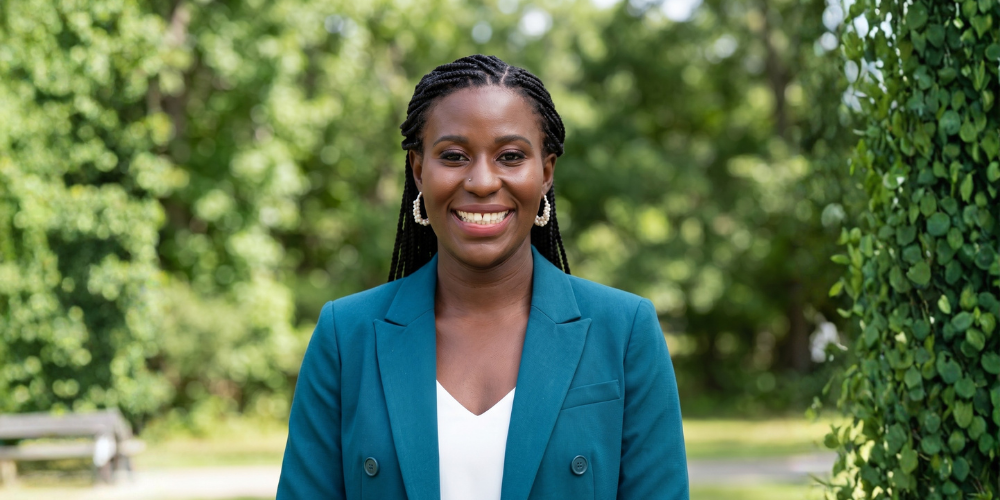
Priscilla Amofa-Ho, MA, PhD, dedicates her career to clinical and interventional research for those at risk of dementia. Nearly every step of her career was made alongside scholars, scientists, and other professionals. From testing memory-boosting proteins in mice as an undergraduate to building a digital health tool with engineering faculty today, her work has always meant borrowing expertise she doesn't have to reach people she otherwise couldn't. Amofa-Ho joined as new research faculty at the College this past May, where her collaborative approach continues in her work.
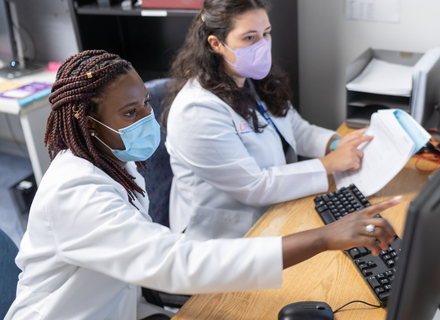
Amofa-Ho conducting her PhD research at UF.
Amofa-Ho's path into dementia research began at Carleton College in Minnesota, where volunteering with older adults first exposed her to working with the disease. That curiosity led her to Rush Alzheimer's Disease Center, where she started in the lab identifying forms of dementia in brain tissue via autopsy before moving into patient-facing clinical research.
She wanted to work with these patients while there was still time to intervene and keep symptoms of dementia at bay. This drove her to pursue a PhD in neuropsychology at the University of Florida, studying non-pharmacological interventions for cognitive impairment.
Her dissertation introduced a new statistical approach to quantifying the chances of a patient developing symptoms by combining five known interdependent risk factors and showing how they compound one another to raise a person's risk of physical disability and cognitive decline. The work was published in Alzheimer's & Dementia, one of the field's top journals.
Intervention Before it’s too Late
Today, Amofa-Ho's research centers on early intervention. Rather than observational research on patients already experiencing dementia, her aim is set on the years before symptoms appear, when factors like sleep, physical activity, diet, and social engagement can still meaningfully lower risk. That focus grew out of her time following patients at Rush, where she noticed how differently people responded to treatment depending on how early they received it.
Interventional treatment for dementia and Alzheimer’s aligns personally with Amofa-Ho as well, as she has seen dementia affect her own family. She says in communities she’s been a part of, cognitive decline is too often accepted as an inevitable part of aging rather than something that can be addressed.
"It's really devastating to meet a 55-year-old who is losing their memory, and there is nothing that can be done about it," Amofa-Ho said in regard to intervening when cognitive impairment is still mild. "What can I do to give people the chance to live longer, to experience the things they really want to experience?"
Much of her current work also involves reaching patients who have historically been left out of research and care entirely, including rural and African American communities that are often underrepresented in clinical studies but disproportionately affected by dementia.
The Necessity of Collaboration
Reaching the populations she serves requires expertise Amofa-Ho doesn't always have on her own, which is part of why interdisciplinary collaboration has become central to how she - and practically every researcher at USF - works. She regularly partners with physicians, social workers, and biostatisticians to further her research. For example, she is in an ongoing collaboration with a cancer specialist at Tampa General Hospital (a partnership brokered by College of Nursing Dean, Usha Menon) to better understand cognitive impairment in cancer patients.
Right now, she is working alongside faculty and students in USF's College of Engineering as well. With people who know how to develop applications, Amofa-Ho is working on a digital tool designed to deliver behavioral interventions to patients who might not otherwise have access to them. It's a clear picture of how she works: identify a need, then find the right people to help meet it.
That approach, she says, is part of what drew her to the College of Nursing, where she's found leadership and colleagues eager to make those connections.
One person doesn’t have all the knowledge. So you need to bring in other expertise to help you get where you’re going. It's just the people here (at USF) who have those connections and can also help us make that connection.
Priscilla Amofa-Ho, M.A., PhD.
As she settles into her new role, Amofa-Ho is looking ahead to expanding her research and the partnerships behind it, one collaboration at a time.