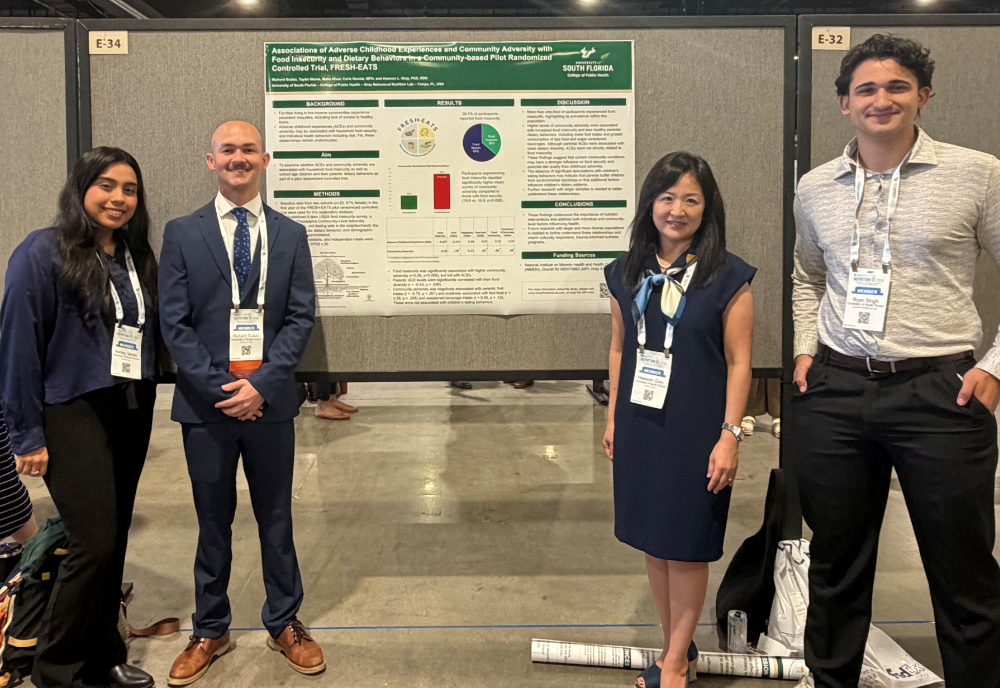
A team of students from USF’s College of Public Health (COPH) and Judy Genshaft Honors College offered plenty to digest at an international conference on nutrition science, where topics ranged from ultra-processed foods to obesity medications.
The students presented at the annual American Society for Nutrition meeting in Maryland, which showcased the latest developments in the field, including clinical, basic, translational and global public health research. The students all discussed topics that contributed data to FRESH-EATS, a community-based, multi-component nutrition intervention program. The grassroots organization focuses on improving food access and dietary behaviors among families in underserved areas.
Ashley Varela, an MPH epidemiology graduate student and research assistant, gave a presentation called “Behavioral and Psychosocial Factors Associated with Child and Parent Health Outcomes in a Pilot Randomized Controlled Trial of FRESH-EATS.’’
Richard J. Scalzo Jr., an undergraduate majoring in health and nutrition science, presented on a topic titled “Associations of Adverse Childhood Experiences and Community Adversity with Food Insecurity and Dietary Behaviors in a Community-based Pilot Randomized Controlled Trial, FRESH-EATS.’’
Ryan Singh, a biology major in the Judy Genshaft Honors College, discussed his poster “Anthropometric and Blood Pressure Outcomes in a Pilot Randomized Controlled Trial of FRESH-EATS: Preliminary Analysis Using the Year 1 Data.’’
As a Hispanic woman and Tampa native, I understand the struggles of food access among families living in low-income communities, and that made this project very meaningful to me,’’ Varela said. “I’m honored to be able to work in the same communities I grew up in.’’
Chronic diseases such as diabetes and hypertension are prevalent in low-income neighborhoods where access to healthy foods is limited. The FRESH-EATS project addresses this gap and promotes healthy eating habits among children and their families.
Varela’s report suggests that parental meal planning may potentially improve health outcomes: “The findings showed how family meals and planning are significantly associated with lower odds of obesity and high-risk blood pressure.’’
Scalzo said his research underscores the importance of “nutrition interventions’’ that address both individual and community-level factors influencing health. Adverse childhood experiences also may be associated with household food security and health behaviors, but these relationships remain understudied. He said further research with larger and more diverse populations is needed to create culturally responsive nutrition programs.
But one thing is certain, Scalzo said: Too many people rely on convenience in their diet.
“I personally believe the primary reason that people aren’t eating healthy foods is the ease of access to ultra-processed foods,’’ he said. “If you’re surrounded by 20 restaurants and 19 of them are unhealthy, chances are you going to choose one that’s unhealthy. Add in the fact that it’s quicker and cheaper to eat unhealthy and it sums up why we struggle so much as a country from a nutrition standpoint.’’
Singh’s study looked at children between the ages of 5 and 15 and their caregivers in a first-year pilot. He described the potential benefits for improving biometric health indicators, such as body mass index, that can help refine how FRESH-EATS assists families and reduces “diet-related health disparities in underserved communities.’’
The findings from their research suggest that addressing community adversity and consistent family meal planning may make a difference, said Dr. Heewon Gray, associate professor, Department of Community Health Sciences and director of USF’s Gray Behavioral Nutritional Lab. She mentored the students and continues to guide them in their ongoing work.
“Students are not only assisting with collecting and analyzing data,’’ she said, “but are actively engaged in the community, involved in intervention activities such as cooking classes, and interacting with these families every week over several months.’’