Welcoming our new class of medical students is always one of my favorite days of the year.
This year, for the first time, we had five students entering the USF Health Morsani College of Medicine MD/PhD program, the largest class so far, bringing our current total to 17.
These students will spend eight years here before graduating with a dual degree that prepares them to be the next generation of leading physician-scientists. I like to call them the Navy SEALS of medical students because of the length and rigor of their training — twice as long as an MD alone. Our newest students hail from some of the nation’s top universities: the Massachusetts Institute of Technology, the University of Pennsylvania, Emory University, Wake Forest University and Haverford College.
We have been gradually expanding our program over the past few years. It’s clear evidence that USF has grown and evolved from its founding more than 50 years ago to become one of the nation’s best research-intensive medical schools — ranked among the top 16 in the nation two years in a row by U.S. News & World Report.
As part of that growth, we’ve made some important changes to the program. Moffitt Cancer Center, one of our hospital partners and home to many of our oncology faculty and researchers also has invested in our program. We’ve now named it the Morsani College of Medicine – Moffitt Cancer Center MD/PhD Program. We’re grateful that Moffitt will fund tuition costs for some of the students doing research there.
These students also have the option to conduct research in other USF Health programs that are national leaders, including in such areas as neuroscience, cardiology, infectious diseases and health informatics. And they also have a broad array of clinical research opportunities available at our other partner hospitals, including Tampa General Hospital and the James A. Haley Veterans’ Hospital.
We intend to continue the program’s upward trajectory, with plans for it to eventually qualify as a Medical Science Training Program (MSTP), funded by a training grant from the National Institutes of Health.
With the growth of the program, we also have named two faculty members as co-directors and assistant deans: J. Zachary Porterfield, MD, PhD, and Yao Yao, PhD.
Dr. Porterfield is an associate professor of Internal Medicine, director of the HIV Clinical Pathogenesis and Trials Unit for MCOM’s Institute for Translational Virology and Innovation, and co-director of MCOM’s Scholarly Concentration in International Medicine and Infectious Disease. He earned his undergraduate degree, MD and PhD from the University of Oklahoma and completed an infectious disease fellowship at Yale University. He also was an NIH Fogarty Global Health Fellow in South Africa. He is an NIH-funded researcher whose work includes studying HIV in teens, HPV-related head and neck cancers, and other topics.
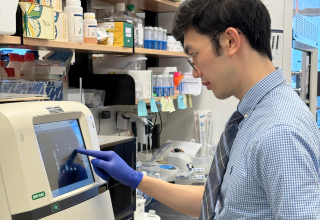
MCOM MD/PhD student Vincent Lok hard at work in the lab.
Dr. Yao is a professor of Molecular Pharmacology and Physiology. He completed his undergraduate and master’s degrees at Sichuan University in China and his PhD in Molecular and Cellular Pharmacology at Stony Brook University in New York. He also was a postdoctoral fellow in the Patricia and John Rosenwald Laboratory of Neurobiology and Genetics at Rockefeller University in New York. He is an NIH-funded researcher whose research interests include studying how certain types of glycoproteins may affect the blood-brain barrier in stroke and other neurological disorders.
I’m delighted to have two fine co-directors for this pivotal program whose research interests and specialties will complement each other and provide a wide range of expertise with which to advise our students.
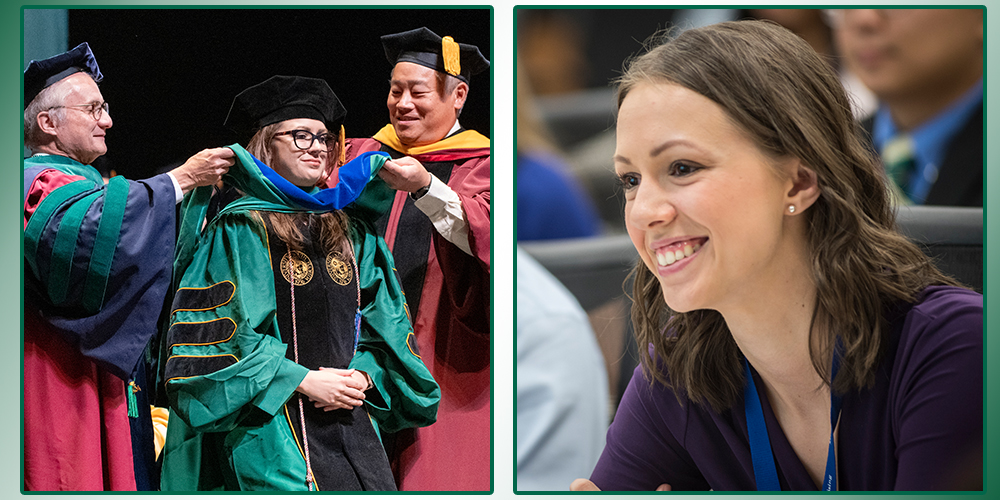
Before you know it, these students will follow the path of Monica Moore. Just a few months ago, Monica walked across the stage and received her MD and PhD — the first graduate of our dual degree program. Dr. Moore has just started residency training in family medicine at the University of Rochester Medical Center in New York.
My own research expertise is in reproductive sciences. So, it was especially rewarding for me to see Monica, who earned her PhD in biomedical sciences with a concentration in molecular physiology and pharmacology, focusing her research around gynecology, studying the stress-responsive protein FKBP51 and its role in the effects of prenatal stress on the development of the ovary and how this impacts ovarian health throughout the reproductive life course.
Where will the scientific pursuits of our five new students in the Class of 2034 take them? I’m looking forward to finding out.
To read more about MD/PhD student Vincent Lok, click here.