
Nicholas J. Panetta, MD, with the USF Health Morsani College of Medicine and Tampa General Hospital has achieved a major milestone in robotic microsurgery, performing the first ever fully robotic lymphovenous bypass (LVB) from incision to closure in the United States using FDA-cleared NanoWrist® Dissection Instruments on the Symani® Surgical System. This innovation allows surgeons to perform delicate tissue dissection and vessel preparation with unmatched control, marking a new era in minimally invasive care for patients living with lymphedema.
Lymphedema is swelling from a buildup of lymph fluid in soft tissues, usually in arms or legs. It is caused by a damaged or blocked lymphatic system which normally drains fluid and fights infection. Lymphedema is often caused by cancer treatments like lymph node removal or surgery but the condition can also be genetic. Lymphovenous bypass (LVB) is a supermicrosurgery that treats lymphedema by connecting these blocked lymphatic vessels directly to nearby small veins, creating a new drainage route for the built-up fluid and offering relief for swelling.
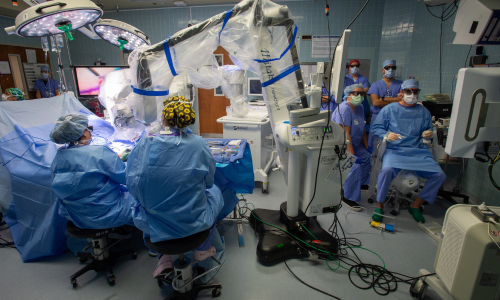
Dr. Nicholas Panetta performing fully robotic surgery using the Symani Surgical System
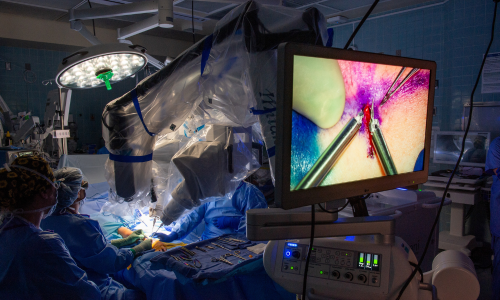
(Photos courtesy of TGH)
“Robotics will define the future of microsurgery, especially in lymphedema work where sub-millimeter precision is essential. Using these new instruments, I’m proud to have completed the first fully robotic LVB in the U.S.,” said Dr. Panetta, chair of the USF Health Morsani College of Medicine Department of Plastic Surgery and chief of the Plastic Surgery Institute at TGH. “These tools are unlocking capabilities that extend beyond the limits of the human hand to support the best possible outcomes for patients.”
The NanoWrist® dissection instruments, recently cleared by the U.S. Food & Drug Administration, are designed for sub-millimeter precision, enabling robotic access to tiny, delicate anatomy, such as lymphatic vessels. Combined with Symani’s advanced technology, these tools allow surgeons to complete complex microsurgical procedures, entirely robotically.
The University of South Florida and Tampa General brought the Symani Surgical System to the Southeastern United States in November 2024. Tampa General was the first hospital in the region to offer this first-of-its kind robotic technology. Benefits include smaller incisions and less invasive procedures, greater precision involving delicate anatomy and ultimately better patient outcomes.