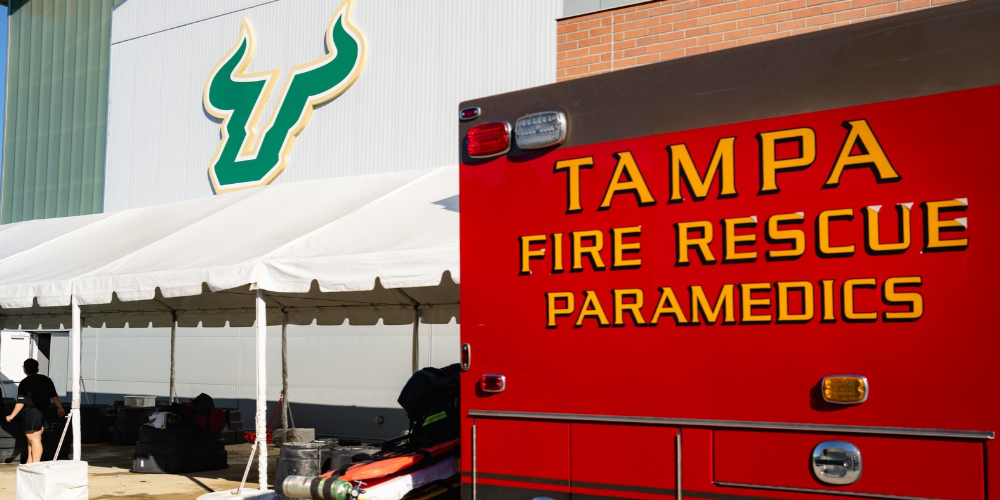
In Florida's intense heat and humidity, recognizing and treating heatstroke can quickly mean the difference between life and death. To prepare for these emergencies, 44 students from the USF Health School of Physical Therapy and Rehabilitation Sciences (SPTRS) partnered with Tampa Fire Rescue for a hands-on simulation to put their emergency response skills to the test.
First- and second-year Master of Science in Athletic Training (MSAT) students responded
to a simulated exertional heatstroke, worked alongside emergency medical personnel
and practiced delivering lifesaving care in a realistic setting.
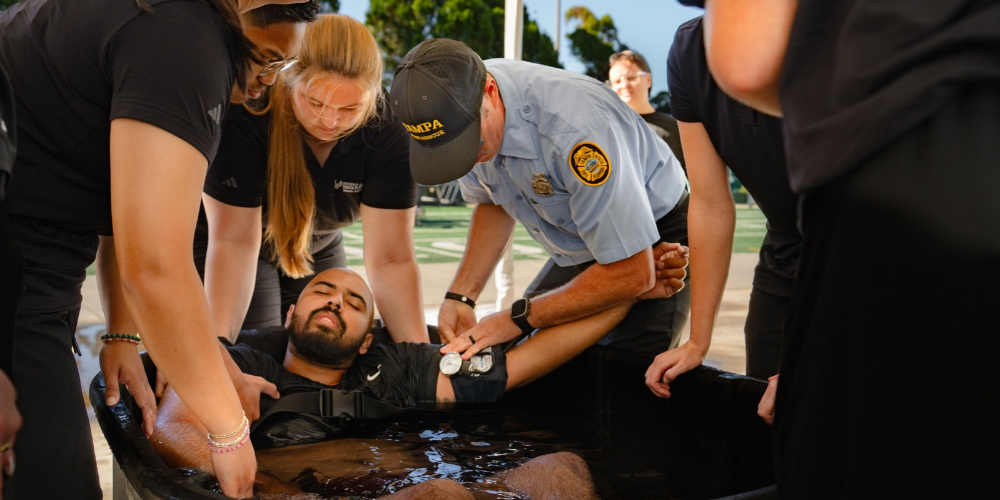
USF Health Master of Science in Athletic Training students (MSAT) work alongside Tampa Fire Rescue personnel to practice emergency response and cold-water immersion techniques during a simulated exertional heatstroke scenario at the USF Athletics Indoor Performance Facility.
Exertional heatstroke occurs when the body's core temperature rises to dangerous levels during physical activity. Without immediate treatment, it can lead to organ damage, long-term complications or even death.
During the exercise, students worked in groups of six to eight to respond to a simulated
athlete who had collapsed on the field. They assessed the patient, checked vital signs
and identified a core body temperature of 106 degrees Fahrenheit, indicating a heatstroke
emergency.
Students practiced using rectal thermometers on a medical simulator to accurately
measure core body temperature while preserving patient privacy. Once the condition
was identified, teams initiated cold-water immersion to rapidly lower the patient's
temperature.
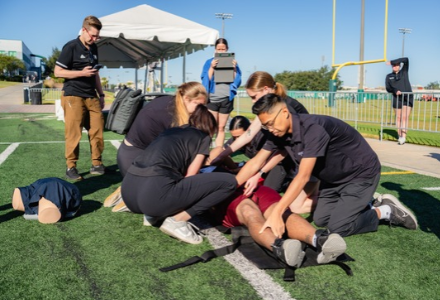
Athletic Training students work together to assess and prepare a simulated heatstroke patient for emergency cooling during a hands-on training exercise.
“The exercise reinforced the importance of cooling patients before transporting them to a hospital,” said Gary Cohen, PhD, LAT, ATC, assistant professor and athletic training director of clinical education at USF Health SPTRS
The simulation emphasized the ‘cool first, transport second’ approach, requiring students to continue cooling the patient until their core body temperature reached a safe level before transferring care to emergency medical services.
The involvement of Tampa Fire Rescue added another layer of realism allowing students to engage in a live 911 call with an actual dispatcher and work alongside responding emergency personnel to transfer the patient using the same procedures they would encounter in the field.
"This collaboration for us gives our students the real-world experience with an emergency situation where they're going to have to transfer care and actually work collaboratively with these providers," Cohen said.
For MSAT student Natalie Green the simulation provided an opportunity to apply classroom knowledge in a realistic environment while learning how to respond under pressure.
"It's hard to replicate real-life situations until you're in them," Green said. "USF
tries really hard to get us as close to the real thing as possible while still making
it safe."
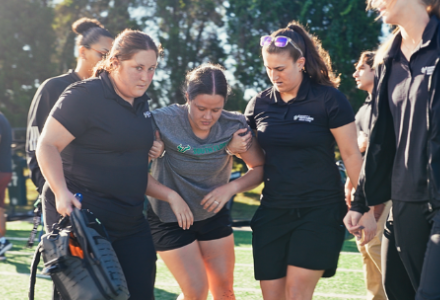
Athletic Training students assist a simulated heatstroke patient off the field.
Green said one of her biggest takeaways was the importance of establishing roles and rehearsing an emergency action plan before a situation occurs. Having emergency responders participate also gave students a better understanding of how to communicate and coordinate patient care.
“It’s one thing to talk about calling 911, but actually speaking with a dispatcher and learning what information they need during an emergency really helps us prepare for the real thing,” Green said.
The experience was equally beneficial for Tampa Fire Rescue personnel who gained an opportunity to work directly with future athletic trainers and become more familiar with the treatment methods they may encounter when responding to emergencies at athletic events.
“Collaborating with USF Health helps my own skills while building relationships with professionals I may encounter in the future,” said Scott Mayville, a firefighter and paramedic with Tampa Fire Rescue. "I think it creates an environment on both sides where we can react appropriately together, which ultimately is going to be better for patient outcomes.”
Mayville was joined by Gregory Carballa, a Tampa Fire Rescue training officer. Together, they helped students practice communicating patient information, coordinating emergency care and transferring responsibility to a responding EMS team.
"The real critical piece of this simulation is that students understand how they react
to stress and are able to have that simulated stress so that they can perform under
pressure and make the appropriate decisions in a chaotic environment," Cohen said.