
A groundbreaking discovery by Robert C. Gallo, MD, half a century ago helped establish the scientific foundation for modern cancer immunotherapy. Now, two of the world’s leading immunologists are revisiting the discovery and its enduring impact on medicine in a new Landmark Perspective in Science.
Published on the 50th anniversary of Dr. Gallo's seminal 1976 Science paper, the Landmark Perspective traces how research aimed at finding a way to grow human T cells in the laboratory, as part of the search for human retroviruses, led to the discovery of IL-2 and ultimately helped transform immunology, virology and cancer medicine in ways that could not have been anticipated at the time.
Today, Dr. Gallo serves as founding director of the USF Health Institute for Translational Virology and Innovation (ITVI), James P. Cullison Professor of Medicine at the University of South Florida Morsani College of Medicine, director of the Microbial Oncogenesis Program at the Tampa General Hospital Cancer Institute and co-founder and chair of the Scientific Leadership Committee of the Global Virus Network.
The Landmark Perspective was written by Rafi Ahmed, PhD, director of the Emory Vaccine Center and one of the world’s leading authorities on T-cell immunity and immune memory, and Steven A. Rosenberg, MD, PhD, chief of the Surgery Branch at the National Cancer Institute and a pioneer of cancer immunotherapy. They conclude that Dr. Gallo's discovery was a pivotal advance that made the discovery of interleukin-2 (IL-2) possible, fundamentally transforming scientists' ability to study the human immune system and laying the foundation for today's most transformative cancer immunotherapies.
"Modern cancer immunotherapy became possible because scientists learned how to isolate, grow and understand human T lymphocytes," said Dr. Rosenberg. "Few scientific advances have had such far-reaching consequences across both immunology and cancer medicine. Dr. Gallo's work fundamentally changed what became possible. Dr. Gallo's 1976 discovery was one of the pivotal scientific advances that made that progress possible. Fifty years later, its influence continues to be seen throughout cancer immunotherapy and in the development of new immune-based treatments."
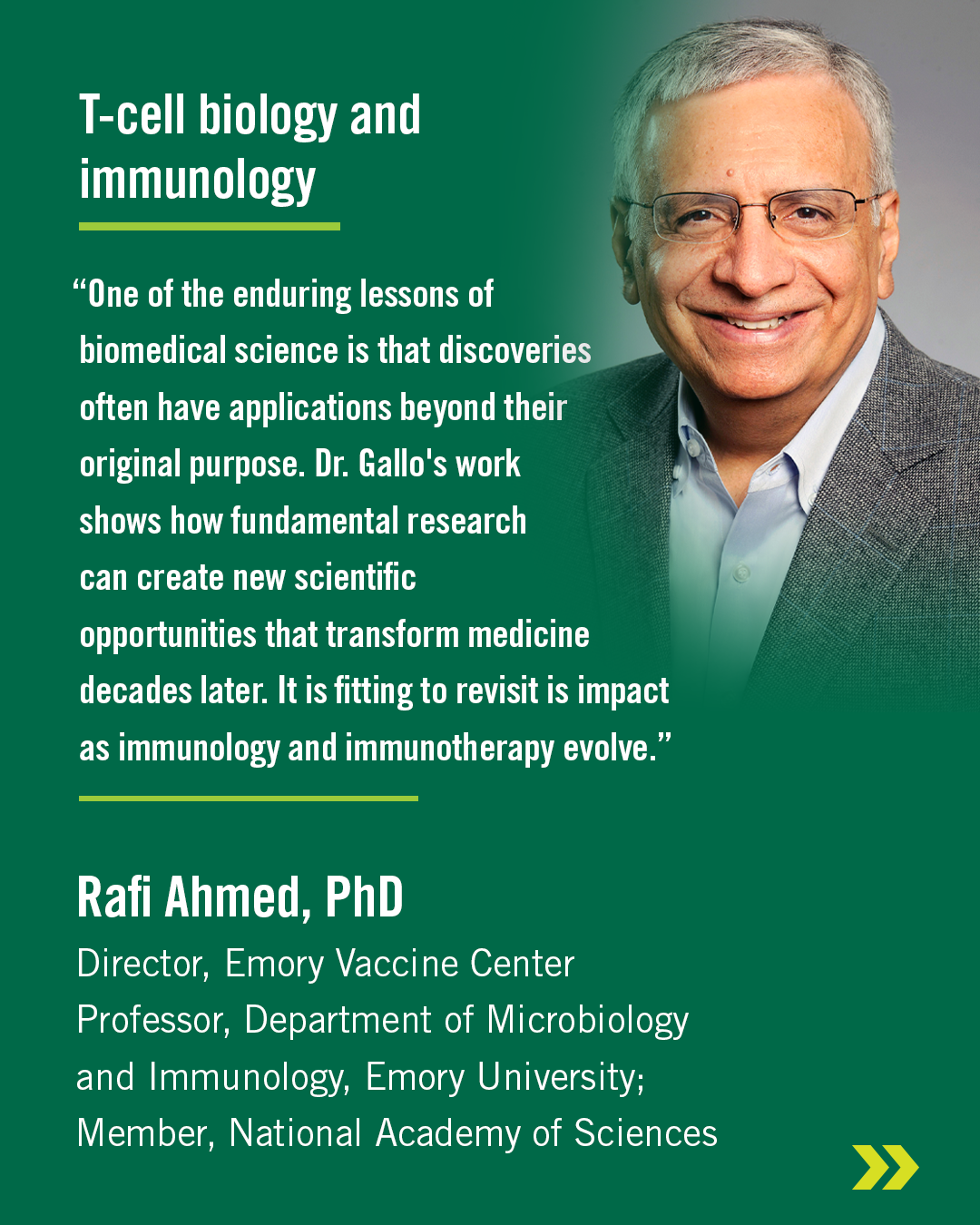
Co-author of the Landmark Perspective, Rafi Ahmed, director of the Emory Vaccine Center
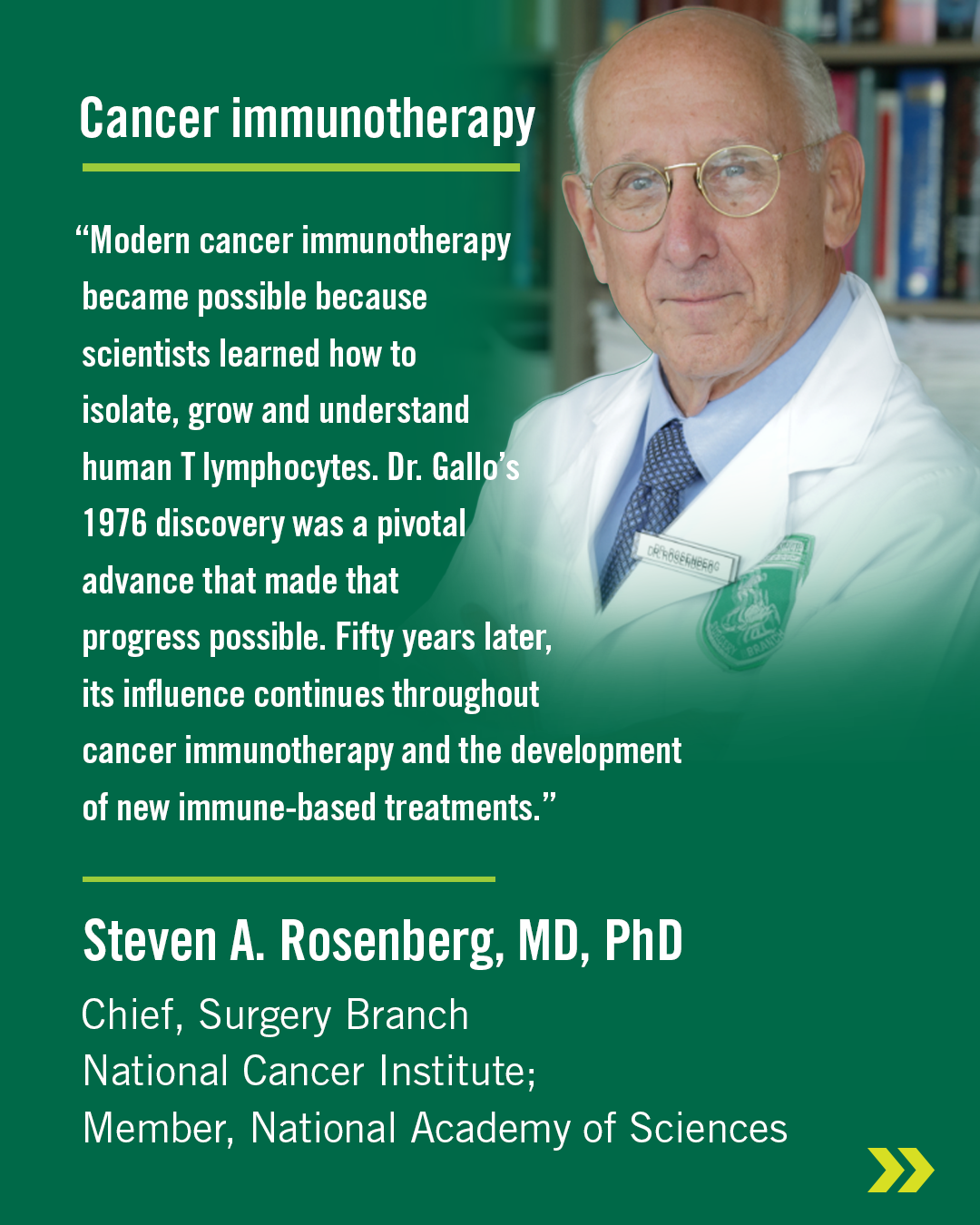
Co-author of the Landmark Perspective, Dr. Steven Rosenberg, chief of Surgery Branch at the National Cancer Institute
At the center of that scientific history was a longstanding challenge Dr. Gallo and his colleagues set out to solve: how to grow human T cells outside the body over extended periods. Their research identified a naturally occurring factor that stimulated T-cell growth, later named IL-2. The ability to grow T cells in the laboratory opened the way to subsequent advances in cellular immunotherapy, including tumor-infiltrating lymphocyte therapy, CAR-T cell therapy, and other treatments that harness the immune system to fight cancer.
That scientific breakthrough also reshaped the course of virology. It enabled Dr. Gallo and his colleagues to discover the first human retroviruses, HTLV-1 and HTLV-2, establishing the field of human retrovirology. Building on those discoveries, Dr. Gallo co-discovered that HIV is the cause of AIDS and led the development of the blood test to detect HIV, dramatically improving the safety of the world's blood supply while fundamentally advancing scientists' understanding of the human immune system.
"One of the enduring lessons of biomedical science is that the greatest discoveries often have applications far beyond their original purpose," Dr. Ahmed said. "Dr. Gallo's work is an outstanding example of how fundamental research can create entirely new scientific opportunities that continue to transform medicine decades later. It is fitting to revisit its impact as immunology and immunotherapy continue to evolve."
Half a century after the original discovery, the publication offers a contemporary assessment of its enduring influence as cancer immunotherapy continues to revolutionize clinical care and scientists pursue the next generation of immune-based therapies.
"When my colleagues and I published our findings in Science in 1976, our goal was to solve a fundamental scientific problem that would allow us to determine whether human retroviruses existed," said Robert C. Gallo, MD. "We could not have predicted how broadly those discoveries would influence immunology, virology and cancer research. Science advances by following evidence, not expectations. This publication reminds us that transformative advances often begin with fundamental questions whose ultimate impact cannot yet be imagined."
"Dr. Gallo's career exemplifies the mission of leading academic health centers by pursuing bold scientific questions, translating discovery into innovation and improving human health," said Charles J. Lockwood, MD, MHCM, executive vice president of USF Health and dean of the USF Health Morsani College of Medicine. "The discoveries recognized in this publication continue to influence biomedical research around the world and reflect the type of visionary, translational science that defines USF Health. We are proud that Dr. Gallo continues advancing that tradition by mentoring future scientists and leading groundbreaking research at the Institute for Translational Virology and Innovation."
"Cancer immunotherapy represents one of the defining advances in modern oncology, and IL-2 helped open possibilities that scientists continue to build upon today," said Eduardo M. Sotomayor, MD, vice president and executive director of the Tampa General Hospital Cancer Institute. "Dr. Gallo has a long tradition of bringing leading scientists together to exchange ideas at pivotal moments in the field. As we mark this anniversary, our Microbes, Genes & Cancer Symposium carries that tradition forward, focusing not only on how far we have come."
The symposium, held earlier this year, brought together internationally recognized leaders in immunology, oncology, virology and microbial oncogenesis, including Rosenberg and Ahmed. A special scientific session examined the discoveries that led to IL-2 and their enduring influence on modern cancer immunotherapy.
The conversation will continue March 11-13, 2027, in Venice, Italy, at the 2nd Microbes, Genes & Cancer Symposium, where scientists from around the world will explore new developments across immunology, cancer biology, microbial oncogenesis and translational medicine. The symposium will be held in partnership with the annual European LeukemiaNet/Kompetenznetz Leukämien Symposium, Tampa General Hospital Cancer Institute and the Global Virus Network.