In a small Western Maryland mining town, nestled in the rural shadows of the Allegheny and Appalachian Mountains, Laura Bohn spent her childhood chasing butterflies and grasshoppers, or fishing near her home just north of Cumberland and south of the Pennsylvania state line.
Her father worked in a factory that made acetate fibers while her mother stayed at home to raise Bohn and her two sisters and teach Sunday school. A future career in molecular research was not at the forefront of Bohn’s mind, but that began to change in elementary school when she took part in a special science education program designed for children from non-academic communities.
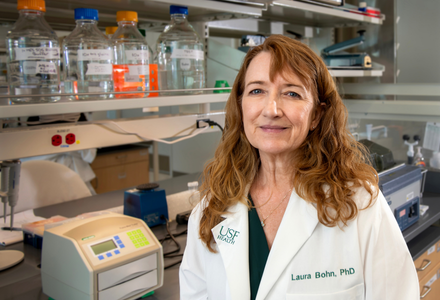
Laura Bohn, PhD (Photo by Allison Long)
“They let us do things like dissect pig hearts and lungs in the fifth grade,” she recalls. “I remember bringing a serrated knife from home at the request of the teachers so we could cut the parts as needed. And they gave us little cafeteria milk straws to blow up air sacs in the lungs.”
Those early experiences ignited a lifelong interest in science that would carry the young student from a small town in coal country into the almost unimaginably smaller world of molecular pharmacology.
Today, Bohn is a leading international scientist pursuing new therapies for pain and addiction, with research supported for three decades by the National Institutes of Health and the National Institute on Drug Abuse. She also serves as senior associate vice president for research at USF Health and vice dean of research for the USF Health Morsani College of Medicine.
Working at a microscopic scale, she has sought to understand precisely how drugs communicate with cell receptors — and how subtle differences in that communication could lead to safer treatments for pain and opioid-use disorders.
Her groundbreaking work tackles one of the most resonant questions in medicine: Can scientists preserve the powerful pain relief provided by opioids while reducing the effects that can make the drugs so dangerous?
A molecular pathway
Bohn’s route from the mountain mines of Western Maryland to the molecular frontier of pain research began without much of a roadmap.
After high school graduation, she took a summer internship at the chemical factory where her father worked. By then, the family had moved to Virginia, placing Bohn in proximity to a certain bustling university in Blacksburg.
“I went to a couple of small colleges at first because I didn’t really know what college was,” she said. “But I took an organic chemistry class over the summer and loved it, so I transferred to Virginia Tech.”
That became the launching pad for her career.
At Virginia Tech, Bohn found professors who cultivated her growing interest in science, and one course in particular — Nutrition and the Brain — introduced her to the relationship between what people consume and the neurotransmitters that shape how the brain functions.
“For me, that was a wow moment,” she said.
In 1993, she earned degrees in biochemistry and in chemistry. By chance, it was the same year her dad, who had decided to enroll in a neighboring college, earned his own bachelor’s degree. Her mother would also later enroll in college and graduate with a teaching degree the same year as one of her sisters.
Bohn went on to earn a doctorate in biochemistry and molecular biology from Saint Louis University School of Medicine in 1999, followed by postdoctoral research at Duke University in the Howard Hughes Medical Institute. There, she trained with Drs. Marc Caron and Robert J. Lefkowitz, who would later receive the Nobel Prize in Chemistry for research involving the class of cellular receptors that would become central to Bohn’s career.
Rethinking how opioids work
Those receptors are known as G protein-coupled receptors, or GPCRs, a large family of proteins found on the surface of cells and among the most prevalent types of drug targets in humans.
Opioid receptors belong to that family.
When an opioid such as morphine, oxycodone or fentanyl binds to one of those receptors, it initiates a series of molecular signals inside the cell. Those signals can produce powerful pain relief. But continual use of opioids can also lead to tolerance and dangerous effects, including suppression of respiratory function.
For years, scientists tended to think about receptors in relatively simple terms, believing that a drug bound to a receptor and turned it on, almost like flipping a switch.
Bohn’s research illuminated a much more complicated picture.
“We try to understand how drugs or hormones talk to cells, and how they tell them to make your body react,” she said. “We focus on the point of contact where the drug or hormone binds on the surface of the cell. We used to think that point of contact turned it on and off like a switch, but now we know it’s more like a microprocessor.”
Rather than simply switching a receptor on or off, different drugs can influence how the receptor behaves and which molecular signals follow.
Bohn’s laboratory is trying to understand those differences to steer the receptor toward desirable effects like pain relief, while avoiding or reducing the unwanted effects.
“By trying to understand the mechanics of how we can cause a chemical drug to twist this way or that, we can figure out some of the drug efficacy and make a better pain reliever — and get rid of those side-effect profiles."
Laura Bohn, PhD
The search for safer pain relief
When Bohn first began studying the relationship between cell receptors and pain relief, the place where she grew up was not a conscious influence on the direction of her research. Over time, though, that connection hit closer to home.
Bohn remembers her family heating their old wooden house with coal and worrying as a child that it might catch fire.
“I used to have this fear that the house would burn down, and I would practice climbing out of my bedroom window and standing on the roof of the porch, wondering, ‘How can I get out of here if it catches fire?’” she said.
Years later, as the opioid epidemic devastated communities across the entire United States, Appalachia was among the regions most affected. Bohn found herself thinking again about towns like the one she had once called home.
“If you’re introduced to an opiate because of an injury or surgery, you may not realize you may be facing a different life entirely,” she said.
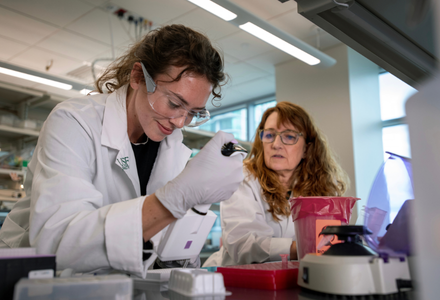
(Photo by Allison Long)
The risks posed by opioids are rooted in the same questions of molecular signaling that Bohn has spent years researching: What happens inside a cell after an opioid binds to its receptor, and can scientists change what happens next?
A recent pair of studies by her team published in Nature and Nature Communications uncovered something particularly intriguing about that process.
While scientists traditionally understood the first steps of receptor signaling as moving in one direction, Bohn showed that the process can also work in reverse, and that some drugs can favor a reverse reaction over a forward one.
“We’ve studied two new chemicals that strongly favor the reverse cycle and, when administered at non-effective doses, can enhance morphine and fentanyl-induced pain relief while not enhancing respiratory suppression effects,” she said.
These discoveries have not been tested for toxicity or opioid side effects but could create a foundation for the development of new drugs, allowing researchers to design compounds that alter how the receptor cycles and signals.
That possibility is closer than ever thanks to another groundbreaking finding from Bohn’s lab.
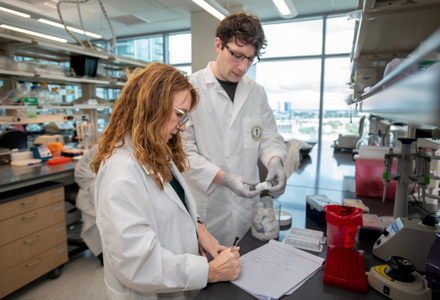
(Photo by Allison Long)
Her team identified an experimental compound, SR-17018, which binds to the receptors involved in opioid pain relief, but with a crucial difference — it produces the same pain-relieving effects as traditional opioids, without causing respiratory suppression or tolerance.
“We picked a drug out of the collection that we felt would be least harmful because it has very little activity — it’s pretty weak, and we showed that it could alleviate pain modestly but developed no tolerance with chronic treatment,” she said. “Developing a new class of opiate without the addictive side effects for humans would be the greatest pride of my career.”
The broader lesson of Bohn’s research extends beyond pain relief.
The cell receptors she studies are involved in an enormous range of biological processes. If scientists can better understand how individual drugs steer GPCRs toward different molecular responses, the same approach could ultimately be used to target the receptors involved in other conditions such as depression and psychosis.
In that way, Bohn’s work is advancing on two fronts at once: finding new drugs to treat pain and understanding the scientific machinery well enough to design even better ones.
For Bohn, the goals of answering new scientific questions and discovering new molecules for potential clinical use have always gone hand in hand.
The questions she asks today may seem a long way from the fifth-grade classroom in Western Maryland, where she first dissected frog organs and inflated tiny air sacs through cafeteria straws.
Now, she searches for answers in signaling pathways and molecular interactions too small to see with the naked eye.
But the curiosity behind her work has changed remarkably little.
And one lesson of her career has been true from the very beginning: Sometimes the answers to the biggest questions are found in the smallest places.