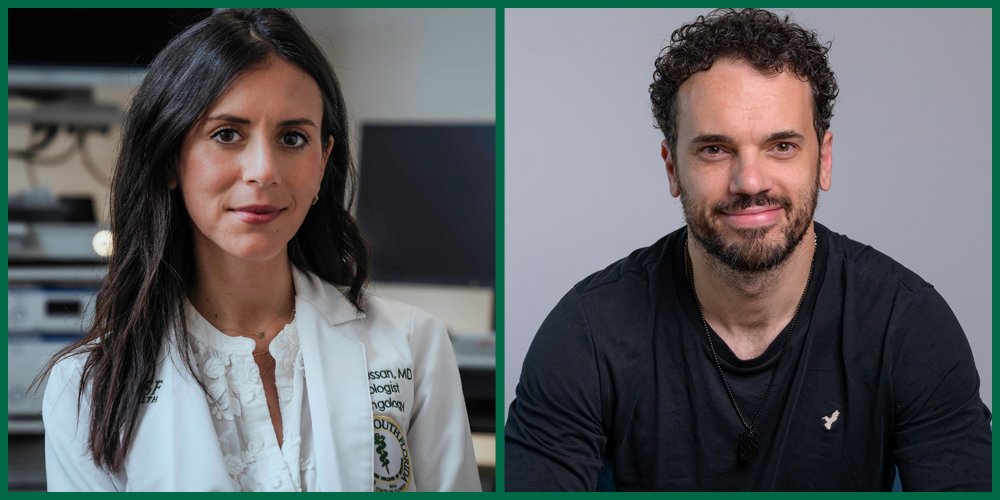
The USF Health Institute for Voice and Hearing Innovation and the Luxembourg Institute of Health have launched the International Society for Vocal Biomarkers, a global organization that unites researchers, clinicians and industry partners who are developing voice-based tools to detect and monitor disease.
“Vocal biomarker research is advancing quickly, but it is still happening in silos. The International Society for Vocal Biomarkers gives the diverse community of researchers, clinicians, and startups a shared home and a place to collaborate so that progress made in the lab can translate into real impact for patient health,” said society co-founder Yael Bensoussan, MD, a laryngologist, associate professor of otolaryngology at the USF Health Morsani College of Medicine and director of the USF Health Institute for Voice and Hearing Innovation.

Dr. Yael Bensoussan
The society builds on two existing vocal biomarker networks: Bridge2AI-Voice in the United States, and eVoiceNet in Europe. With National Institutes of Health funding for the first phase of Bridge2AI-Voice ending. this year, the society gives the networks a permanent home and opens participation to researchers and startups who previously had no formal way to join.
Voice changes can accompany respiratory, neurological, psychiatric and cardiac conditions. For example, a short daily voice recording could help care team members identify fluid buildup in the chest and potential heart failure days before symptoms appear and give them more time to adjust treatment. For people with amyotrophic lateral sclerosis, weekly recordings could show how speech changes between clinic visits and track the impact of investigational.
Guy Fagherazzi, PhD, head of the Department of Precision Health at the Luxembourg Institute of Health and co-founder of the society, said the field has reached a turning point. Researchers now have large, ethically collected voice datasets and artificial intelligence tools that detect health signals they could not measure before, and regulators have begun asking how such tools should be tested and approved.
Until now, clinicians, artificial intelligence engineers, speech scientists, bioethicists, regulators and patients have worked in separate circles, each with their own conferences and language. The organization gives them a single home to share what they know and produce discoveries that are reliable, ethical and useful to patients.
The society leaders said real problems are solved when teams of computer scientists and clinicians work side by side from the start, with patients and ethicists also at the table. They said the society’s sense of community makes that approach possible and will move vocal biomarkers out of the lab and into the clinic.

Dr. Guy Fagherazzi
“Voice varies by language, accent and culture, and a tool built in one country may not work in another. Bringing researchers together across continents is how we make sure these tools work fairly for everyone,” Fagherazzi said.
Over the next five years, the society aims to develop validated tools that clinicians trust, set shared data and reporting standards and train a workforce that spans disciplines.
“At the end of the day, the goal is to get vocal biomarker tools to improve patient health. To get these solutions to real patients, it needs scientific evidence, reproducible evidence, commercial solutions and advocacy to payers, regulators and others,” Dr. Bensoussan said. “In five years, we hope that our network can foster more collaborations between researchers and industry and create a network for discoveries and implementation of health solutions so that it can reach patients faster,” she said.
To learn more about the society, visit isvb.org. Members join a community of clinicians, artificial intelligence engineers, speech scientists, bioethicists, regulators, patients and industry partners, and help shape the standards and shared knowledge of the field.

About USF Health
USF Health is dedicated to making life better through research, education and patient care. It is the partnership of the USF Health Morsani College of Medicine, the College of Nursing, the College of Public Health, the Taneja College of Pharmacy, the School of Physical Therapy and Rehabilitation Sciences, the Biomedical Sciences Graduate and Postdoctoral Programs and USF Health’s multispecialty physicians’ group, the largest on Florida’s west coast. In 2026, U.S. News & World Report ranked the USF Health Morsani College of Medicine as a Tier 1 medical school for the second consecutive year, placing it among a premier group of 16 medical schools nationally to earn this highest possible designation. U.S. News also ranked the USF College of Public Health and the USF College of Nursing’s Master of Science programs as No. 1 in the state. Together with Tampa General Hospital, USF Health forms one of the nation’s premier academic health systems, with more than 1,000 physicians and providers caring for more than one million patients each year. USF Health is part of the University of South Florida, a top-ranked research university and member of the Association of American Universities (AAU). USF serves approximately 50,000 students and generates nearly $10 billion in annual economic impact for Florida. For more information, visit health.usf.edu.
About the Luxembourg Institute of Health
The Luxembourg Institute of Health is a public biomedical research institute. Its Department of Precision Health includes the Deep Digital Phenotyping Research Unit, which uses digital health technologies to find biomarkers, including vocal biomarkers, for remote patient monitoring. The department coordinates eVoiceNet, a European network with 255 members.