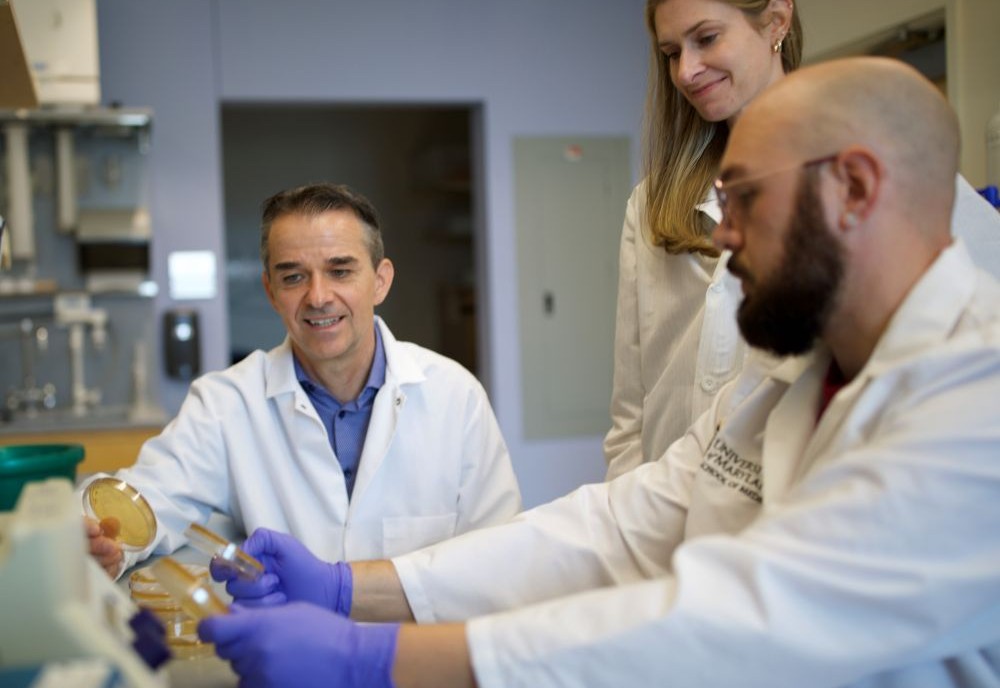
Vaginal dysbiosis is a condition that can raise the risk of sexually transmitted diseases in women, cause problems during pregnancy or even adversely affect fertility. And finding a solution has become the life’s work of Jacques Ravel, PhD, keynote speaker at USF Health Research Day on Friday, March 6.
Dr. Ravel serves as director of the Center for Advanced Microbiome Research and Innovation at the Institute for Genome Sciences, University of Maryland School of Medicine in Baltimore. And for the past 20 years, he has developed a research program focused on applying modern genomics techniques and ecological principles to studying the role and dynamics of the vaginal microbiome in women’s health.
That microbiome, when healthy, is dominated by bacteria known as Lactobacillus. They produce lactic acid, which maintains an acidic pH and helps fend off infections. However, when Lactobacillus decreases, the possibility of problems increases — from yeast infections to a heightened risk of sexually transmitted infections, infertility and issues with pregnancies.
“The vaginal microbiota is very interesting, because in humans it’s dominated by Lactobacillus,” Dr. Ravel said. “And there is a species, Lactobacillus crispatus, associated with every positive outcome we can think of. But when things don’t go well, when you lose those Lactobacillus, you go from the dominance of one organism to very diverse communities of many bacteria. And that is when you have symptoms associated with a dysbiotic condition called bacterial vaginosis.”
That condition, in turn, increases the risk of sexually transmitted infections, including HIV, the virus that causes AIDS, and HPV, or human papillomavirus, a common virus that can lead to cervical cancer.
“When women experience bacterial vaginosis during pregnancy, there is an increase of adverse outcomes, like pre-term birth or low birth weight, things like that,” he said. “And some women have a hard time getting pregnant as a result of the condition, so it’s often associated with fertility issues. If you can solve this condition, you’re going to solve a lot of other problems.”
Dr. Ravel uses clinical genomics and systems biology approaches to develop improved strategies for managing gynecological and obstetrics conditions. He has published more than 350 peer-reviewed publications. In addition, he is the co-director of the NIH-funded Collaborative Research Center on Human 3D Biomimetics Cervicovaginal Models for Sexually Transmitted Infections. The center’s goal is to develop an innovative microfluidic biomimetic model of the lower reproductive tract to study aspects of sexually transmitted infections, such as chlamydia and gonorrhea, which are not achievable in humans, animal or other cell models.
His current objective is to develop a probiotic to prevent the problems caused by bacterial vaginosis and thus improve women’s health overall.
“The current approved treatment for bacterial vaginosis has not changed in 40 years — no new drugs, no new treatment, no innovation at all,” he said. “And that’s really damaging, because we know that in 60 percent of the women, the treatment doesn’t work. So you have women who have been suffering from this condition for years, and the medical establishment has done nothing for this.”
When might Dr. Ravel’s probiotic treatment be available?
“There’s still a long road getting a product to market, because they have to be approved by the FDA and we still need to do several clinical trials to finalize this product,” he said. “And further development is needed to improve the product, but we’re making a lot of progress.”
Dr. Ravel is well-positioned for the intensive work that lies ahead. His work led to his election to the Fellowship of the American Academy of Microbiology (AAM) in 2012. Then, in 2015, he was awarded the Blaise Pascal International Research Chair and spent two years at the Institut Pasteur in Paris. He is also the founder and editor-in-chief of the Microbiome journal.
Dr. Ravel grew up in a family where medical treatments of various kinds were a common thread. His father worked in prosthetics, an uncle was a doctor, one of his brothers is a physical therapist and another is a nurse. “So I’ve always been somewhat in that field,” he said. “I studied biology and in college I loved science and research.”
In 1991, Dr. Ravel decided to come to the United States, earning his PhD from the University of Maryland at College Park with a degree in Environmental Molecular Microbiology and Ecology. He did his post-doctoral training as a Ruth L. Kirschstein National Research Fellow in the Chemistry Department at The Johns Hopkins University in Baltimore, working on the chemistry and bioinformatics of natural products.
Later, he joined the Institute for Genome Sciences at the University of Maryland School of Medicine in 2007 as an associate professor. Previously, from 2002 to 2007, he was an assistant investigator at The Institute for Genomic Research (TIGR) in Rockville, the pioneering institute where the first microbial genome was sequenced.
It was in Baltimore that Dr. Ravel met his future wife. The couple has four children, with the older three following his footsteps into the University of Maryland. “My wife teaches English — actually, ESL, English as a Second Language,” he said. “So that was really helpful. I got to learn English the right way.”
Now he’s mastered the mysteries of the microbiome, hoping his work leads to a breakthrough in women’s health.