Rosemary Borter spent months searching for options after doctors recommended removal of her thyroid.
“I was terrified thinking of surgery,” she said.
The retired 67-year-old accountant’s thyroid had grown into a goiter, an enlarged gland.
Her diagnosis was nontoxic multinodular goiter—nodules filled the gland while her hormone levels stayed normal.
For many patients, a diagnosis that something is wrong with their thyroid presents a difficult decision: remove the gland and take hormonal supplements for the rest of your life or keep it and live with difficult, or even dangerous, symptoms.
USF Health is now offering those patients a third option—one that mediates the medical effects but helps patients retain the gland, which is located at the base of the neck and helps to regulate metabolism, heart rate and energy.
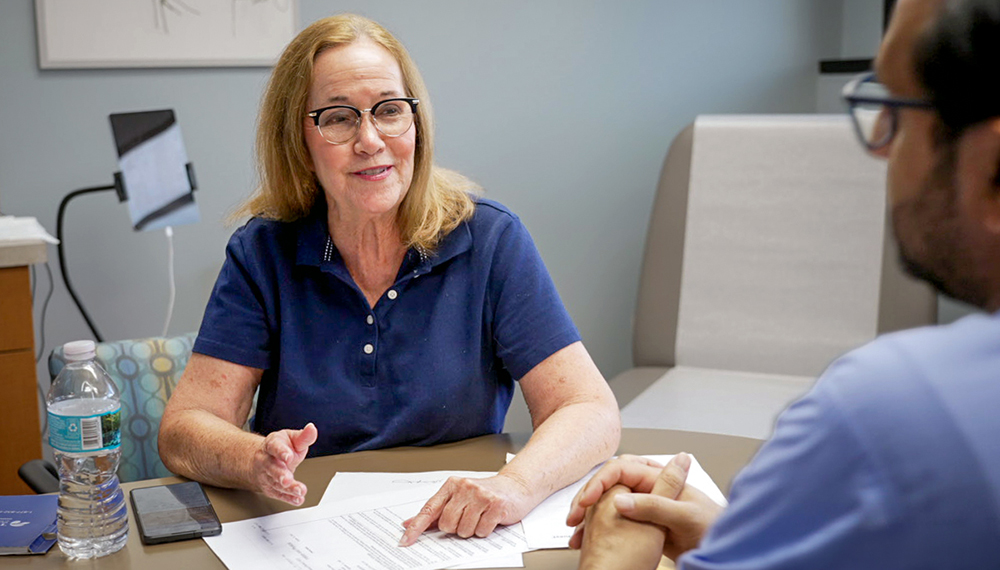
Rosemary Borter reviews paperwork with Jamil Shaikh, MD, during an appointment.
Thyroid artery embolization (TAE) is a minimally invasive procedure that shrinks an enlarged thyroid without removing it, explained Jamil Shaikh, MD, an interventional radiologist and assistant professor of radiology.
For patients like Borter, TAE offers a welcome new path. Shaikh calls this specialty that treats patients without a scalpel “medicine's best kept secret.”
Dr. Shaikh said Borter’s gland measured 120.5 milliliters on imaging before the procedure. That is more than four times the upper limit normal for women. Over several years, the gland pressed on her windpipe and esophagus, making it hard to swallow and to breathe while lying down.
TAE also treats hyperthyroidism, an overactive thyroid that makes too much hormone. Patients with Graves' disease, an autoimmune form of the condition, also make for good candidates for the procedure, Shaikh adds.
In a small 2025 study in the Journal of the Endocrine Society, five of seven patients with an overactive thyroid had normal thyroid function after the procedure.
Interventional radiologists perform the TAE procedure by using X-rays, CT scans and ultrasound to thread a catheter and wire “the size of spaghetti noodles” through the wrist to the arteries that feed the thyroid.
Once the thyroid is reached, it is injected with microscopic particles that block blood flow. Patients receive sedation, not general anesthesia, and most go home the same day.
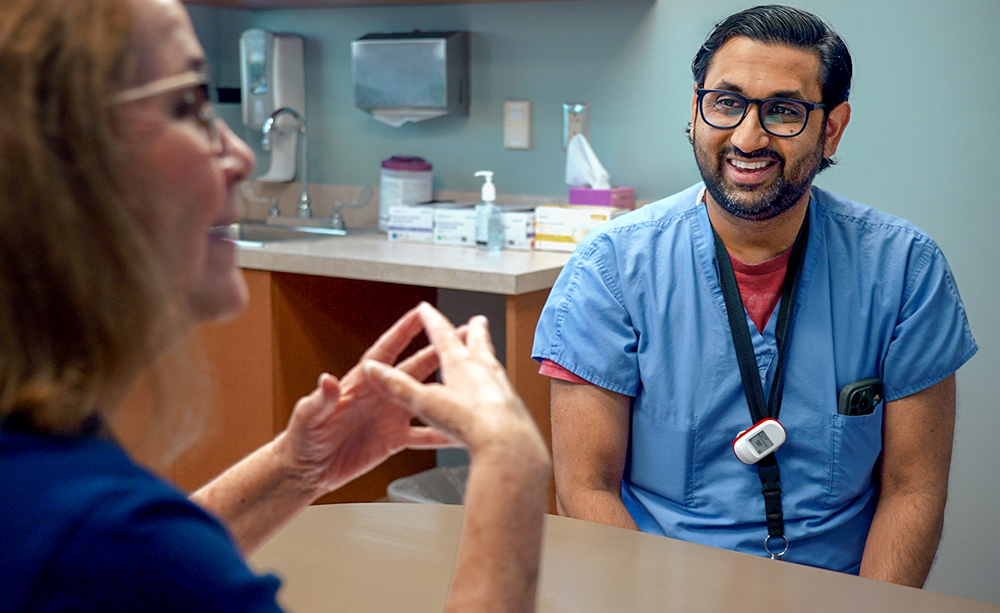
Jamil Shaikh, MD, listens as patient Rosemary Borter describes her recovery.
About six months later, the gland shrinks.
“Data show reductions of up to 70 percent in volume,” Shaikh said. “Shrinking the gland rather than removing it is one of the only ways to keep the thyroid and avoid lifelong supplements.”
Borter’s CT scans showed the gland extending into her chest, making her a candidate for TAE, which Shaikh performed for her in June.
Just three weeks later, Borter already noticed she could breathe deeper and even tested her improved breathing on a treadmill. Her labs were also normal at her one-month checkup. Imaging showed her thyroid shrank from 120.5 milliliters to 47.5 milliliters, a reduction of more than 60 percent, Dr. Shaikh said.
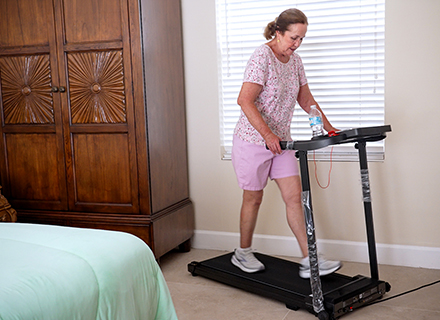
Rosemary Borter walks on a treadmill at home.
“It’s not getting rid of my thyroid,” she said. “It’s shrinking it. I’m glad Dr. Shaikh did it. I would definitely recommend him.”
Dr. Shaikh said only a limited number of U.S. centers offer TAE, an established procedure. USF Health takes part in a nationwide registry study that evaluates the safety and effectiveness of TAE.
“You can go back to your life through a very minimally invasive procedure,” Dr. Shaikh said.
Photos and video: Allison Long | USF Health