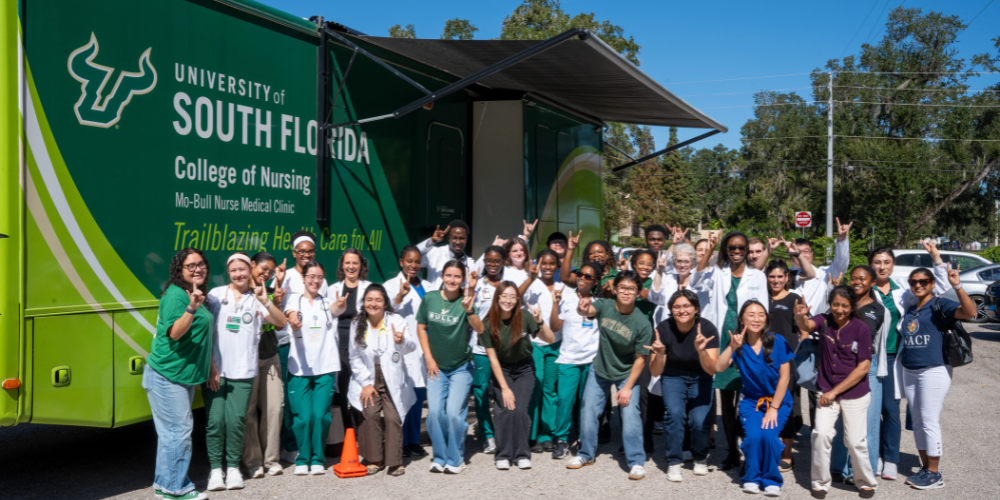
The USF Health College of Nursing’s MoBull Nurse Medical Clinic’s mission has always been to help make the Tampa Bay Community healthier by meeting patients where they are by hosting clinics with its partners. Being a clinic on wheels makes transportation an easy barrier of access to hurdle. However, time is a commodity that leaves many people without care as well. Which is why the MoBull clinic has been hosting weekend health clinics in the community alongside partner organizations for the last year with great success.
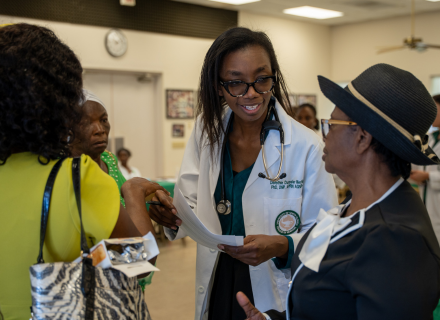
Dr. Durosier guiding patients at the Patomos weekend health fair
Most people work Monday through Friday, and taking time off for a health screening isn’t always realistic. Dorothie Durosier Mertilus, associate professor, coordinates the clinics with Ivonne Hernandez, assistant professor, alongside the USF Health Service Corps. Durosier points out that there is great opportunity to help the community by setting up clinics at places where groups of people are already gathering. Many of the weekend clinics are held at churches right after services, so the crowd is already there.
“Everybody’s already there at church,” said Duellyn Pandis, director of clinical practice. “So when church lets out, the bus is set up and ready to see people. It’s kind of a win-win.”
On October 24, the most successful weekend clinic to date was hosted at Patmos Haitian Seventh Day Adventist Church in Riverview, where Durosier is a member. The college alone conducted 28 health screenings, completed six cervical cancer screenings, and four primary care visits. One patient was referred to the emergency department after USF students and nurses identified a need for a higher level of care.
Partners that remove barriers
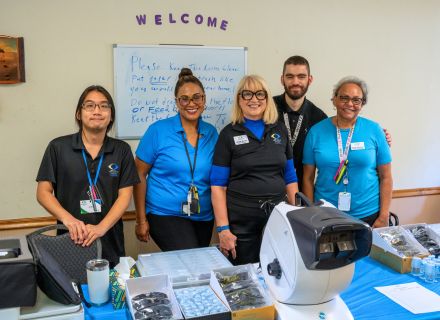
Providers from Preserve Vision Florida at the Patmos weekend health fair
USF College of Nursing coordinates the weekend clinics and, unlike most weekday sites, coordinates with partner healthcare organizations to provide more services. These include other colleges from USF Health as well as a robust list of other organizations.
Partner providers often come with mobile health units of their own, adding to the resources available to patients that the MoBull can’t provide alone like HIV and syphilis screening, diabetic retinopathy screening, and more. Currently, there are about a dozen partners collaborating on weekend sites.
Preserve Vision Florida, a statewide non-profit, is one of those partners. They provide vision screens for children from six months up, along with their parents. Just like the MoBull unit, the organization pays for an eye exam and glasses when a screening for anyone without insurance. At the Oct. 24 clinic, they conducted 35 vision screenings.
Myralee Berrios, director of screening and education at Preserve Vision Florida, said the timing is the reason these events are so successful.
“This one is so successful because Dorothy has it well prepared, and she does it after the church service, so the people are here already,” she said. Asked whether she sees more people on weekends than on weekdays, she did not hesitate. “Oh, yeah. Absolutely.”
Berrios credited the organizers’ planning. “She knows what to do and where to do it and when to do it.”
Immerging students in the community
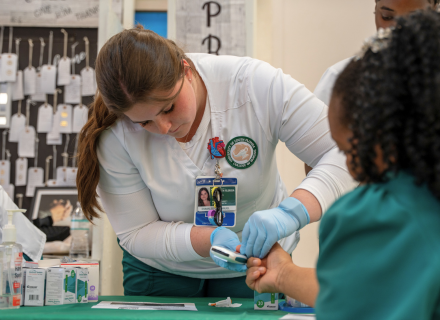
Emmalee Emanual conducting a health screen
Emmalee Emanuel, a Level 3 undergraduate nursing student, has worked a couple of weekend clinics. She said the weekend clinics offer a variety of experiences packed into a roughly five-hour shift.
“There’s a lot more going on at this one,” she said, pointing to blood pressure, glucose, cholesterol, flu vaccines, Pap tests and diabetic retinopathy screening, all in one place.
For her, these clinics offer experiences that are unique to didactic and clinical learning at nursing school
“A lot of people don’t have insurance. A lot of these people don’t have access to this at all. They don’t see a doctor ever,” she said. “So being able to be part of that is really important to me.”
Seeing so many services in one place has shown her how much the community was missing. Additionally, she finds community-based health care to be “a little more personable” than a hospital rotation and provides quality hands-on experience to bring back to clinical settings.
Trust that brings people back
Because congregations invite their own neighbors, patients arrive already trusting the setting. Hernandez said that trust is a big part of why people come, and some have traveled from as far as Fort Myers for care.
“Without it,” Emanuel said, “there’s a lot of services these people today wouldn’t be getting.