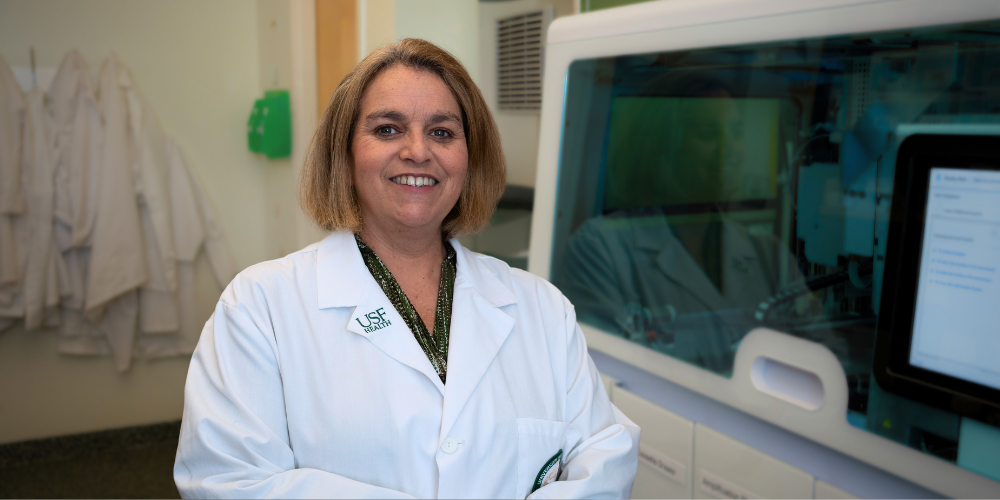
USF College of Nursing student Stacy Pryor, RN, thought she would always be a bedside nurse. She had worked steadily for two decades as a registered nurse when a back injury forced her to evaluate her options. That’s when she decided to return to school.
Starting with an associate’s degree in nursing, Stacy had a lot of work to do. Once she received her Bachelor of Science in Nursing, she continued her schooling to obtain a Master of Nursing Education at USF. A PhD-prepared nurse at the college encouraged her to shift her focus and pursue nursing research.
Stacy began USF’s PhD program in 2022, and she graduates this week. Her experience during the COVID-19 pandemic focused her research, bringing her face-to-face with a problem that needed a solution: the well-being of nurses.
“The pandemic changed everything for everybody. I don't think those outside of healthcare fully understand what it was like for us. I saw what it did to me and my colleagues, mentally and physically. We needed change. I decided that I was going to do what I could to push that change forward.”
The USF College of Nursing provided Stacy with the path to begin her work of ensuring a survivable and sustainable healthcare system for nurses. She credits the mentors and leaders at the college for giving her the tools and support she needed.
“For anybody who is thinking about what they can do besides bedside nursing, if you’ve found a problem that you want to fix, consider research,” said Stacy. “Be the voice; be the one who does the work. It is 100% worth it.”
Stacy’s PhD work investigated whether the level of stress nurses felt matched their hormonal stress levels. A total of 240 nurses from 16 different hospitals answered the online survey Stacy developed, which asked participants about their levels of stress, including burnout, anxiety, depression, and sleep. The second component of the study measured saliva and hair samples to identify whether participants’ levels of the stress hormone cortisol matched the stress they indicated in the survey. Forty-five of the nurses who took the survey sent in samples to complete this optional biomarker portion of the study.
The results were surprising. The biomarkers were not as elevated as Stacy anticipated. She tested herself and found the same discrepancy: her cortisol levels did not match the stress she felt.
While the study was underpowered—the number of participants who sent in samples was lower than the study’s goal, and further study is necessary—the results were unexpected. Stacy is eager to investigate further.
“The next step is trying to figure out why this is the case. Have nurses had so much chronic exposure to stress that our bodies just don’t mount the same response anymore? There are also other hormones that can be assessed as a measure of stress. Cortisol is our go-to, but there are others that could also show a relationship.”
As a PhD-prepared nurse, Stacy plans to continue her work with the mentors she collaborated with here at USF to make change for nurses across the healthcare workforce.
“We need to fix the systemic problems to elevate nursing back to a job people love to do, a job people dream of. That's how it was for me when I first started. And it's not that way anymore for a lot of people.”
After three years of research-focused work here at USF, we’re excited to watch Stacy continue her work shaping the future of nursing.