When the soft, cushion-like discs in the spine become injured or start to bulge, the
effects can be debilitating.
Cervical discs help stabilize the neck and allow for smooth movement. But when damaged,
they can cause numbness, tingling, loss of grip strength and sharp pain that travels
down into the arm, hand and fingers.
Medication and physical therapy can help provide some relief, and if symptoms do not
improve, surgery is often considered the next step. But for patients with neurological
conditions, such as multiple sclerosis (MS), invasive surgery can carry additional
risk, including potential neurological injury.
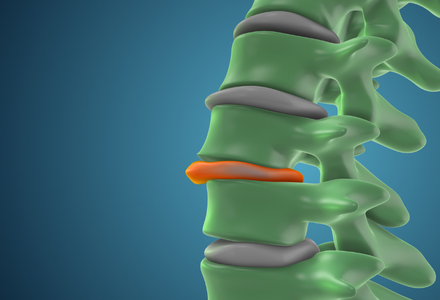
An illustration of a slipped disc in the spinal cord.
USF Health researchers are working to address this gap by highlighting a promising
non-surgical alternative for treating cervical disc herniation, commonly referred
to as a slipped disc.
In a recent case study published in the Journal of Physical Medicine and Rehabilitation, Dr. Nathan Schilaty, associate professor in the Department of Neurosurgery, Brain and Spine and Medical Engineering at the Morsani College of Medicine and College of Engineering, demonstrated the successful use of a non-invasive approach.
“Patients can suddenly find themselves asking, ‘Will I be able to live my life the way I did before?’” Schilaty said. “Having a conservative and reliable treatment option that avoids surgery is incredibly valuable.”
Using the specialized computer‑controlled device DRX9000C, researchers treated a 35‑year‑old
woman with MS and severe cervical disc injury who was experiencing debilitating pain,
weakness, sensory loss and disability. Unlike traditional traction methods, this device
works by gently stretching the neck to relieve pressure on damaged discs using a process
called targeted traction. The programmed, cyclical pulling motions adjust force in
real time, helping clinicians target specific areas of the spine and tailor treatment
to the patient.
Instead of surgery, she underwent 20 sessions over a 15-week period, helping her fully
return to daily activities and reported no pain after just five treatments.
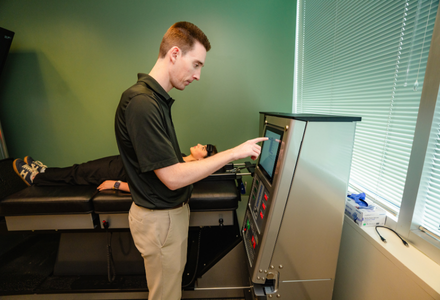
Jacob Connolly, an MD/PhD candidate in the Morsani College of Medicine, makes adjustments to the machine. The amount of force is computer-controlled and customized to each person. (Photo by Ryan Rossy)
"In roughly 20 to 25 percent of patients, surgery often doesn’t help pain, it makes
it worse. Our lab focuses on studying alternative options,” said Jacob Connolly, an
MD/PhD candidate in the Morsani College of Medicine working alongside Schilaty in the Center for Neuromusculoskeletal Research. “The patient’s MRI scans showed the disc herniation shrinking and nerve compression
decreasing over time, dropping her disability score to zero.”
Beyond relieving pain, the treatment also led to measurable structural improvements.
Imaging showed the size of the herniation decreased by more than 30 percent, while
spinal canal space increased by more than 80 percent following treatment.
Most significantly, at her one-year follow-up exam, the patient remained pain-free
and fully functional with no worsening or flare-ups of her MS symptoms.
“The goal is to broaden care options, ensuring patients receive individualized treatment and only move to surgery when it’s truly necessary,” Connolly added. “By gently decompressing the spine, this approach may allow the disc to return to its proper position and relieve pressure on the nerves.”

Dr. Nathan Schilaty prepares a patient for cervical decompression. The goal is to target specific areas of the spine for relief over a period of several weeks through gently stretching out the spine. (Photo by Ryan Rossy)
The FDA has cleared the device for use and is becoming increasingly available across the United States and in more than 50 countries.
Schilaty is hopeful about the impact it could have for other patients with disc herniation
who may not be ideal candidates for surgery or who want to avoid the invasiveness
of spinal interventions.
“Patients aren’t focused on the metrics we measure. They’re wondering if they’ll get
their lives back,” Schilaty said. “When we can restore quality of life with a conservative,
non-surgical approach, that’s an incredibly meaningful step forward. This is just
one of the tools in the toolbox that we’re using, but we hope that it’s utilized more
often.”