Build practical AI skills for legal work. Learn how legal professionals use AI for research, drafting, case analysis, contract review, case management, and workflow support while staying grounded in ethics and professional responsibility.
Course Snapshot
| Format | Registration Fee | Access Begins | Time to Complete | Focus |
|---|---|---|---|---|
| Self-Paced Online | $995 | The 15th of every month | 4 months | Legal AI tools, prompt writing, legal research, drafting, case analysis, ethics, confidentiality, and responsible AI use |
Course Overview
Embracing AI for Legal Professionals introduces legal practitioners to the AI tools, workflows, and ethical questions shaping today’s legal field.
This 24-contact-hour online course gives paralegals, legal assistants, attorneys, legal operations professionals, and law firm administrators hands-on exposure to AI tools used in legal settings. You will explore how platforms such as ChatGPT, Claude, Copilot, Clio Case Management, CoCounsel, Gemini, and other tools support legal research, document drafting, case analysis, contract review, case management, and communication.
The course also focuses on the risks legal professionals need to understand, including client confidentiality, misinformation, credibility, authorship, intellectual property, and ethical use. No programming knowledge is required. You will practice prompts, evaluate AI-generated responses, and learn how to use AI in ways that support legal work without replacing legal judgment.
Skills You'll Gain
By the end of this course, you will be able to:
- Explain foundational AI concepts and how legal professionals use AI today.
- Describe how Large Language Models support legal tasks.
- Use AI tools for legal drafting, research, and case analysis.
- Write and test prompts tailored to legal workflows.
- Evaluate AI-generated content for credibility, accuracy, and ethical risk.
- Identify opportunities and limits of AI tools in legal practice.
- Apply AI tools without compromising confidentiality or legal standards.
- Use legal AI tools more efficiently and responsibly in day-to-day work.
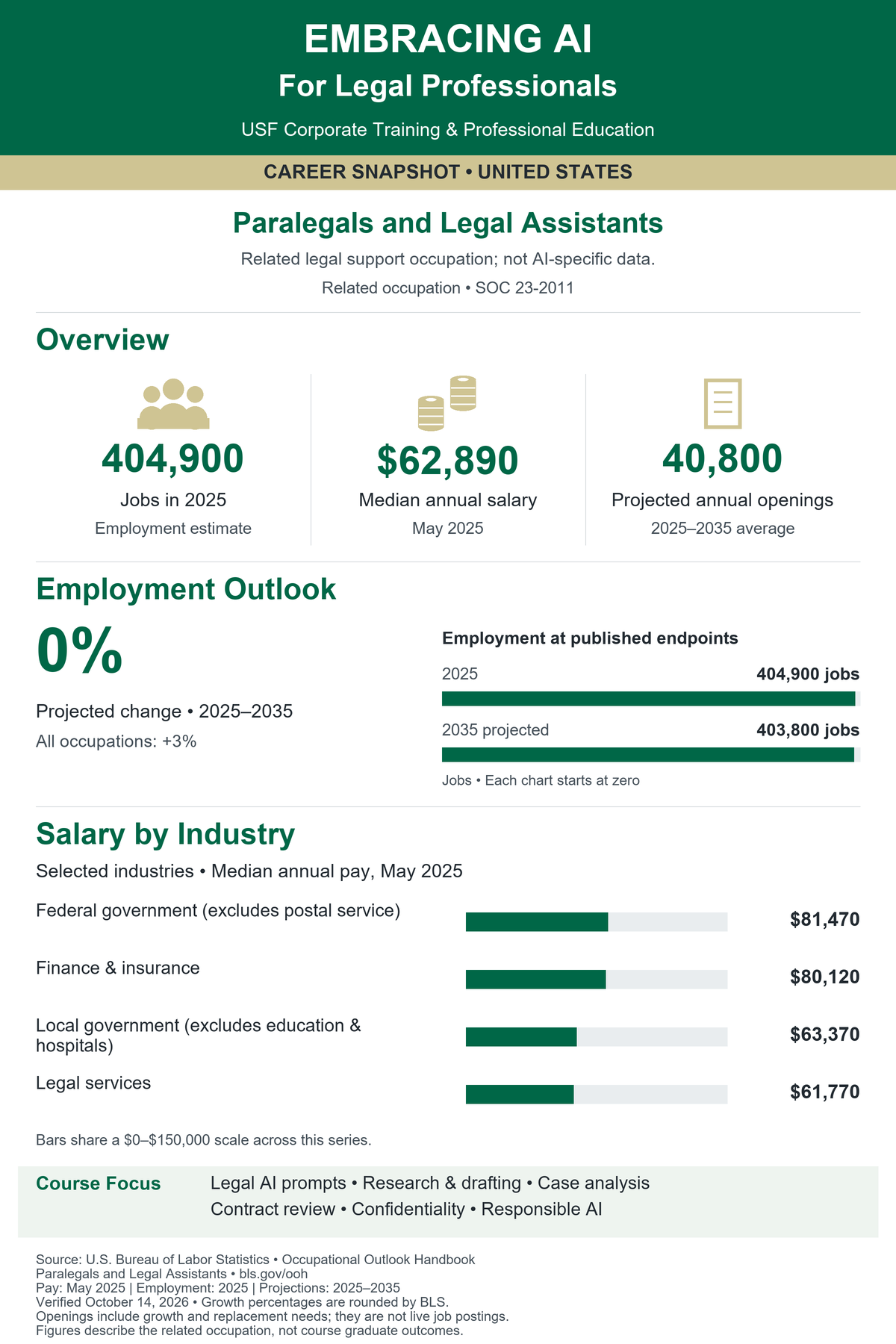
Tools and Details
Tools You'll Use
- ChatGPT.
- Claude by Anthropic.
- Microsoft Copilot.
- Gemini by Google.
- Clio Case Management.
- CoCounsel.
- Genesis.
- ElevenLabs text-to-voice.
- Free legal technology applications.
- Legal AI prompt exercises and response review activities.
Topics You'll Cover
- AI in legal practice.
- Large Language Models.
- Legal research and case law analysis.
- Contract review and analysis.
- Litigation support tools.
- Case management tools.
- Prompt engineering for legal tasks.
- Legal document drafting.
- AI ethics, confidentiality, and misinformation.
- Credibility, authorship, and intellectual property.
- AI risks, benefits, and future legal norms.
What You'll Walk Away With
- A stronger understanding of AI and its role in legal work.
- Hands-on experience with legal AI tools and workflows.
- Prompt-writing practice for research, drafting, contract review, and case analysis.
- A framework for evaluating AI-generated legal content.
- Practical knowledge of AI ethics in legal settings.
- Skills to use AI tools without programming experience.
- Four months of access to complete the program.
Who Should Enroll
This course is designed for legal professionals who want to use AI tools with more confidence, structure, and ethical awareness.
It is a strong fit for:
- Paralegals and legal assistants.
- Attorneys who want to apply legal technology in daily work.
- Law firm administrators and legal operations leaders.
- Legal educators.
- Career changers preparing for legal technology shifts.
- Legal professionals who want practical AI skills without coding.
Course Modules
Module 1: AI in the Legal Field
Learn how AI tools are changing law firm workflows, legal research, case management, and document work. Review Large Language Models, AI limitations, and the ethical issues legal professionals need to understand.
Module 2: Specialized Legal AI Applications
Explore litigation support tools, contract analysis, predictive modeling, case management, legal research, and free legal technology applications used in real legal scenarios.
Module 3: Prompt Engineering for Legal Tasks
Practice writing precise prompts for legal research, case law analysis, contract review, drafting, and task-specific legal workflows. Learn how to evaluate AI responses before using them.
Module 4: Document Drafting and AI Ethics
Use AI to support drafting tasks such as interrogatories and legal requests. Examine credibility, authorship, intellectual property, confidentiality, and the future of AI in legal practice.
Participant and Client Feedback
Employees at companies like these have trusted USF Corporate Training & Professional Education with their skills training and career advancement.
Learn more about training for your team, organization, or company



A new career. Greater responsibility. New connections. Opportunities you haven't even
imagined yet.
Your potential is already there. Let's see where it can take you.

Not sure where to start?
Our advisors are here to help you compare options, understand formats, and choose a course that fits your schedule and goals.