
Preparing for the SAT Reading and Writing section can feel overwhelming, especially when multiple answer choices seem almost identical. But improving your performance doesn't always mean memorizing more grammar rules or spending hours studying vocabulary. Sometimes, the most effective strategy is learning to recognize patterns in the questions and knowing which rules to apply.
The digital SAT Reading and Writing section tests skills including grammar, punctuation, sentence structure, vocabulary in context, and understanding how ideas connect. While some questions require careful reading and analysis, others become much easier when you know what to look for.
Here are six practical SAT Reading and Writing tips to help you approach test day with more confidence.
1. Use the Subject Test to Check Verb Agreement
When an SAT question gives you several answer choices with different verb forms, start
by identifying the subject of the sentence.
A verb needs to agree with its subject, whether that subject is singular or plural.
For example:
The student _____ the answer.
A) know
B) knows
C) knowing
D) have known
The correct answer is B) knows, because student is singular and requires the singular verb knows.
One helpful shortcut is to substitute a simple pronoun for the subject. If the subject is singular, try he, she, or it. If it's plural, try they. You can also use this technique when the sentence includes unfamiliar names or lengthy descriptions.
SAT tip: Identify the subject first, then check which verb form agrees with it. Don't automatically choose the answer that sounds most natural without checking the grammar.
2. Know When Names Need Commas
Commas can change the meaning of a sentence, especially when a name or description
provides additional information.
The SAT may ask you to determine whether information is essential to identifying a
person or thing.
Compare these two examples:
Example A:
The singer Harry Styles performed at the concert.
In this sentence, Harry Styles identifies which singer we're discussing. The name is essential to the intended meaning, so commas aren't necessary.
Example B:
The lead singer, Harry Styles, performed at the concert.
Here, the name is presented as additional information about an already identified person. The commas indicate that the sentence could still make sense without the name.
The important distinction is whether the information is necessary to identify the person or is simply providing extra detail.
SAT tip: Try removing the name or descriptive phrase. If the remaining sentence still clearly identifies the intended person or thing, commas may be appropriate. Always consider the sentence's context.
3. Remember That a Colon Needs a Complete Sentence Before It
Colons are commonly used to introduce lists, explanations, or examples. However, there's one important rule to remember for the SAT:
The words before a colon must form a complete sentence.
Consider this example:
Incorrect:
My favorite sports are: tennis, golf, and volleyball.
The words before the colon don't form a complete independent sentence in this construction because the list completes the sentence.
Correct:
I enjoy three sports: tennis, golf, and volleyball.
The words I enjoy three sports form a complete sentence, so the colon is appropriate.
Another correct example is:
The team faced one major challenge: limited preparation time.
The second part explains the challenge introduced by the first.
SAT tip: Read everything before the colon by itself. If it cannot stand alone as a complete sentence, the colon is probably incorrect.
4. Try the Semicolon Swap
Semicolons are another punctuation feature that frequently appears in SAT Reading and Writing questions. A semicolon can connect two closely related independent clauses without using a coordinating conjunction. An independent clause is a group of words that can stand alone as a complete sentence.
Correct example:
The experiment failed; the researchers tried again.
Try replacing the semicolon with a period:
The experiment failed. The researchers tried again.
Both parts are complete sentences, so the semicolon works.
Incorrect example:
The experiment failed; because the equipment broke.
Although The experiment failed is a complete sentence, because the equipment broke is a dependent clause. It cannot stand alone.
SAT tip: When you see a semicolon, mentally replace it with a period. If both sides work as complete sentences, the semicolon may be correct.
Remember that the SAT also tests semicolons in more complex punctuation structures, so always read the full sentence.
5. Ignore Distracting Words Between the Subject and Verb
One of the SAT's favorite grammar challenges is placing extra words between a sentence's subject and verb. These additional phrases can make it harder to identify whether the verb should be singular or plural.
Consider this example:
The collection of paintings _____ displayed in the museum.
A) are
B) is
At first glance, you might be tempted to choose are because paintings is plural.
But paintings isn't the subject of the sentence. The actual subject is collection, which is singular.
The correct answer is B) is.
Try temporarily removing the distracting phrase: The collection is displayed in the museum.
Now the correct verb is easier to identify.
SAT tip: Find the main subject and mentally set aside any descriptive phrases between the subject and verb. Make sure the verb agrees with the actual subject, not a nearby noun.
6. Identify the Relationship Before Choosing a Transition
Transition questions test your ability to understand how ideas connect. Instead of choosing the transition that sounds best, first determine the relationship between the sentences or ideas.
Common relationships include:
-
Contrast: however, nevertheless, in contrast
-
Cause and effect: therefore, consequently, as a result
-
Addition: furthermore, moreover, additionally
-
Example or clarification: for example, specifically, in particular
Consider these two sentences:
The student studied consistently for several weeks. _____, her practice test scores improved.
Which transition makes the most sense?
A) However
B) As a result
C) In contrast
D) Nevertheless
The correct answer is B) As a result.
The second sentence describes an outcome of the student's preparation, so a cause-and-effect transition is appropriate.
SAT tip: Before looking at the answer choices, ask yourself whether the ideas show a contrast,
cause and effect, addition, or example. Then select the transition that matches that
relationship.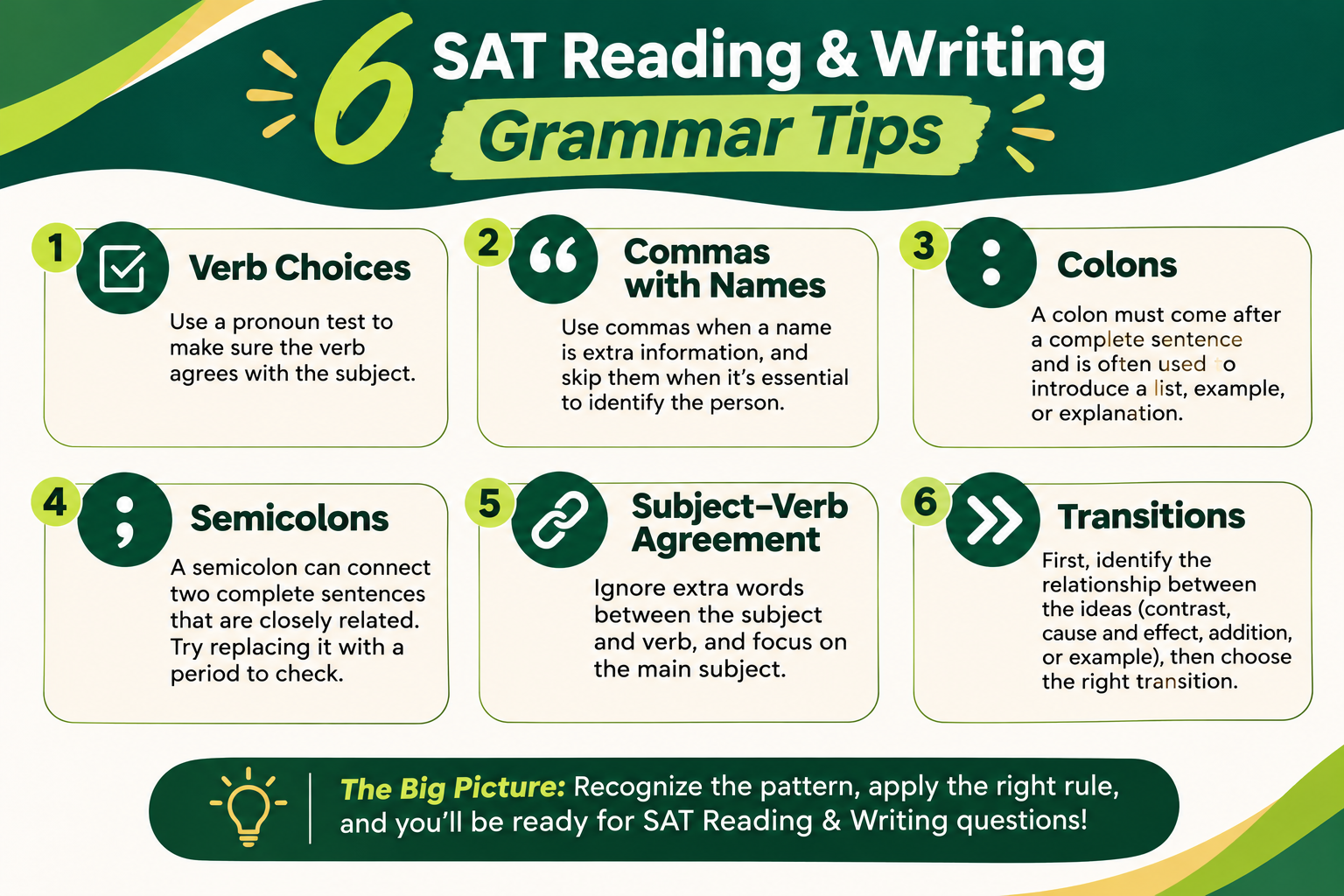
How to Put These SAT Strategies Into Practice
Knowing these shortcuts is helpful, but applying them consistently is what makes the difference. As you prepare for the SAT, focus on recognizing the types of questions that challenge you most. If punctuation questions are slowing you down, practice identifying independent clauses. If subject-verb agreement is difficult, work on finding the true subject of longer sentences.
You can also use official SAT practice questions to build familiarity with the digital test format and identify areas where you need additional preparation. A few minutes of focused practice on a specific skill can be more productive than repeatedly answering questions without understanding why you got them wrong.
Build Your Confidence Before Test Day
The SAT Reading and Writing section isn't just about knowing grammar rules. It's about applying those rules efficiently, understanding how ideas connect, and recognizing what each question is actually asking. By practicing these six strategies, you can develop stronger habits, avoid common mistakes, and approach the SAT with greater confidence.
Looking for more structured preparation? USF Test Prep offers SAT preparation programs designed to help students strengthen their skills, practice test-taking strategies, and prepare for exam day.
Explore USF SAT Test Prep programs and take the next step toward your score goals.