
Whether you're preparing for your first SAT or hoping to improve your score on a retake, understanding how SAT scoring works can help you set realistic goals and make smarter decisions about your preparation. You've probably heard students talk about getting a 1200, 1400, or even a perfect 1600. But how are those scores calculated? What is a raw score, and how does College Board make sure scores are comparable across different test dates?
Let's break it down.
SAT Scoring at a Glance
The SAT uses a scoring scale ranging from 400 to 1600 points. Your total score combines your results from two sections: Reading and Writing and Math.
| SAT Scoring Fact | What You Need to Know |
|---|---|
| Total SAT Score | 400-1600 |
| Reading and Writing | 200-800 |
| Math | 200-800 |
| Perfect SAT Score | 1600 |
| Total Questions | 98 |
| Scored Questions | 90 |
| Penalty for Wrong Answers | None |
For example, if you earn a 650 in Reading and Writing and a 700 in Math, your total SAT score would be 1350. Both sections contribute equally to your total score, so improving either one can help raise your overall result.
How Does Digital SAT Scoring Work?
The digital SAT uses a statistical scoring system that considers more than simply how many questions you answer correctly. To understand how your score is calculated, it helps to know three important concepts: raw scores, score conversion, and equating.
What Is a Raw SAT Score?
A raw score traditionally refers to the number of questions a student answers correctly before that result is converted to a scaled score. For example, on a traditional test with 40 scored questions, answering 32 correctly would produce a raw score of 32. However, the digital SAT works differently. Instead of converting a simple count of correct answers into a final score, the digital SAT uses a statistical model called Item Response Theory (IRT). This model considers the difficulty and characteristics of the questions you receive, along with your pattern of correct and incorrect answers.
That means two students who answer the same number of questions correctly could receive different scaled scores.
The important distinction: Your number of correct answers matters, but it doesn't directly determine your final SAT score.
How Does an SAT Score Conversion Table Work?
You may have seen SAT conversion tables online that show how a raw score translates into a scaled score. On older paper-based SAT exams, these tables were used to convert the number of correct answers into scores on the 200–800 scale. For example, a conversion table might show how a particular number of correct Math answers corresponds to a scaled Math score.
However, there is no single universal raw-score conversion table for the current digital SAT.
Because the digital SAT is adaptive and uses a more sophisticated scoring model, you cannot reliably calculate your official score by counting correct answers and looking them up in a generic conversion chart. Online SAT score calculators may provide estimates, but they should not be treated as exact predictions of your official score.
What Is SAT Equating?
Have you ever wondered whether taking the SAT on one test date might be easier than taking it on another? That's where equating comes in.
Equating is a statistical process designed to ensure that SAT scores have a consistent meaning across different versions of the exam. Because different students may receive different combinations of questions, some test forms may be slightly more difficult than others. Equating accounts for those differences so students aren't unfairly advantaged or disadvantaged simply because of the questions they receive. For example, a 1300 earned on one SAT administration is intended to represent the same level of achievement as a 1300 earned on another.
The takeaway: You don't need to search for the easiest SAT test date. The scoring system is designed to make results comparable across different versions of the exam.
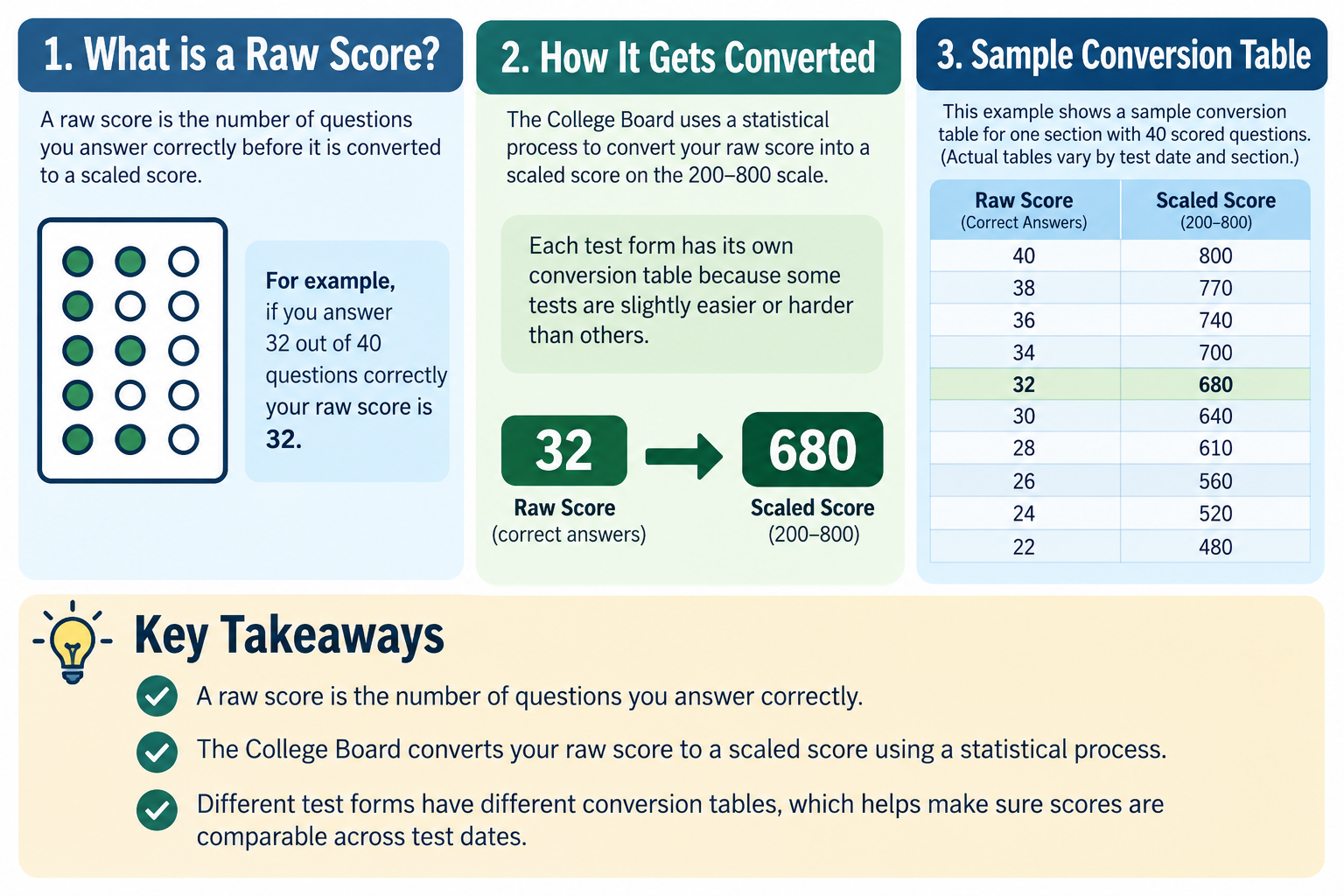
Understanding SAT Raw Scores and Score Conversion: See how the number of correct answers translates into a scaled score on traditional SAT exams and learn why the digital SAT uses a different scoring method. The conversion table shown is illustrative and does not represent official digital SAT scoring.
How Does Adaptive Testing Affect Your SAT Score?
The digital SAT uses multistage adaptive testing, meaning the difficulty of your second module depends on how you perform in the first. Each section has two modules. Your performance in the first determines whether you receive a more challenging or less challenging second module. Students who perform well in the first module generally receive the more challenging second module, giving them the opportunity to demonstrate higher levels of achievement. However, your final score depends on your performance across both modules, not simply which version you receive.
Here's something else worth knowing: Of the SAT's 98 questions, eight are unscored pretest questions. Students aren't told which questions are unscored, so it's important to approach every question as though it counts.
Do You Lose Points for Wrong Answers?
No! The SAT does not have a guessing penalty. If you're unsure about a question, try eliminating incorrect answers and making your best educated guess.
The takeaway: Never leave a question unanswered if you have time to provide an answer.
What Is a Good SAT Score?
There's no universal definition of a good SAT score. It depends on your college admissions goals, scholarship opportunities, and academic strengths. Many colleges publish the middle 50% SAT score range of their incoming students. Reviewing these ranges can help you establish a realistic target. For Florida students, SAT scores can also play an important role in qualifying for the Florida Bright Futures Scholarship Program.
Bright Futures has specific academic and testing requirements that vary by scholarship level and graduation year, so be sure to check the current eligibility criteria.
The bottom line: A good SAT score is one that helps you move closer to your college and scholarship goals.
What Does Your SAT Score Report Tell You?
Your SAT score report contains more information than just your total score. It includes your individual Reading and Writing and Math scores, percentile rankings, and performance information for different academic skills. For example, if you earn a 580 in Reading and Writing and a 670 in Math, your results suggest that Reading and Writing may offer opportunities for improvement.
Your score report also identifies performance across content areas such as Algebra, Advanced Math, Information and Ideas, and Standard English Conventions. These insights can help you focus your preparation on the skills that need the most attention.
Think of your score report as a roadmap for what to study next.
What Is SAT Superscoring?
Here's another SAT scoring concept worth understanding: superscoring.
Some colleges allow students to combine their highest section scores from different SAT test dates.
For example:
| SAT Test Date | Reading and Writing | Math | Total |
|---|---|---|---|
| First SAT Test | 650 | 600 | 1250 |
| Second SAT Test | 620 | 700 | 1320 |
| Superscore | 650 | 700 | 1350 |
Although the student's highest single-test score was 1320, their superscore would be 1350. Not every college uses superscoring, so it's important to check the admissions policies of the institutions you're considering.
How Can You Improve Your SAT Score?
Understanding your SAT score is the first step. The next step is using that information
to prepare strategically.
Here are a few ways to get started:
- Take an official practice test. Use College Board's Bluebook application to establish your starting score.
- Identify your weakest areas. Review your score report to determine which skills need additional attention.
- Practice under timed conditions. Build confidence working within the SAT's time limits.
- Learn test-taking strategies. Practice eliminating incorrect answers, managing difficult questions, and using the SAT's built-in tools.
- Consider retaking the SAT. Targeted preparation between test dates may help you improve your results.
Rather than studying everything equally, focus your time on the areas where improvement could make the biggest difference.
Prepare for Success with USF Test Prep
Your SAT score isn't just a number. It's a starting point for understanding your strengths, identifying opportunities for improvement, and working toward your college goals. Whether you're preparing for your first SAT or hoping to improve your score, a focused preparation strategy can help you approach test day with greater confidence.
USF Test Prep offers instructor-led SAT preparation designed to help students strengthen academic skills, practice test-taking strategies, and prepare for the exam.
Ready to work toward your target SAT score?
Explore USF Test Prep to learn more about available SAT preparation programs.