
If you're preparing for college, you've probably heard plenty about the SAT and ACT. Both exams are designed to measure skills that can help predict college readiness, and both are accepted by colleges and universities across the United States.
But here's something you might not realize: The SAT and ACT aren't identical, and choosing the right one could make a difference in how confidently you perform on test day. From the types of questions you'll encounter to the amount of time you'll have to answer them, each test offers a different experience.
So, should you take the SAT or ACT? Let's break down the differences and help you figure out which test might be the better fit.
SAT vs. ACT: What's the Difference?
At their core, the SAT and ACT assess many of the same academic skills. Both evaluate reading comprehension, writing, and mathematical reasoning. However, their structures, timing, and scoring systems are different.
| Feature | SAT | ACT |
|---|---|---|
| Test format | Digital | Online or paper |
| Main sections | Reading and Writing, Math | English, Math, Reading |
| Science | Not a separate section | Optional |
| Writing/Essay | Not part of the standard SAT | Optional |
| Total testing time | 2 hours, 14 minutes | 2 hours, 5 minutes (without optional sections) |
| Score range | 400-1600 | 1-36 |
| Calculator use | Allowed throughout Math | Allowed throughout Math |
| Adaptive testing | Yes | No |
One important update: The ACT introduced an enhanced version of its exam in 2025, with a shorter core test and optional Science and Writing sections. Students should make sure they're using current ACT preparation materials rather than older resources.
The digital SAT also uses adaptive testing, meaning your performance in the first module of each section helps determine the difficulty of the questions in the second module.
The ACT does not use this adaptive structure.
Neither approach is inherently better, but understanding the differences can help you feel more prepared.
1. Consider Your Strengths in Reading and Writing
One of the biggest differences between the SAT and ACT is how they assess reading and writing skills.
SAT Reading and Writing
The digital SAT combines reading and writing into one section. You'll encounter short passages, often followed by a single question. These questions assess skills such as:
- Understanding the main idea of a passage
- Interpreting vocabulary in context
- Analyzing evidence and arguments
- Identifying grammatical errors
- Improving sentence structure and clarity
Because the passages are relatively short, you won't need to read several long selections before answering questions. If you prefer working through shorter pieces of text and focusing on one question at a time, the SAT's format may appeal to you.
ACT English and Reading
The ACT separates English and Reading into two sections. The English section focuses on grammar, punctuation, sentence structure, and effective writing. The Reading section asks you to interpret passages, identify important details, understand relationships between ideas, and draw conclusions. f you're comfortable reading longer passages and quickly identifying important information, the ACT may be a good fit.
The takeaway: If shorter reading passages appeal to you, consider the SAT. If you prefer more traditional reading comprehension passages, you may feel more comfortable with the ACT.
2. Think About How You Handle Math
Both exams test mathematical reasoning, but they emphasize different skills and have different pacing requirements.
SAT Math
The SAT Math section includes 44 questions across 70 minutes. Topics include algebra, advanced math, problem-solving and data analysis, geometry, and trigonometry. Students can use the built-in Desmos graphing calculator throughout the section.
With approximately 95 seconds per question, the SAT generally provides more time to work through each math problem.
ACT Math
The enhanced ACT Math section includes 45 questions across 50 minutes.
It covers algebra, functions, geometry, statistics, probability, and other mathematical concepts. Students can use approved calculators throughout the section.
With approximately 67 seconds per question, ACT Math requires students to work at a faster pace.
The takeaway: If you prefer having more time to solve challenging problems, SAT Math may be more comfortable. If you're confident working quickly across different mathematical topics, ACT Math may suit your strengths.
Want a closer look at the differences? Read our companion article, ACT vs. SAT Math: What's the Difference, and Which Test Is Right for You?
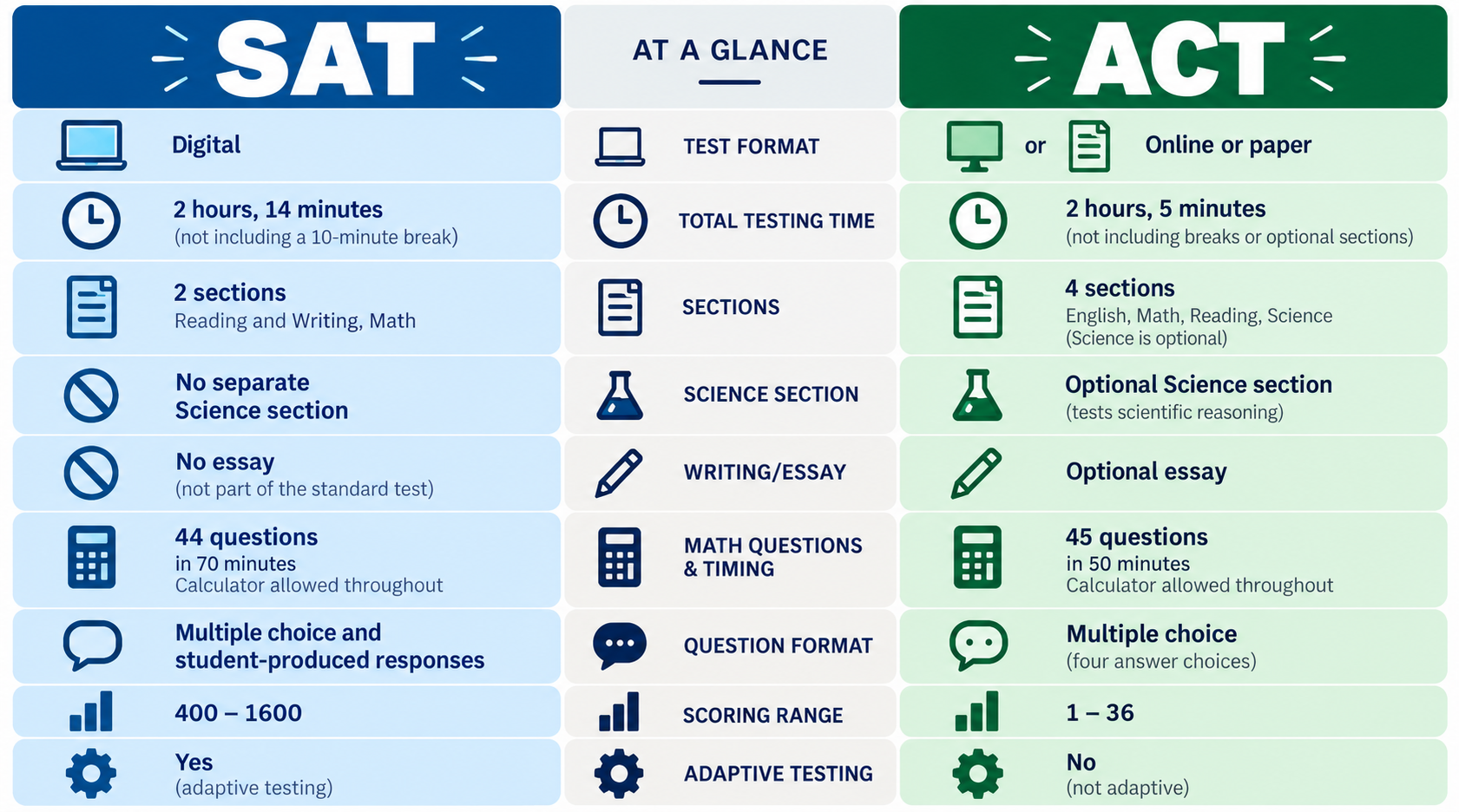
SAT vs ACT at a glance.
3. How Well Do You Perform Under Time Pressure?
Time management is an important part of both exams, but the experience can feel quite different.
The SAT generally gives students more time per question, particularly in Math. The ACT moves at a faster pace in several sections, requiring students to read, process information, and select answers efficiently. For example, imagine you're working through a difficult math problem. Do you prefer having time to think through multiple approaches before selecting an answer? Or are you comfortable making a quick decision and moving on?
Neither approach is wrong. The important thing is recognizing which testing environment allows you to perform at your best.
The takeaway: If you frequently run out of time on standardized tests, the SAT may be worth exploring. If you work quickly and accurately, the ACT could be a strong option.
4. What About the ACT Science Section?
One difference between the two exams is the ACT's optional Science section.
The SAT does not have a separate Science section, although some questions involve interpreting scientific information. The ACT Science section focuses primarily on scientific reasoning rather than memorizing scientific facts.
Students may be asked to:
- Interpret charts, graphs, and tables
- Analyze experimental results
- Compare scientific explanations
- Evaluate evidence and draw conclusions
For students who enjoy interpreting data and thinking through scientific problems, the ACT Science section may provide an opportunity to demonstrate additional strengths. However, because Science is now optional, students should check whether their prospective colleges or scholarship programs require or recommend it.
The takeaway: Don't choose the ACT simply because you enjoy science. Consider whether taking the optional Science section supports your specific college admissions goals.
5. Do Colleges Prefer the SAT or ACT?
Here's some good news: Most colleges that consider standardized test scores accept both the SAT and ACT.
Generally, colleges do not favor one exam over the other simply because of its name. What matters is how your scores compare with the institution's admissions expectations and how they fit within your overall application. Some colleges are test-optional, while others require standardized test scores. Requirements can change, so it's important to check the admissions policies of the schools you're considering.
For Florida students, standardized test scores may also play an important role in scholarship eligibility. For example, the Florida Bright Futures Scholarship Program has specific standardized testing requirements that vary by award level and academic year. Before choosing your test, review the current eligibility requirements for any scholarships you plan to pursue.
The takeaway: Choose the test that gives you the best opportunity to demonstrate your abilities, while keeping your college and scholarship requirements in mind.
6. Which Test Is Easier: SAT or ACT?
This is probably the most common question students ask. Unfortunately, there's no universal answer.
The SAT isn't automatically easier than the ACT, and the ACT isn't automatically easier than the SAT. It depends on your academic strengths, testing preferences, and preparation.
You might prefer the SAT if you:
- Like working with shorter reading passages
- Want more time per math question
- Feel confident with algebra and mathematical reasoning
- Prefer taking a digital, adaptive exam
- Enjoy using graphing technology to solve problems
You might prefer the ACT if you:
- Are comfortable reading longer passages
- Work efficiently under time pressure
- Prefer a nonadaptive testing format
- Feel confident across a broad range of math topics
- Want the option to demonstrate scientific reasoning skills
These aren't hard-and-fast rules. A student who loves algebra might still perform better on the ACT, while a strong reader might discover that the SAT is a better match.
The only way to know for sure is to experience both tests.
7. How to Decide Which Test to Take
Still undecided? Here's a practical approach.
Step 1: Take a Practice SAT
Start with an official SAT practice test through College Board's Bluebook application. Try to replicate actual testing conditions. Set aside uninterrupted time, follow the test instructions, and avoid unnecessary breaks. Afterward, review your score and identify areas where you struggled.
Step 2: Take a Practice ACT
Next, complete an official ACT practice test using the current enhanced format. Again, try to simulate real testing conditions. Pay attention not only to your score but also to how you felt throughout the exam. Did you run out of time? Were certain sections especially challenging? Did the question formats feel comfortable?
Step 3: Compare Your Results
Because the SAT and ACT use different scoring scales, you can't compare their numerical scores directly. Instead, use an official SAT-ACT concordance resource to understand how your scores compare. Then consider which exam felt more manageable and where you have the greatest opportunity to improve.
Step 4: Choose a Test and Build a Study Plan
Once you've identified the test that best matches your strengths, focus your preparation. Rather than splitting your study time equally between both exams, concentrating on one can help you develop familiarity with its structure, timing, and question types. You can always reconsider your choice later if your practice results suggest another approach would be more effective.
8. Don't Forget About Your Testing Timeline
Choosing the right exam is only part of the process. You also need to decide when to take it. Many students begin exploring the SAT and ACT during their sophomore or junior year, leaving time to prepare, review their results, and potentially retake the exam before college application deadlines.
Your ideal timeline will depend on your academic schedule, college application plans, and scholarship goals. For more guidance, check out our article, When Should You Take the SAT?, to learn how to build a testing schedule that works for you.
Prepare for Success with USF Test Prep
Whether you choose the SAT or ACT, preparation can help you approach test day with greater confidence. USF Test Prep offers instructor-led preparation designed to help students strengthen academic skills, practice test-taking strategies, and identify opportunities for improvement. Our preparation programs focus on helping students understand the exam, manage their time effectively, and build confidence through structured instruction and practice.
Ready to start preparing?
Explore USF Test Prep to learn more about available SAT and ACT preparation programs.
The bottom line: The best test isn't necessarily the one your friends are taking or the one you've heard is easier. It's the one that allows you to demonstrate your strengths and work toward your college goals.