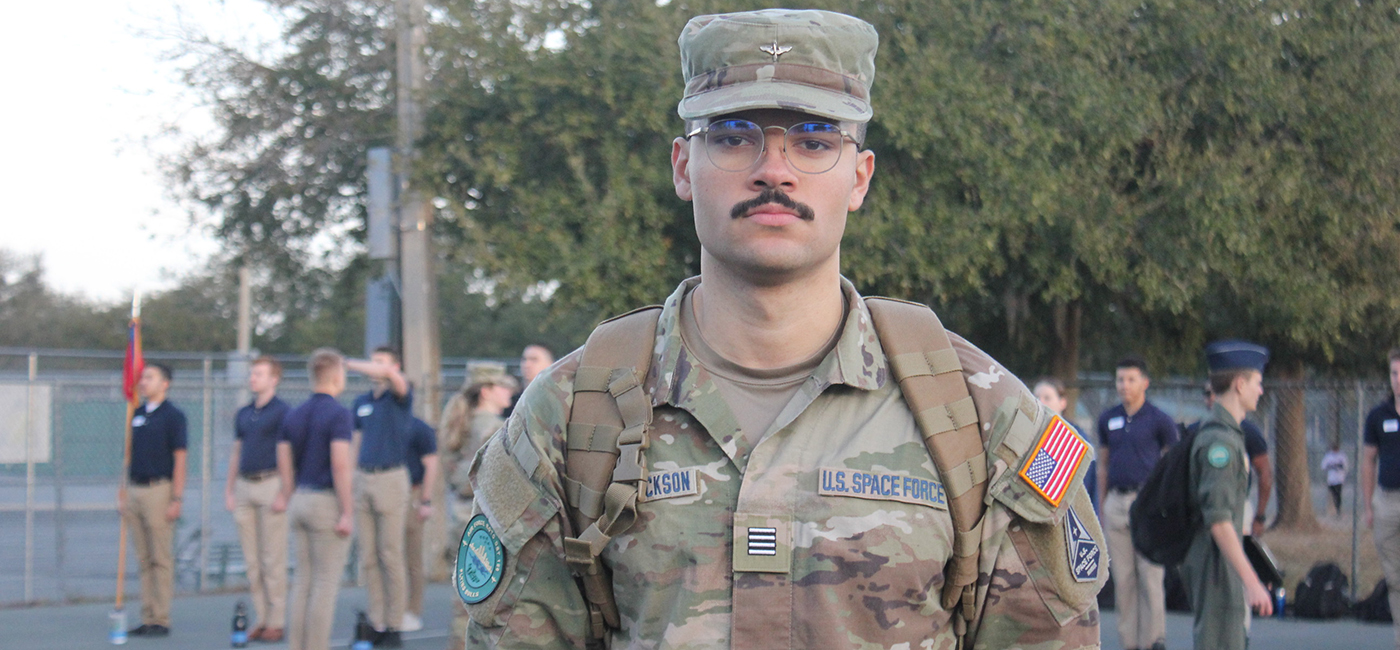
As he waited to begin training with the U.S. Space Force in Colorado Springs, Jacob Sotel-Jackson realized his path into one of the nation's newest military branches began with a single, unlikely decision: enrolling in a quantum computing elective at the University of South Florida. He didn't know at the time, but choosing that elective course would be life changing.
"I had no idea what quantum computing was, at the time" he said. "It sounded kind of out there."
At the urging of a friend with the same major, they discussed taking a class together, and Associate Professor Richard Rauscher's class in quantum computing was open.
Looking at the requirements, he knew linear algebra was part of the curriculum, and he wasn't looking forward to working on that kind of math. This was an elective.
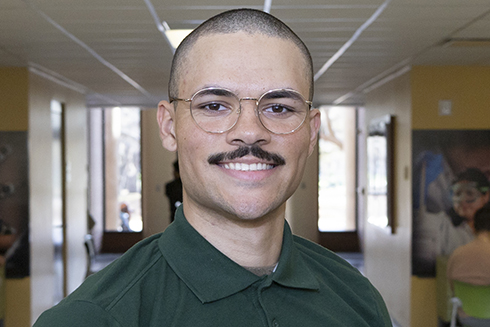
"That wasn't something I was interested in," he remembers. "But my friend convinced me to just jump into this and take the class with him."
Now, he's a second lieutenant enjoying some down time in Colorado Springs before reporting to his initial training with the U.S. Space Force – and quantum computing is part of his daily life.
"I don't if I would have really gone and done a deep dive into quantum without that class," he said. "The more I learned about it, I was super fascinated by it. It just sparked a real big interest in me. I saw that this is something that could really change the world in the next couple decades."
From USF ROTC to the U.S. Space Force
USF was a natural choice for college. His mother was a nursing school graduate, it was right down the road from his home, and as a child, he spent time on campus attending STEM activities that the university hosted.
"That got me interested," he said. "I had also always been interested in computers and video games from a young age."
Similarly, military service was a natural choice for him. Both of his parents were U.S. Army veterans who recommended he join USF's ROTC program. The U.S. Space Force was still so new, it wasn't represented in the ROTC program then. But the U.S. Air Force was, and part of the Air Force mission statement at that time included protecting cyberspace.
"That just aligned with what I was really interested in," he said. "When then the opportunity for me to go into Space Force popped up, I thought, 'Oh, this is pretty cool.'"
How a quantum computing class changed a career direction
Sotel-Jackson was content taking the core computer science classes.
"It was very grounded in traditional computing, zero, ones – binary bits – and regular programming," he said.
Then his friend convinced him to enroll in that quantum elective.
Quantum computing is relatively new as a practical technology, but the science behind it is decades old. It uses the rules of quantum physics to solve certain problems much faster than today's computers. Instead of processing information as simple on-or-off bits, quantum computers use quantum bits that can represent many possibilities at once, allowing them to tackle extremely complex calculations.
"It was a difficult class," he said. "It was like nothing I had done in computer science before. It was completely different because at its core, it's quantum mechanics rather than computing in binary zeros and ones that we're used to in regular computer science."
His curiosity didn't end when the course was over. In his free time, he read textbooks to learn more. Then he took another graduate-level course on quantum information before his graduation.
"The opportunity came up to for me to get a graduate degree through the Space Force, just after commissioning," he said. "When I was looking into different programs, I decided that what I wanted to do was actually research quantum computing. That's what guided my graduate degree search."
Sotel-Jackson graduated from USF in 2024 and earned a master's degree from Purdue University 18 months later.
Through his graduate research, Sotel-Jackson focused on the use of hybrid quantum-classical machine learning for the security analysis of quantum key distribution channels for sharing encryption keys.
While he doesn't yet know the details of what he will be doing with Space Force, he knows he has the latest knowledge to tackle whatever project comes his way.
He recently reached out to his former faculty member via email, thanking him for the class that inspired this passion.
"Over the semester, I realized it was one of the most intriguing and fascinating topics I had ever encountered," he wrote. "I decided that I want to be part of this. I want to make sure that I'm near the front of this and I'm prepared and knowledgeable. When this stuff does become mainstream, and it does have a significant impact on the world, I want to be able to look back and say that it basically all started with that class."
The views and opinions expressed in this article are those of the individual and do not necessarily reflect the official policy or position of the Department of Defense or U.S. Space Force. Use of military rank, titles, or imagery does not imply endorsement by the Department of Defense.