Research & Projects
Projects
Understanding individual listener abilities
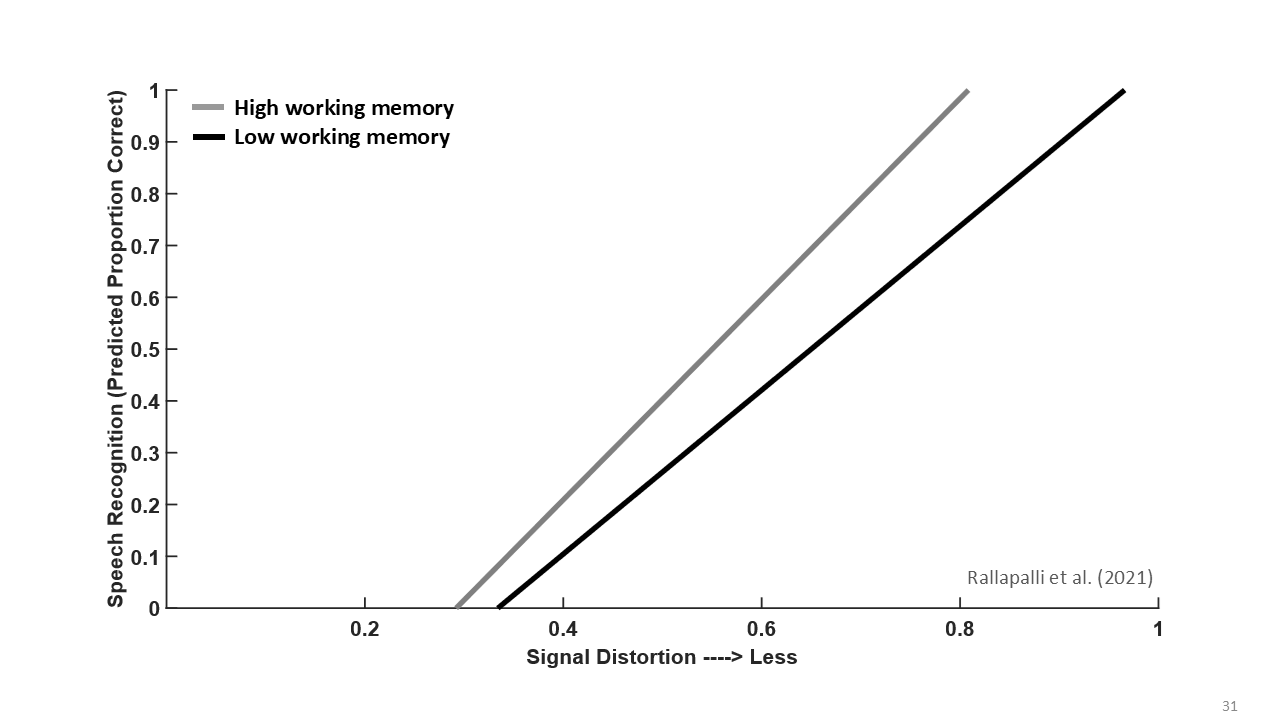
Two individuals with the same hearing loss often respond differently to the same hearing aids, especially in noisy environments. Current clinical practice for hearing aid treatment is predominantly based on an individual’s hearing levels to restore audibility. Very little is understood about how hearing aid processing interacts with a listener’s auditory perceptual and cognitive abilities that promote successful speech-in-noise listening. A priority of our research is to investigate individual abilities that will lead to better personalization of hearing loss treatment. Specifically in this line of work we investigate how cognitive processes (e.g., working memory) impact speech understanding with hearing aids. A key translational goal is to determine whether standard hearing aid protocols must include tests of cognitive and auditory abilities beyond the standard hearing test.
Novel Signal Processing for Improved Hearing Aid Outcomes
A major focus of our lab is evaluating and advancing novel signal-processing strategies to improve listening outcomes for individuals with hearing loss. Traditional hearing aids apply uniform processing across all sounds, which can unintentionally distort important acoustic cues and contribute to complaints such as reduced sound quality, listening effort, and unnatural listening experiences. Our work examines emerging approaches such as source-based compression that allow hearing aids to treat different sound sources (e.g., speech and background sounds) in more flexible and targeted ways. Using a combination of behavioral testing, perceptual ratings, and laboratory-based acoustic analyses, we investigate how these technologies influence listener outcomes This line of research aims to inform the development of next-generation hearing technologies that move beyond audibility alone toward more personalized, listener-centered amplification.