Curriculum
Curriculum
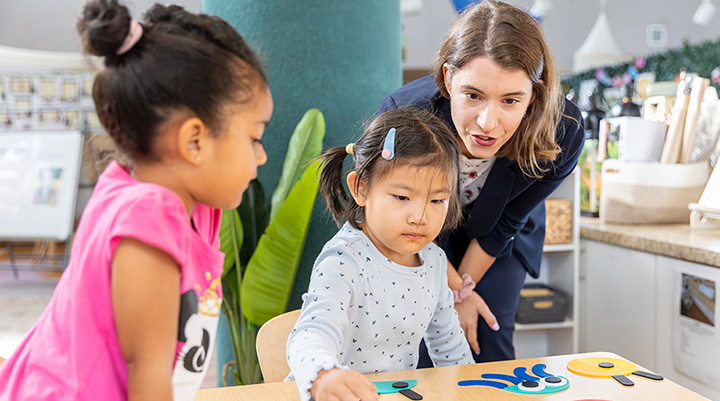
At the PCL, teachers are curricular decision-makers who conduct practitioner research in order to better understand the children they teach, innovate practices, and to inform the field of early childhood education. They actively participate in on-going dialogue about how they embody the program philosophy in day-to-day activities. As they engage in teaching and learning as inquiry, they are responsible for understanding and experimenting with developmentally appropriate practices. Teachers are expected to possess deep knowledge of content, skills, and processes across domains, and to utilize a variety of instructional approaches to best serve the children they teach (e.g., explicit instruction, facilitating project work/investigations with children, and building on child-initiated play to enhance learning.)
Curriculum content is drawn from the following domains:
- Language, Literacy, and the Arts
- Mathematics, Science, and Technology
- Social Studies
- Social/Emotional Development
- Physical Development
The Project Approach
The Project Approach is a framework for engaging in inquiry with young children. A project is an in-depth study of a real-world topic that typically occurs over a period of weeks or even months
Projects Occur in Three Phases:
- The purpose of Phase 1 is to discover what children already know about a topic of study and to provide some initial common experiences in order to generate questions for further investigation.
- During Phase 2, teachers and children build upon and extend prior knowledge by engaging in firsthand investigation to find out answers to their question or questions.
- During Phase 3, children review and synthesize what was learned and decide how to communicate what they have learned with others. Projects provide a context for young learners to apply their growing academic knowledge and skills in authentic ways (Katz, Chard, and Kogan, 2014). Throughout the work, children connect with knowledge and skills across curriculum domains and represent what they are learning in a variety of ways (e.g., writing, drawing, painting, dramatic play, 3-dimensional construction, music and movement, and graphics).