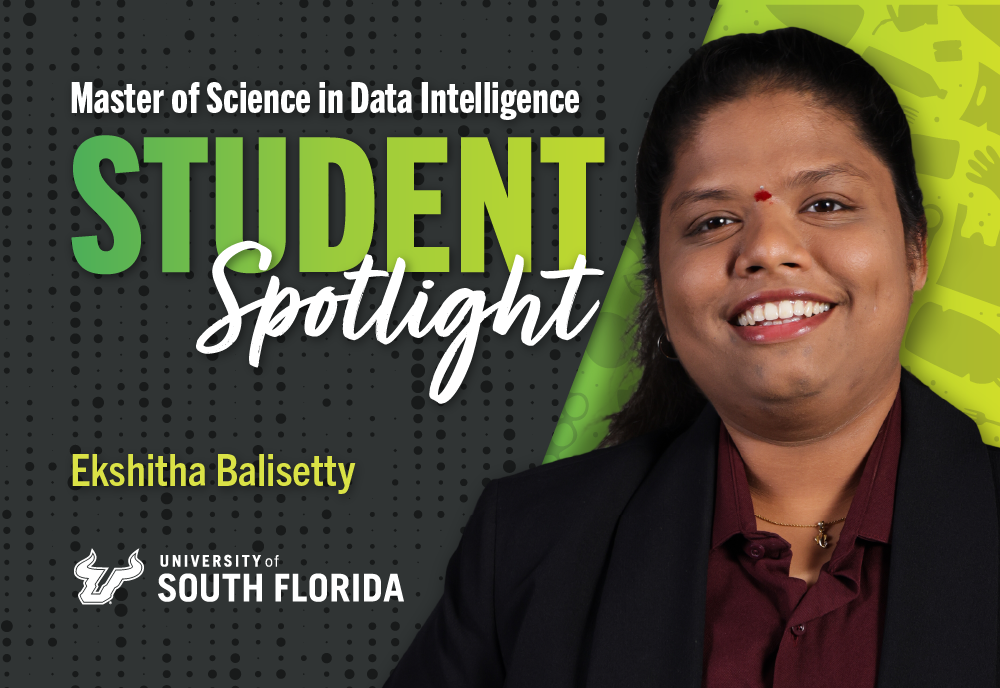
Microplastics are difficult to see, but Ekshitha Balisetty is helping create a virtual world where students may one day explore how those tiny particles move through the environment.
A graduate of the University of South Florida's Master of Science in Data Intelligence (MSDI) program, Balisetty is contributing to research that combines virtual reality and artificial intelligence to make complex environmental science concepts easier to understand. The project also reflects a lesson she learned through MSDI: technology is most valuable when it helps people solve real problems.
Making the Invisible Visible
Working with Assistant Professor Bo Pei in USF's College of Education, Balisetty is researching a virtual reality platform that would allow students to visualize processes involving microplastics that are difficult to observe directly. Rather than simply reading about how microplastics move through water, ecosystems, and food chains, students could explore those processes through an immersive virtual environment.
The interdisciplinary project also explores how AI could personalize the learning experience by recognizing when students are confused and providing explanations based on their learning needs.
“It's not only about building something that works,” Balisetty said. “It's about building something that is useful.”

Why MSDI Felt Different
Before enrolling in MSDI, Balisetty had already completed a master's degree in computer science at USF. While that program gave her a strong technical foundation, she wanted something that would allow her to apply data, AI and machine learning to real-world problems.
MSDI stood out because of its interdisciplinary approach. Alongside machine learning and data analytics, she explored cybersecurity, optimization, deep learning, reinforcement learning and natural language processing.
“My computer science master's taught me how to build the technology,” Balisetty said. “Data intelligence taught me to think more deeply about what the data is telling me, why I am building something and how I evaluate whether it actually solves the problem.”
That shift in thinking became one of the program's biggest benefits. Instead of immediately focusing on algorithms and models, she learned to first ask whether the solution addressed the user's actual need.
“I don't want to build technology just for the sake of building technology,” she said. “I'm interested in the intersection between the technology, the problem and the person who is actually going to use it.”
Faculty, Projects and Real Experience
Balisetty credits MSDI's faculty with helping transform classroom concepts into practical skills.
One of her favorite experiences was Applied Data Intelligence with Soumyadeep Hore, where she developed a cyberattack detection system using network traffic data to distinguish normal activity from different types of attacks. The project pushed her to work through large datasets, coding challenges and machine-learning models while building confidence in her problem-solving abilities.
She also credits Professor John Borrero's Optimization Methods with Apps course with changing how she approaches decision-making and complex problems.
Beyond individual assignments, MSDI helped her build a portfolio that included projects in cybersecurity, machine learning and natural language processing.
“When we graduate, those projects become more than coursework,” she said. “They become our portfolio.”
The support extended beyond the classroom. Balisetty said professors were accessible, provided meaningful feedback and often helped students recognize when they were moving in the wrong direction before problems became larger obstacles.
“When it comes to picking my favorite professors, I really can’t pick one because all of the professors that I’ve worked with are really amazing and so sweet.”
Looking Ahead
Balisetty plans to begin a Ph.D. at USF in January 2027 and hopes to continue exploring human-centered AI, educational technology and interdisciplinary research. She is particularly interested in understanding how intelligent systems can help people learn, make decisions and understand complex information.
Earning a doctorate would also make her the first person in her family to achieve that milestone.
For future MSDI students, Balisetty's advice is simple: stay curious, ask questions and use projects as opportunities to create meaningful work rather than simply earning a grade.
“You might enter knowing what you want to study,” she said, “but you may leave discovering something you didn't even know you were passionate about.”
Extended Deadline
If you are inspired by Balisetty’s story, but missed the Oct. 15 application deadline to start classes in January 2027, reach out to MSDI’s online success coach as soon as possible. Our team can help answer your questions, discuss your options and provide guidance on next steps. An expedited admissions decision process will be available for only a short time, so email us today!