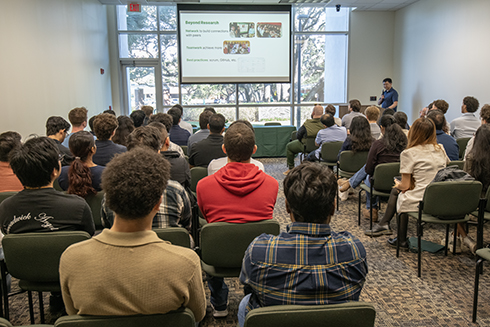
Doctoral student Chance Hamilton sat before a room full of researchers and students and rubbed the sparse hair on his head. As a panel member at the Fall 2025 Bellini College REU Symposium, he wanted to give undergraduate students a realistic view of what it's like to do research.
Hamilton is nearing the end of his doctoral studies in USF's Bellini College of Artificial Intelligence, Cybersecurity and Computing, and he's been doing research long enough that, as he jokes, he didn't always look this way.
He jokes that at one time; he had a full head of hair.
"That kind of sums up research – rubbing all of your hair off," he said laughing. "It is very challenging, but it's probably the most rewarding thing you'll do in college."
Hamilton was among the speakers at the college's Research Experience for Undergraduates symposium that showcased student research, introduced faculty mentors and outlined opportunities. Nearly 75 students attended the event, held Dec. 5 at USF Research Park.
The REU program allows students to work closely with faculty on active research projects and often leads to publications, conference presentations or graduate school admissions. Participating students gain experience in problem-solving, inquiry-based learning and emerging technology areas, while faculty benefit from early talent development who allow for added research capacity.
Equal parts challenging and rewarding
Hamilton shared that his experience as a student researcher taught him how to approach questions differently. Hamilton framed the thought process of research as, "learning how to learn."
"You're not solving questions with answers," he added. "We're trying to look into questions that don't necessarily have answers or best practices, and we're trying to find those or shed lights on them."
The symposium was organized by faculty member Alfredo Weitzenfeld, who is quick to point out that the Spring 2026 registration is open for students who want to gain authentic, high-level research experiences early in their academic career.
"The whole idea is for you to gain experience in research, and we hope that you think about graduate studies in the future, either in the immediate future, or later on," Weitzenfeld said to the students. "To participate in this, you just have to find a faculty member and talk to them and say, 'I want to work in your lab,' and then you've got to register."
Weitzenfeld, whose research interests are in the areas of biologically-inspired robotics, robotics learning, spatial cognition and computational neuroscience, wants students to know what all is available to them and to get them interested in research.
Larry Hall, assistant dean of research in the Bellini College, encouraged the students who attended to get involved in learning that happens outside traditional coursework.
"We're really happy to have so much participation in our research experience," Hall said. "For undergraduates, there's a lot of participation this year and we want to continue that. We want to make sure you have the best possible experience."
Hall shared that he had a student researcher who recently had a paper accepted for publication, an outcome that emerged directly from their participation in the program.
"So, you actually can get publications out of it," he said. "But you also get the experience of doing something different than the classrooms. In classrooms, there's a right answer. You want to get the right answer. You want to get that 100, right? In research, we don't know what the right answer is."
Hall explained university research is about asking questions that aren't yet solved, and developing the curiosity and persistence to pursue them.
"I highly encourage it," he said. "It's challenging and fun."
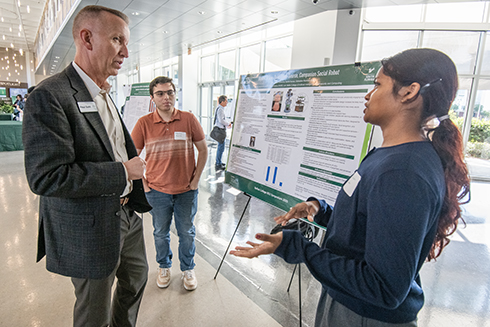
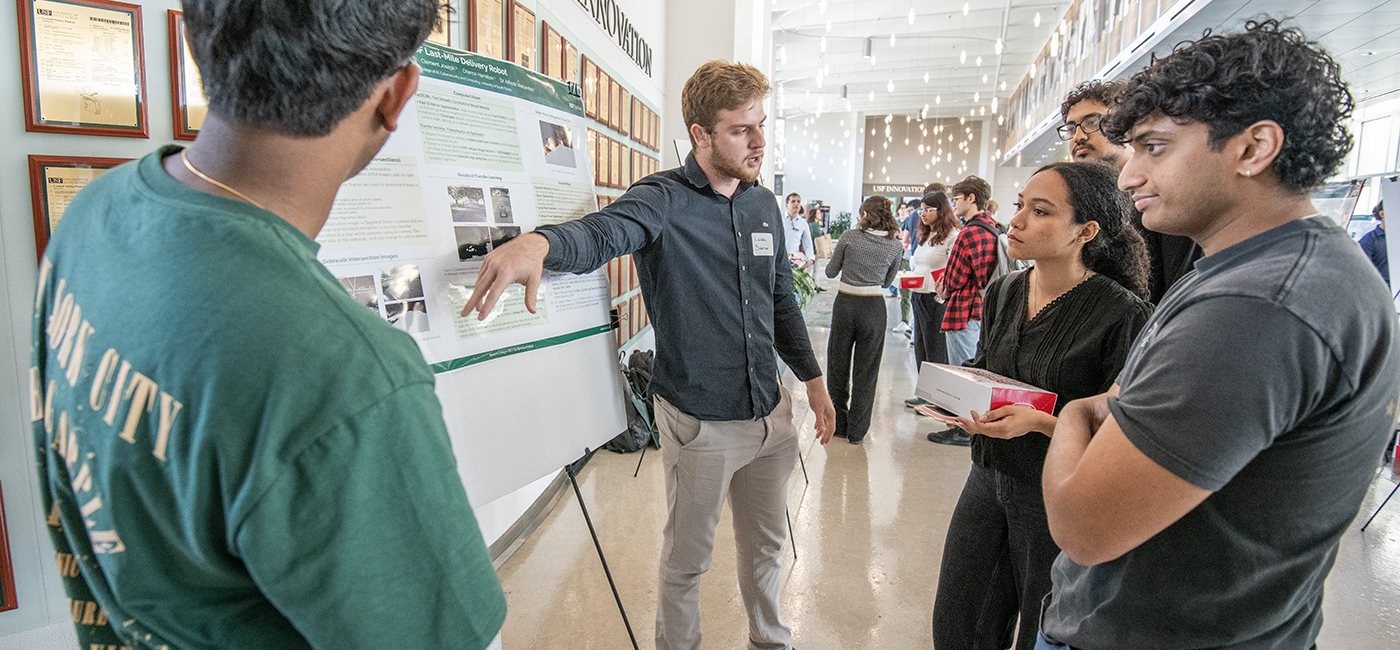
At the end of the symposium current participants showcased their research posters. Poster topics ranged from autonomous delivery robots to leveraging large language models for data annotation to social robots for older adults to improving human-robot collaboration in safety critical tasks and podcast-based educational content generated by large language models.
The panel discussion that included Hamilton also included other students who shared their insights into the program.
Lucas Araujo, an undergraduate student, discussed how he first got involved with the REU program.
His interest in robotics began in high school and when he got to USF, he took one of Weitzenfeld's courses in robotics.
"It was an amazing experience," he said. "I wanted to pursue more. I wanted to do more with that and put into practice what I learned."
He got involved with the REU program.
"This opened my eyes to what robotics and the research area can bring to me as a student," he said. It also helped him understand the graduate and PhD programs and how to do research articles.
Hamilton offered parting advice for timid students: Just approach faculty. Be interested in their work. He explained that doesn't mean reading complicated research publications. Just stick to the abstracts and headlines, so they can find things that interest them.
"They are people at the end of the day. They will open up and talk your ear off."