Most of John Murray-Bruce’s toys didn’t survive his childhood. His father allowed him to take them apart to figure out why something made a sound or moved a particular way.
That helped spark a curiosity that would eventually lead him to a career in research as an associate professor in the USF Bellini College of Artificial Intelligence, Cybersecurity and Computing.
“I was interested in puzzles,” he said. “I discovered later on that if I wanted to learn more about the world, I needed to understand the language in which to represent the world: physics and mathematics.”
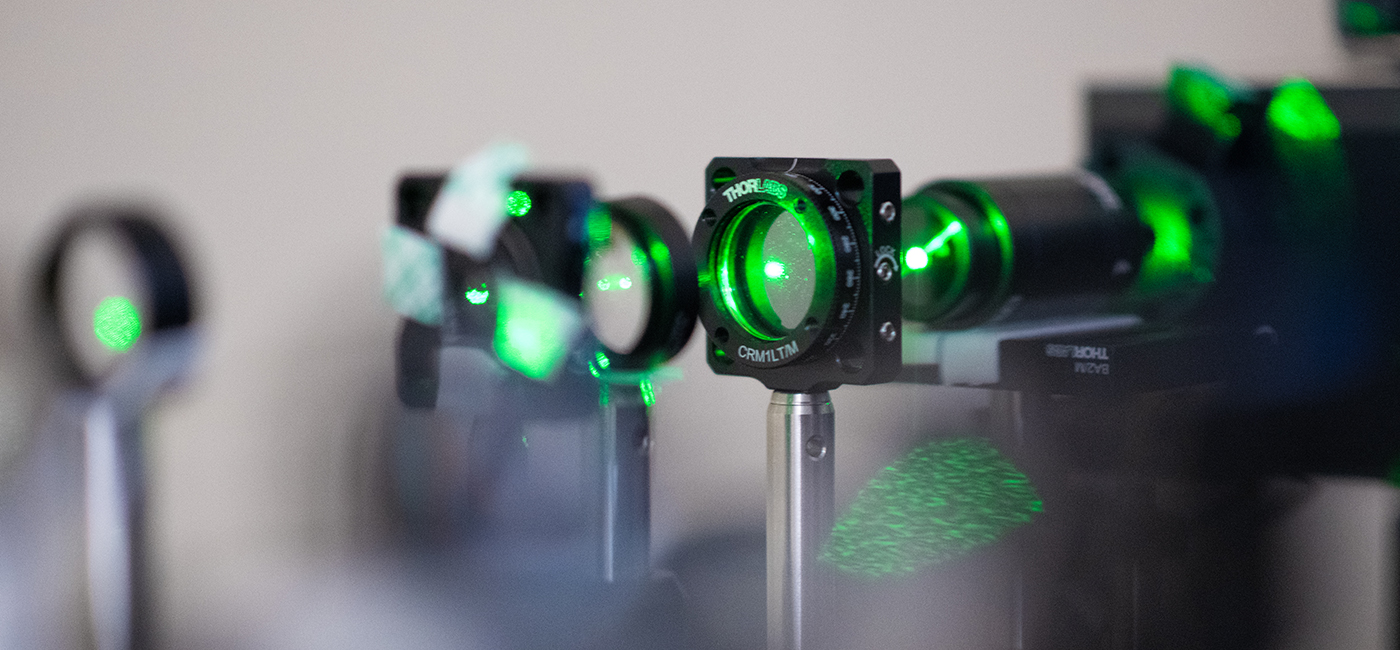
Today, that curiosity drives Murray-Bruce’s computational imaging research at the Bellini College where he’s developing new approaches to how cameras and other imaging systems capture and interpret information. His work includes federally funded research with applications ranging from long-distance X-ray imaging to new ways of representing visual information.
His path to that work was shaped by a series of mentors who recognized and encouraged his curiosity.
Murray-Bruce completed his high school education in the U.K., where one of his high school math teachers, Mr. Grant, became an early role model. Noticing his interest in calculus, Mr. Grant gave Murray-Bruce a textbook on integration calculus. Within a year, he had completed every problem in the book.
In the days before Google, the young electronics hobbyist built wireless microphones, AM radios and tinkered with his many of his toys. By the time he was 6 years old, “I'd been zapped at least a dozen times,” he said.
Those were some of the earliest signs of his interest in electrical and electronic engineering.
“When the time for university came, I chose to study electrical and electronic engineering,” he said.
While studying at Imperial College London, he grew fascinated by a course in signal processing, which he found to be an area that held applications in many fields. Much of the world can be thought of as signals, from brain waves to temperature and sound, or even financial systems and social networks. His signal processing professor and later doctoral advisor, Pier Luigi Dragotti, became a mentor and taught him how to conduct research.
“He was very picky about the tiniest of details,” Murray-Bruce said. “How to ask the right questions, how to formulate hypotheses, and how to see projects through to the end.”
After finishing his doctoral degree, Murray-Bruce knew he wanted to stay in academia. He became a postdoctoral associate working with Vivek Goyal at Boston University. They designed models and algorithms for sensors that interact with the world in a variety of domains.
“I was exposed to a whole breadth of problems and found a new way of thinking about the world,” he said. “My mentors were all generous with their time and blunt when things weren’t working. They’d tell me what I needed to hear – the truth and honest feedback.”
That path eventually brought Murray-Bruce to USF, where his computational imaging research includes a fast-paced project supported by the Defense Advanced Research Projects Agency. (DARPA).
“DARPA wants to create surprise and prevent surprises,” he explained. “Our project fits into that space using X-ray imaging. In medical and industrial settings, the source and detector closely spaced. We want to push that to kilometers between the source and the detector. This reveals entirely new challenges, from modeling X-ray photon detection over long distances to making inferences from those detections.”
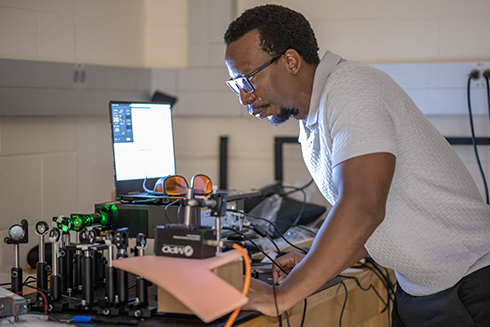
Murray-Bruce works with a team of graduate and undergraduate student researchers on this project, as well as a second supported by a CAREER award from the National Science Foundation. The project focuses more broadly on computational imaging systems and the balance of power between optics and computation in cameras.
“Cameras do a lot of processing,” he said. “What we’re trying to do is see if there are better representations rather than standard pixels. In some cases, there are different abstractions that work better.”
Murray-Bruce highlights the amount of research freedom he has at USF and the support he’s received in terms of lab space and the occasional unconventional request.
“USF has been rapidly rising as an institution in the last decade, and it’s exciting to see the growth from the inside,” he said. “The way Bellini has positioned itself with the hub and spoke model means that people are reaching out to collaborate across fields.”
A collaborative environment of mentorship exists in his lab as well and has fostered student success both within USF and after graduation at places like Amazon, NASA, and the National Oceanic and Atmospheric Administration.
“My students are incredibly resilient and they make me better,” Murray-Bruce said. “Some of the equations aren’t user-friendly, but they are troopers and eventually attain impressive and surprising results. We have a talented bunch, and that’s one of the most exciting parts of my job.”