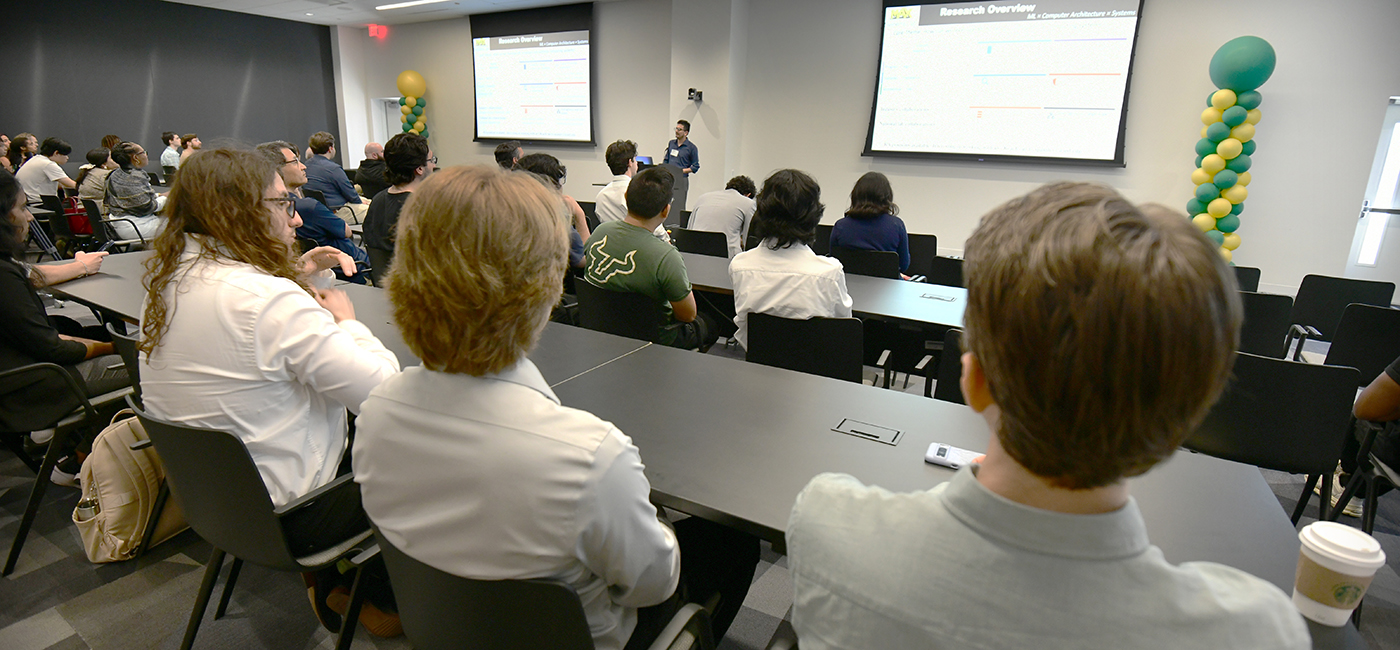
A handful of graduate students were peppered with questions about their research experience during Friday's REU Symposium for the Bellini College of Artificial Intelligence, Cybersecurity and Computing at USF's Research Park.
Developing novel research ideas, balancing the decision between academics and industry, what the research experience is like and what favorite projects they have done were just a few questions posed to them.
Zachary Hinnen, Ricardo Frumento, Anubhav Gupta and Clement Joseph answered their questions in stride as they discussed the different research opportunities available to undergraduate students and what it could mean for their academic future.
The REU program allows students to work closely with faculty on active research projects and often leads to publications, conference presentations or graduate school admissions. Participating students gain experience in problem-solving, inquiry-based learning and emerging technology areas, while faculty benefit from early talent development who allow for added research capacity.
"I find the research rewarding," Frumento said of his experience pursuing his education and research. "Overall, I've liked the experience. USF has supported me in many ways. I did my undergrad here, and I decided to continue to study here because I like the environment and I like the college."
The symposium showcased student research, introduced faculty mentors and outlined opportunities.
Not what they expected, but rewarding
As undergraduate students, Gupta and Joseph shared their experiences with the crowd of nearly 70 students and faculty members who attended.
As the panel discussion progressed, they were asked what lessons they learned in their experience that they will take with them in their personal and professional lives.
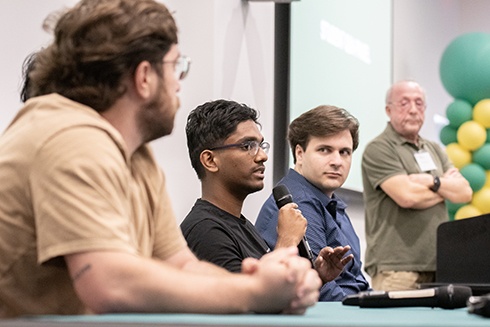
"I think the main takeaway is that research isn't about clear objectives," Gupta said. "You have to do the research. It's about finding something new. Because in previous courses or internships, there were clear objectives to work on, or a clear pathway."
This was different. There was no expected outcome or clear path for him to pursue, even if it didn't lead to a conclusion they expected.
For Joseph, whose research partner wasn't able to attend the symposium, the experience was about the collaborative process.
"It was a great experience working together, and it taught me a lot about the teamwork," he said. "Obviously, we have to read a lot of research papers, and in those papers, if you go down, you see a lot of citations. That shows how research is really intertwined, and not just in your subject, but through a lot of subjects. Research is built and building on past work and trying to improve just a little bit."
Embracing uncertainty in research
That theme of discovery — and uncertainty — was echoed by faculty.
Larry Hall, the college's associate dean of research, reinforced that message, emphasizing that difficulty and uncertainty are central to research.
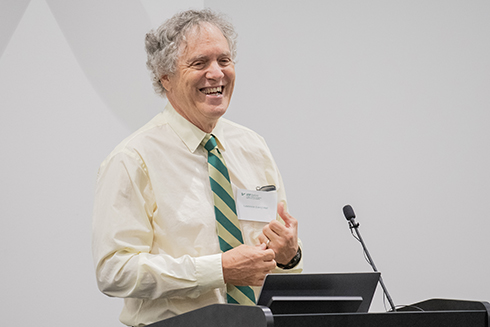
"This is probably the first time that you've done something…and not had immediate success and gotten 100%," Hall said. "I was talking to one group and they were saying, 'Well, we didn't get great results.' These are hard problems. You don't always get great results."
Hall emphasized the journey of the research process is similar to solving real world problems and that not everything is learned in a classroom setting.
"You go in different directions," he said. "You start going this way and realize that doesn't work. There's a wall there, you turn. That's OK. That's different than in a class. In a class you're given a problem and solve it in a specific way."
Hall, who has spent more than 30 years at USF as a researcher, told the audience that while he loves the research, it does have its frustrating moments.
"I really like the research. I find it fun," he said. "Of course, at the same time, I smack my head against things and fail. I can show you big boxes of rejected proposals, but I won't."
Building on a growing research tradition
Now in its second semester, the Bellini College's REU Symposium builds on the momentum that began in the fall as the college expands undergraduate access to research opportunities.
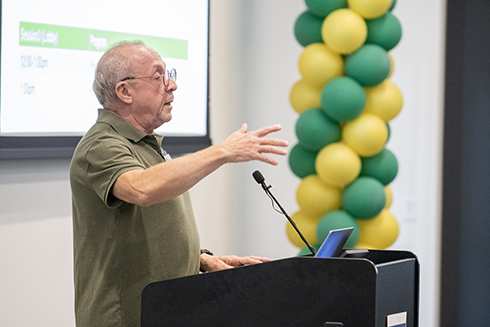
The symposium was organized by Alfredo Weitzenfeld, a professor in the Bellini College whose research interests are in the areas of biologically inspired robotics, robotics learning, spatial cognition and computational neuroscience, wants students to know what all is available to them and to get them interested in research.
Faculty members also used the symposium to introduce their research areas and outline opportunities for undergraduate involvement.
Some of those areas included robotic grasping, NICU infant pain AI, music therapy AI, physical AI for lift assist, mobile assistive robot, AI for electric system design, security of AI integrated systems, generative AI for hardware design, computer system verification and validation. The briefings provided an overview to students of the different research specialties faculty members are involved in and some of the projects that are currently underway in the college.
A platform for student scholarship
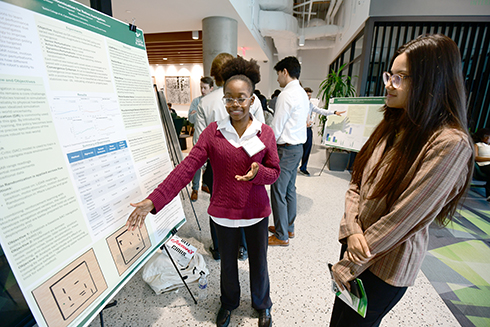
The symposium concluded with students presenting their research posters.
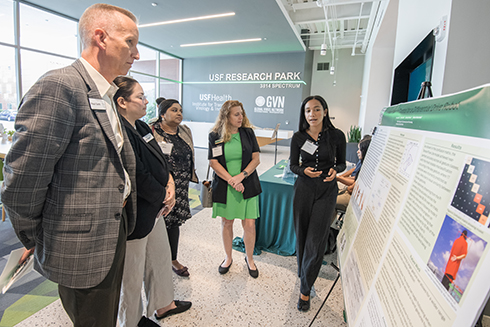
Several explored autonomous and intelligent robotic systems, including navigation, mapping, gesture-based control, gait recognition, delivery robots and biologically inspired approaches to simultaneous localization and mapping. Others focused on human–robot interaction and assistive technologies, with work aimed at social robots, sit‑to‑stand assistance, interactive health applications and expressive robotic behaviors.
The overall best poster winner was Laray Lopez and Seyoung Kan for their poster, "Hand Gesture Control for a Differential Drive Robot." The runner up for the competition was Rinat Mynnakhmetov, whose poster was "RISA: Robotic Interface for Sit-to-stand Assistance."
To download photos from the events please visit our Photo Gallery.