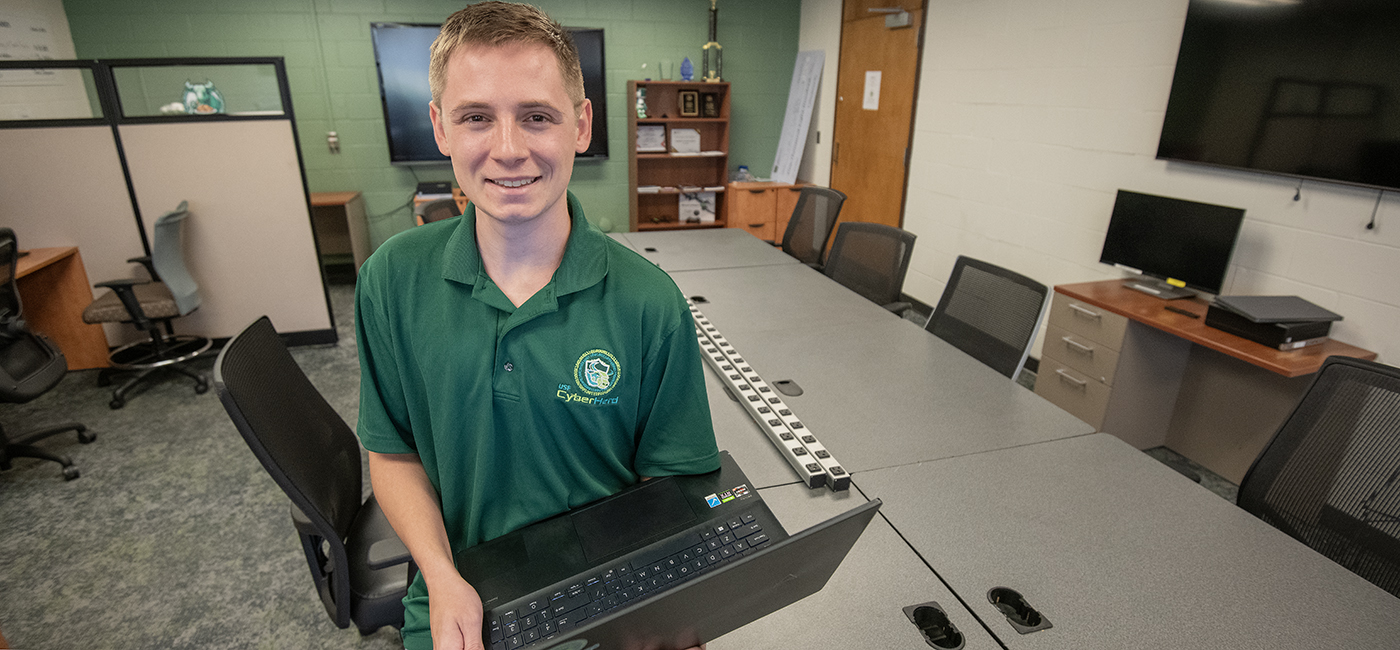
Jackson Liveringhouse left his first meeting of USF's WhiteHatters Computer Security Club with a chip on his shoulder. He didn't know who the student was, but he remembers someone bragging about ranking in the top 1% of users on a competitive hacking website.
It rubbed him the wrong way and became a challenge.
"There was something about the way he said it," Liveringhouse said. "Almost out of spite, I wanted to be in the top 1% on the website, too."
It took a few weeks of grinding it out in front of his computer. He was a freshman and hadn't had much training in cybersecurity, but he hacked away. Liveringhouse's ranking finally cracked the 1% mark. Looking back, he said, the feat isn't that impressive now. His competitive hacking skills are far more advanced. But it was where he began.
That was his first semester at USF. By his second semester, Liveringhouse had become
the WhiteHatter's treasurer.
Now, he's the captain of USF's intercollegiate, competitive CyberHerd
team, which is part of USF's Bellini College of Artificial Intelligence, Cybersecurity
and Computing. He is leading the team and helping his peers prepare for the upcoming
Collegiate Cyber Defense Competition that's later this year.
Preparing for a computer science military career
Liveringhouse became interested in computers during his middle school years, learning basic HTML coding and helping his father's friend build websites for clients. As he learned more, his interest grew into more than a hobby.
"It was just a hobby, and I was just having fun with it," he said. Then came high school and several courses he took, like visual basic and C++, which got him more interested in pursuing it as a degree in college.
At the same time, he also knew he wanted to follow in the footsteps of his family and serve in the military. Both his father and grandfather served in the U.S. Army. Following high school, he joined the National Guard and entered basic training.
"It was always something I wanted to do," he said. "I think it's a very good way to, you know, start off your adult life. It was a way to get out into the adult world and rely on myself versus having to take loans out or relying on scholarships or anything like that."
He has been deployed several times into hurricane ravaged cities in Florida.
Finding his fit
Liveringhouse, who comes from Naples, FL, wanted his collegiate experience to be more than a transaction or knowledge transfer. He wanted to be active in campus life. Shortly after moving in, he explored different technology and computer clubs.
"Part of me was kind of curious about the whole idea of hacking and doing all that kind of stuff," he said.
That's when he found the WhiteHatters. He knew he belonged and immersed himself in the club. He then decided to run for treasurer after the first semester.
But he didn't lose sight of his academic priorities, which were hefty. A double major in computer science and accounting, he knew he had to find a way to balance his finances, mentor other students and practice for competitions.
"That was probably my biggest growth period in my personal skills," he said. "Not only did I now have to deal with the money, but the club is a teaching club. So, I was teaching other members of the club, too."
From Whitehatters to CyberHerd
The CyberHerd team, which began in August 2023, quickly began competing at a serious level. The team started to enjoy podium finishes in hackathons and capture-the-flag competitions. Some of his peers in the Whitehatter's club who were part of the team remembered how the freshman ranked high on the national competitive website. They had seen him perform well in the classroom. They started trying to recruit him to the team.
"They told me, 'Hey, you gotta sign up for this CyberHerd team,'" he said. "So, I signed up and did everything I needed for the tryout."
The commitment level ramped up. Longer practices, higher stakes, tougher competition
and traveling across the U.S.
In the last year, supported in part by CyberFlorida, the team has won several major
competitions and ranked high in others – all against other nationally-ranked
teams.
"Jackson is one of our most experienced members in the team," said Marbin Pazos Revilla, who is the coach of the CyberHerd team and assistant professor in the Bellini College. "He has been exposed to almost every major competition we have participated in: CCDC, CPTC, VIVID, Raymond James CTF and many others, and has rewarded us with critical wins, too. "I vividly remember the moment when he captured the main flag during VIVID in 2024 during the King of the Hill portion of the competition, and the team held on to it until the end and ultimately won first place in the competition."
Liveringhouse is proud of what the team has accomplished in recent years, and he knows they will continue to get better.
"The team's getting better and better, and it's going be disappointing to see how much better it's without me," he laughed. "I want to be a part of it. But I'm also excited to watch people after me, to watch the team get better, and know that I was a part of it."
Pazos Revilla added that it's rewarding to see students excel in competitions, be ready to solve problems and perform well academically.
"However, Jackson goes beyond that, he also serves in the Army National Guard, is always willing to step up and lead the team and mentor new members with humility," he said. "Students like Jackson exemplify the caliber of talent we cultivate at the USF Bellini College of AI, Cybersecurity and Computing."
Broader horizons
In addition the National Guard, Liveringhouse is a member of USF's ROTC program.
That means he spends summers training and is also available for active-duty deployment.
Last summer he attended a cadet summer training where he spent 35 days running infantry operations, just as he would if he were a lieutenant on deployment. The summer before, he trained at Camp Shelby in Mississippi running their internet at the Tactical Operations Center.
"I was running their internet for 16 days with fluctuating power, and people trying to overuse it to play games or check Facebook while it's meant to be used for official stuff," he said.
Then there's hurricane response.
"We've done high water rescues and handed out aid to people," he said. "It's about giving back to your community. It's a great feeling being able to help people who are in need, and it reminds you of what you have."
During his down time from handing out supplies, he also managed to keep up with his studies. Thanks to power generators and satellite connections, he could still access work, lectures and the occasional video game online – when they are available.
But his time with the National Guard isn't just about deployment. It's also a career path that he's learning as he nears his fall graduation.
"After I graduate as a second lieutenant, I'm hoping to get into the National Guard's cybersecurity unit here in Florida," he said.
What's next
Liveringhouse sees his education at USF as critical to where computer science, cybersecurity, and its military applications, are headed. It's part of why the Bellini College was created.
"I do think it is a move in the right direction to have its own college," he said. "This is more than just a field of engineering. It needs its own college because that's where the future is going with this technology. And to say that you're among the first to graduate from USF's Bellini College, I think, has a little bit of prestige."