When Richard Rauscher built the University of South Florida's first version of www.usf.edu in 1994, reshaping the university's future wasn't intentional. As the systems administrator in the College of Engineering, he viewed the work as an interesting technical exercise – hardly the kind of task that draws attention.
After all, he had previously launched several public-facing internet services – such as FTP (file transfer) and Gopher, an early text-based predecessor – without any fanfare.
The idea developed from an informal conversation with a computer science professor. There was no marketing plan, focus group or press release to herald the site's launch.
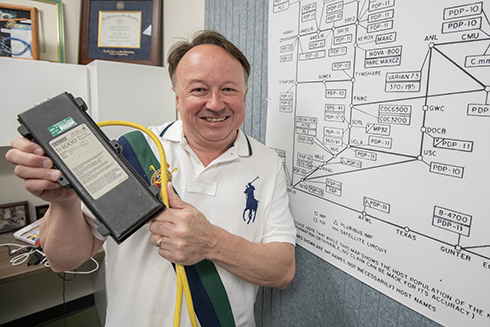
Associate Professor Richard Rauscher holds one of the original USF ethernet tranceivers. Rauscher built the University of South Florida's first version of www.usf.edu in 1994, which ultimately reshaped the university's future. Photo by Jeremy Maready
"I just did it," he said. "It wasn't a big deal. A lot of universities were popping up with their domains, and I thought I'd just put up USF's. There seemed to be a trend to make it called "www" with the domain name. So, that's what I did."
Digital imagery was extremely limited. Digital cameras were not yet common. Pages took minutes to load. Firewalls were nonexistent.
While the screech and static sounds of a dial-up modem still sit in the deep recesses of the brain for many, the technology was cutting edge at the time. USF's website was only one of 3,000 in existence.
"When you were making a website in 1994, most of the people looking at it were either peers or students at another university or they were early adopters to technology. Most had really, really poor home access that would take minutes to load a page, I used to drive to the office on the weekend just to use the high-speed connection USF had," he said.
Now a faculty member in the Bellini College of Artificial Intelligence, Cybersecurity and Computing, Rauscher teaches quantum computing and computer networking. While he is well-versed in the tools of yesterday, he's using the tools of tomorrow to teach this next generation of computing professionals.
And those early challenges of connectivity, scale and security? They are now formal areas of study within the Bellini College.
USF.edu becomes a critical digital infrastructure.
What began as an experiment has become one of the university's most critical pieces of infrastructure.
USF.edu is a critical digital gateway connecting students, faculty, staff and the public to essential information and services. The website has transformed from a collection of links and email address directories to an essential daily utility vital to the university's infrastructure, from admissions and registration to academic programs, library resources, campus news, ticketing, parking and emergency updates.
"The website today is a one-stop hub for the university," Rauscher said.
Long gone are the days of a system operated by a single person. Today, a 15-person team oversees the website's content management system. The site supports more than 300 individual websites and there are about 75,000 pages across USF's three campuses, according to data through 2025. Usage fluctuates throughout the academic year, but the site averaged about 615,000 monthly visitors in 2025.
Performance and accessibility remain a priority, with pages loading almost immediately after navigating to a page. In 2025, USF website data shows desktop users accounted for 57% of site traffic, while 41% accessed the site via mobile devices, reflecting the diverse ways audiences engage with university content.
Just this month, USF launched a redesigned website homepage to improve the user experience. It was the culmination a yearlong research effort that included surveys, focus groups and analysis of website data – not an afterthought.
Early web development helps shape USF's digital direction
At the time, the tools available to build that first web presence were limited, even by the standards of the era.
"We didn't have access to digital photography back then, so a lot of websites were graphic-based," Rauscher said. "The GIF was the only image format that the early web browsers supported. I couldn't even use JPEGs yet."
But putting images on website pages was possible.
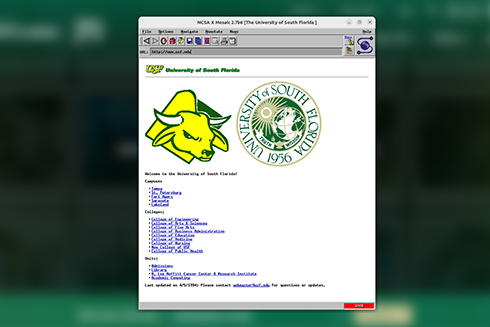
A graphic recreation of the original www.usf.edu website from 1994.
"You'd have to find yourself a flatbed scanner, and you'd have to scanned in," Rauscher said. "That took a while. Then you could potentially put it up there. And then, if you did put the actual picture up there, it would take a person five or 10 minutes to load the page because there's a picture on it."
Most of the content on the website was purely informational, containing links and email addresses for visitors. As the capability advanced, Rauscher updated the site to include photos.
"I put up pictures of University Mall to just let students know there's something here to do," he said. "Tampa was small and North Tampa, even more so. I tried to put stuff up there that potential students might be interested in, but keeping in mind that most potential students – the overwhelming majority of potential students – did not have internet access to that point."
Ken Christensen, professor and associate dean of academic affairs for the Bellini College, arrived at USF in 1995 and remembers the creation of the USF website wasn't significant.
"The full potential of the internet and web was not fully understood at the time," he said. "In the 1990s, all proposals were submitted to the National Science Foundation in paper form. All conference and journal papers were submitted in paper form. All university committee work was done in paper form."
Early internet challenges shape modern cybersecurity
Rauscher and Christensen alike laugh as they recall that there were no passwords requiring special characters, no two-factor authentication and no password vault apps.
"It still didn't take long for shenanigans to happen on the website," Rauscher said. "Maybe six months."
"I put in some of the first firewalls on campus because when the internet started exploding, people started to do things that they shouldn't," he said. "They kind of invited that because it was a new frontier of sorts."
The internet was still a small community. As it grew, so did the problems in securing information from mischievous actors.
"You know, if we got a user misbehaving someplace, well I'd pick up the phone to the person who ran the computer (at another university) that the guy was on, and I'd call him and I'd say, 'Hey, this guy's causing trouble.' Then, he'd go find them and chastise them and that is what happened."
In those days, there wasn't much hacking. Sensitive information wasn't being shared, mostly.
"There wasn't a lot of commerce on the internet at the time, so there wasn't a lot of motivation for people to be professional hackers like they are today," Rauscher said. "People would break into things to read each other's emails and intentionally break systems. The places from which attacks occur today didn't have the internet 30 years ago."
In some instances, that meant breaking into the website and deleting all the files, leaving Rauscher and others to go back and retrieve 8-millimeter data tapes to restore the information.
Cybersecurity isn't an afterthought. It is a priority.
What once required a phone call between university administrators now demands a global workforce trained to defend elections, hospitals, energy grids and national security systems.
Today's cybersecurity professionals are responsible for protecting critical infrastructure from threats that didn't exist 30 years ago. And those attacks can have profound consequences if not monitored and addressed.
Careers in cybersecurity are in demand. Nationally, employers posted 27,000 job openings on Indeed.com in the last year, according to data from Gray Decision Intelligence, with entry-level salaries of about $70,000 for bachelor's degree graduates and about $85,000 for those with master's degrees.
That's why it's a focus of hands-on classroom learning through the Bellini College.
"Platforms like Hack The Box let students actively engage with real-world scenarios rather than just learning theory," said Mackenzie Freel, who is in her senior year majoring in cybersecurity. "Instead of only reading about vulnerabilities or attacks, we're expected to think like attackers and defenders at the same time and work through realistic problems.
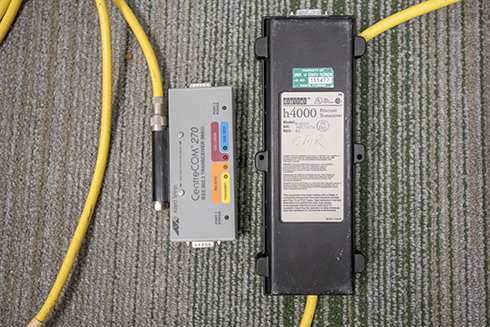
One of the original USF ethernet tranceivers that helped make the University of South Florida's first version of www.usf.edu possible in 1994. Photo by Jeremy Maready
"Learning cybersecurity now means understanding that attacks don't just affect individual systems, they can impact elections, infrastructure, health care and entire countries," Freel said. "That adds a level of responsibility and gravity to the field that didn't exist in the same way before."
Jacob Sotel-Jackson, a USF computer science graduate and one of Rauscher's former students, said the landscape facing tomorrow's computer engineers and cybersecurity professionals is still evolving.
"The role of cybersecurity continues to expand with the ever-changing and expanding cyber landscape," said Sotel-Jackson, who now works for the U.S. Space Force. "AI and LLMs gained notoriety while I was in school, and those tools have become targets of attacks, attack tools and defense tools all at once."
Over the course of three decades, the problems once solved informally by computer engineers – website development, cybersecurity and managing systems -- have matured into separate global industries, he said.
Who will shape what comes next?
USF faculty and researchers are focused on preparing students for a workforce being transformed by technology. John Licato, an associate professor and director of the college's Advancing Machine and Human Reasoning Lab, calls AI a force reshaping how people learn, work and solve problems.
"AI is very possibly the most impactful technology many of us will see in our lifetimes," he said. "It affects every single field of study, and every single job on earth."
He said today's AI boom is part of a much longer story, one where each generation of technology builds on the last, accelerating what students can create, discover and defend.
"Moore's law says the number of transistors we can fit on a microchip doubles roughly every two years. That's no longer the case, but if we generalize that to: 'The capabilities of our computational systems double roughly every two years,' then it continues to hold. The substantial advances in AI of the past few years are just the next stage of this capability increase."
Licato says the responsibility of educators is growing alongside the technology's influence.
Student Freel agrees.
"AI and automation are becoming increasingly integrated into coursework," she said. "This reflects the reality of the modern cybersecurity workforce, where AI-assisted tools are commonly used for research, analysis, scripting and efficiency. Learning how to use these tools effectively and ethically as a student prepares us for how cybersecurity work is actually done in practice."
Through its interdisciplinary curriculum, research-driven learning and industry-aligned programs, the Bellini College aims to prepare students not only to use emerging AI, computing and cybersecurity tools, but also to help shape how those tools are put to use in the modern workforce.
As USF celebrates its 70th anniversary, the evolution of its digital front door – from a single, hand-coded website to a global platform supporting tens of thousands of students –mirrors the university's broader transformation into a national research and innovation leader.