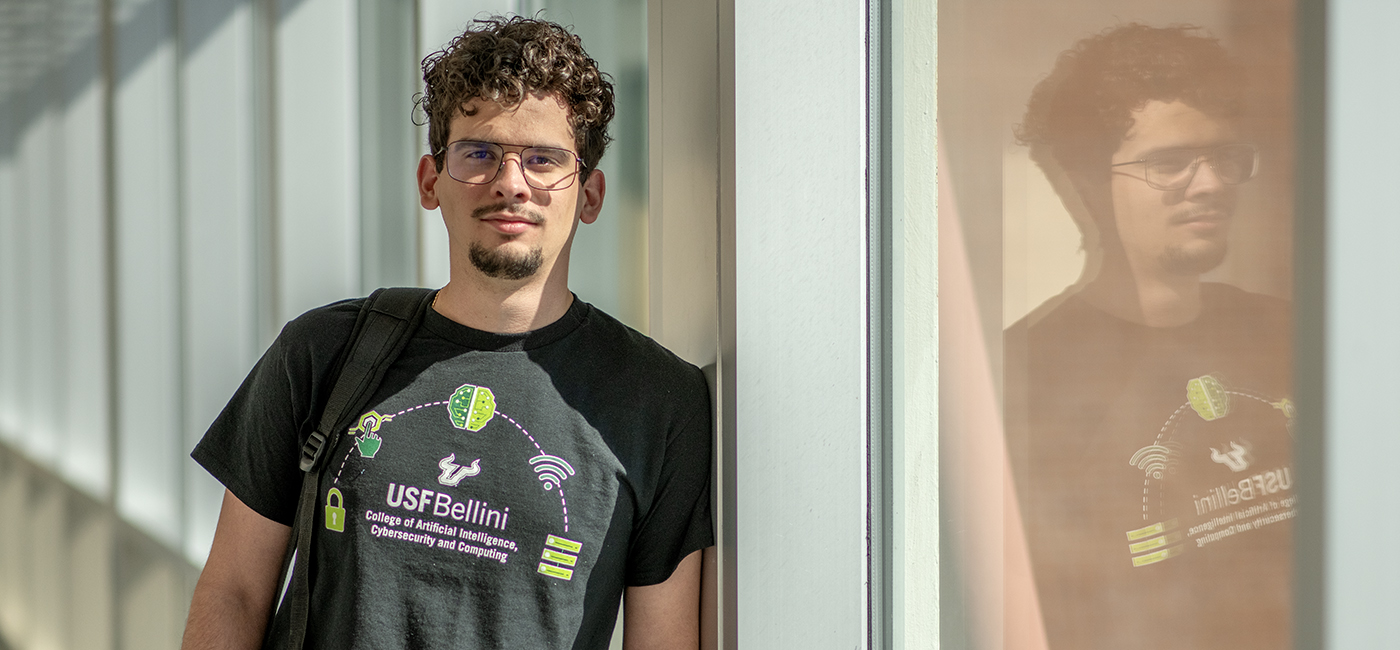
Cristian Hernandez grew up without Internet access.
For a kid enamored with video games, that meant no online gaming. No interaction with other players. For a dreamer who loved computers and how they worked, it meant limited resources and fewer windows to the outside world.
"If you wanted to learn something, you had to read books or talk to people who knew a little bit about it," he said, recalling his childhood in Cuba. "Oh, we had all the games back then. Fable, Far Cry, Minecraft – but there was no interconnection. You were just on your computer playing the game. I played all by myself."
Still, his curiosity pushed him to create. Using only PowerPoint, Hernandez built his own interactive storytelling game using slides. Depending on which hyperlink a user clicked, the story moved to a different slide and unfolded a different direction.
"I was just working with the sources I had," he said. "It was pretty limited."
If you can't see it, how can you be it?
His creativity hinted at his potential. But because he had no internet access, the youngster had no idea that computer science could be a career or that people could support their families playing and creating online games.
That all changed when he was in the ninth grade.
When Hernandez was in elementary school, his father left Cuba to work in the U.S. He wanted to build a pathway toward citizenship for himself and his family. Eventually, Hernandez, his mother and younger brother also immigrated to the U.S. and started a new life in Florida.
Hernandez, now a senior in USF's Bellini College of Artificial Intelligence, Cybersecurity and Computing, entered Florida's public school system in ninth grade.
The transition was difficult.
"I came with absolutely no English experience," he recalled. "I didn't even know how to say hello. My high school start, those first few weeks, was absolutely a disaster for me. I was crying all the time, feeling bad all the time."
But he saw new things and discovered the computing career path.
"As soon as I came to this country and knew that it was a career path, I wanted
it," he said. But he had to survive high school first.
The cultural shift was frustrating. Hernandez had been a strong student in Cuba and
struggled to understand why he wasn't succeeding in the classroom in the same
way. So, he focused harder.
Within a month, he was able to understand spoken English. Within two months, he was comfortable writing. Speaking took longer.
"I never really got to talk in English until about a year," he said. "I would say basic stuff. If I had a question, I would ask it."
As his confidence grew, so did his grades.
"I was so focused on trying to do well in school. The only real experience I got was when I did an AP computer science class and that was about it. I did some courses online, but they were simple and I didn't take them seriously."
But he didn't lose focus on the career he knew was for him.
Turning passion into purpose
Hernandez planned to attend USF after high school, but he chose to go to Hillsborough Community College to save money.
"I wanted to get those two years done in a more affordable way," he said.
After earning an associate degree, he transferred to USF. At first, it was big and a little bit scary. But it also was everything he had worked toward.
"I made it through," he said. "I've loved my experience at USF and the environment."
Through his coursework, Hernandez discovered a passion for algorithms, data structures, software engineering and mobile robotics. He balanced his studies while working at Chick-fil-A and Publix — building both discipline and determination.
Now, he is interning with the Institute of Applied Engineering, contributing to a research project that enables two different systems to communicate with one another.
"The communication with that happens through a middleman," he said. "And I am working on that middleman."
He's found the internship is far different from textbooks and classrooms where concepts and theories are discussed. Here he gets to apply what he's learned to real-world issues. He's hopeful that it turns into a full-time position once he graduates.