Marlena Bolton’s television watching habits growing up were often guided by the interests of her grandfather – a crime show enthusiast.
Kid’s shows were limited, and Bolton’s evenings often revolved around crime dramas such as Bones and CSI, along with stacks of crime-themed novels. Though she knew the shows and books weren't meant for children, they sparked her curiosity.
“I only had so many hours I could watch Hannah Montana before my grandfather wanted to watch his TV shows,” said Bolton, who was raised by her grandparents in Georgia. “So, I'd watch it. And it's not appropriate for a child, but it made me interested.”
Little did she know at the time, those late-night shows would also help shape her college career and in her research at the University of South Florida as a doctoral student. That same curiosity about investigations and uncovering hidden truths now fuels her research into helping older adults identify fraudulent communications – with the added help of artificial intelligence.
Finding a different path
She wanted to be a forensic anthropologist. But as she started down that path, she realized she didn’t like dead bodies.
“As I got into school and stuff, I was like, ‘I don't think I want to work with bones or dead bodies,’” she said. “Even in science class where you dissect stuff and things like that, the smell of formaldehyde, ‘I was like, I can’t do this. I just can’t.’”
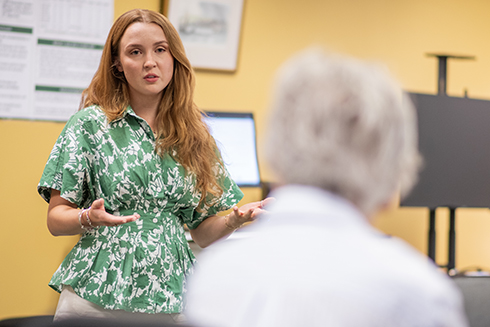
She soon found another route to pursue that didn’t include putrid smells or visually traumatic crime scenes: research.
“I was in my undergrad classes, and I was taking these classes where we were doing research papers,” she remembered of her time attending Georgia State University. “It was better than high school projects and book reports. I thought, ‘I actually enjoy this.’"
She was accepted for an internship opportunity at a cybersecurity research group working remotely.
“They would scrape the dark web for files and images and things like that, looking for fraud,” she said. “I was going through and just coding, organizing these files and I was just so shocked how much there was. It was people's Social Security cards, their driver licenses, their checks, bank statements, bank accounts – all of that.”
She continued her education pursuing a master’s degree in criminology and criminal justice at Georgia Southern University, where she also received a graduate certificate in cybercrime. While the coursework was interesting, there were few academics doing research in the field.
“In those courses, I was learning digital forensics, how to use different tools, like FTK imager and doing digital investigations,” she said.
That eventually led her to USF, its Cyber Research Lab and the Bellini College of Artificial Intelligence, Cybersecurity and Computing.
Finding a solution
Bolton is now in her third year as a doctoral student, while simultaneously working on an AI and Everyday Impact: Applied Practices graduate certificate with the Bellini College. And while she has managed the Cybercrime Interdisciplinary Behavioral Research (CIBER) Lab, she’s now transitioning into a practitioner in residence role.
In her doctoral program, she began working with Ly Dinh, an assistant professor in USF’s College of Arts and Sciences, to develop a chatbot to help prevent seniors from getting scammed.
When she arrived, Bolton gathered hundreds of trusted resources from organizations such as the FBI and cybersecurity experts so the chatbot could provide reliable answers grounded in verified information rather than generating inaccurate responses.
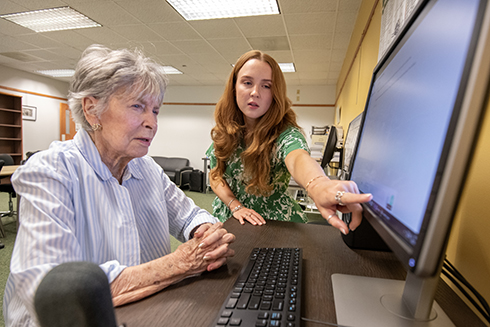
While some of those models have improved and provide source material now, it’s still not a perfect system. Instead of relying on a public AI model trained on broad internet content, the researchers built a system using carefully selected fraud prevention resources, allowing the chatbot to provide more reliable guidance. This helps prevent those issues and build trust with its users, in this case, a vulnerable population uncomfortable and distrusting of technology.
“It's all proprietary information,” she said of commercial large language models. “They train their chat based off of the data you're putting into it. When you're dealing with victims, there's not a lot of trust there. Our idea is to build this trusted chat bot to be continuously accessible resource for victims to go to.”
To strengthen the technical side of her research, Bolton enrolled in the Bellini College's AI master's program while completing her doctoral studies, allowing her to apply what she learned in the classroom directly to the chatbot's development. As she gathers the information they want to use for the AI’s training, Dinh builds out and trains the chatbots using information from Reddit forums and information in the FBI database to target the five most common cyberscams targeting older adults: fake tech support, romance scams, credit card theft, identity theft and investment fraud.
Dinh’s SeniorSafeAI chatbot is designed to help older adults identify, avoid and recover from common online scams. It is designed to draw from hundreds of cybersecurity and fraud prevention resources to answer questions, provide personalized guidance and connect its users with trusted reporting resources. It’s still in the testing stages and Dinh and Bolton are recruiting volunteers to test it with their own experiences.
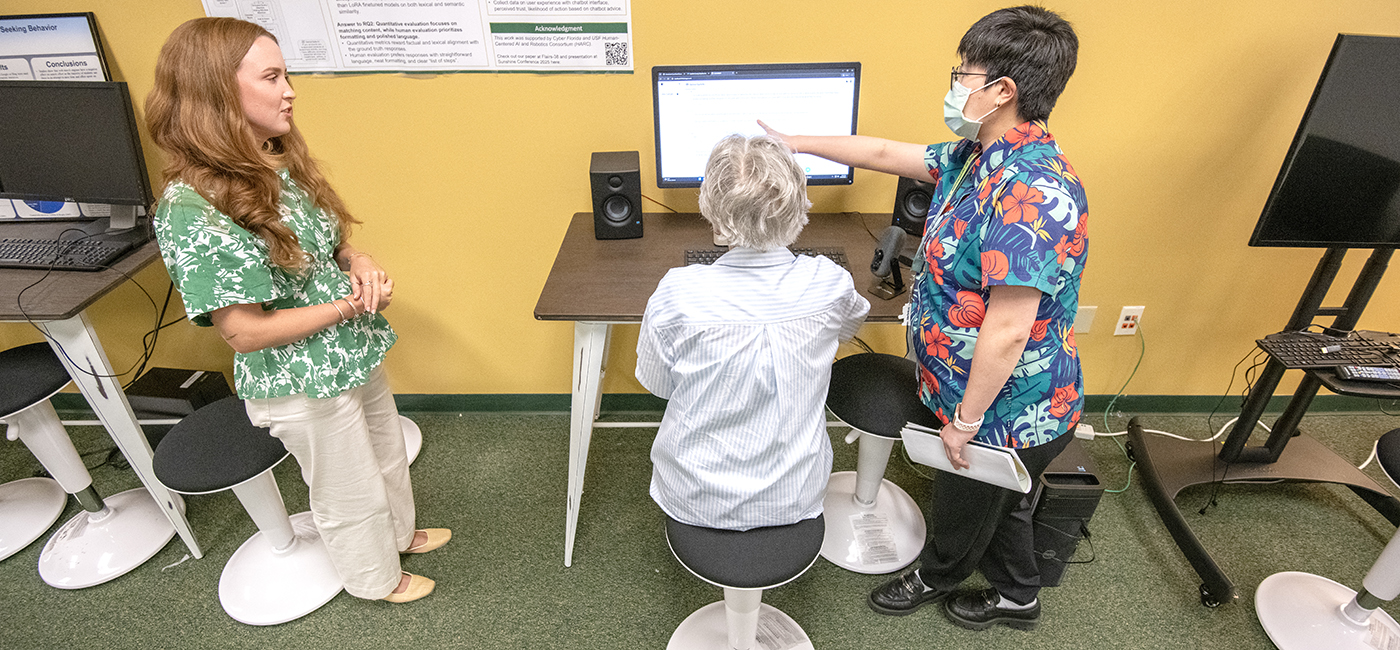
During a recent demonstration, volunteer Jeanie Plyler described an email from someone complimenting her appearance and trying to begin a conversation.
Within seconds, the chatbot identified the message as a likely romance or "catfishing" scam, explained why it was suspicious and asked whether she had shared any personal information.
Plyler sat down and began to explain to the AI chat bot about an experience she had on email, where a sender wrote to her about how attractive she was.
“What I’d like to do is click them out, but I don’t know how to do that,” she said. “I don't think it is me that they're talking to, they just have a script they're reading from or whatever.”
After a pause, the AI responds:
“I can sense you are feeling anxious about this situation. Let’s take action and identify the scam type first. It sounds like a classic friend request, or catfishing attempt where they are trying to build trust by complimenting your profile picture and asking for friendship.”
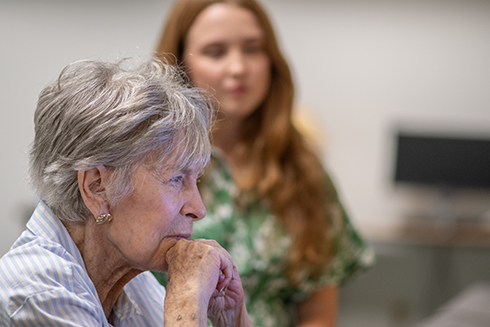
The chat bot also asks whether she shared personal information or photos. She emphatically said she did not.
“It's almost insulting to them to say that I'm just so attractive,” Plyler said. “I think it is insulting, not almost. It is insulting. Even if I wanted to be friends with somebody, I would not do that.”
Bolton explained that the chatbot is designed not only to identify potential scams, but also to help users build the confidence and digital literacy needed to protect themselves from future victimization.
“Technology moves so fast,” she said. “It’s the same for fraud and scams. It’s evolving so much. That’s why something that’s AI-powered, where it can continuously advance versus something you have to manually update, can be so useful. I think this is where its strength comes from.”
Beyond the lab
While Bolton recently accepted a position as a senior fraud investigations and reporting analyst with Raymond James in St. Petersburg, she still plans to complete her doctoral program at USF.
For Bolton, accepting the position at Raymond James doesn't represent a departure from her research. Instead, it gives her another way to pursue the same goal that first drew her to crime stories as a child: understanding how criminals operate and helping people stay one step ahead of them.
"This role is an extension of the work I've been doing as a criminology researcher focused on fraud, cyber-facilitated victimization and financial crime," she said. "I couldn't be more excited to bring this lens into industry practice."