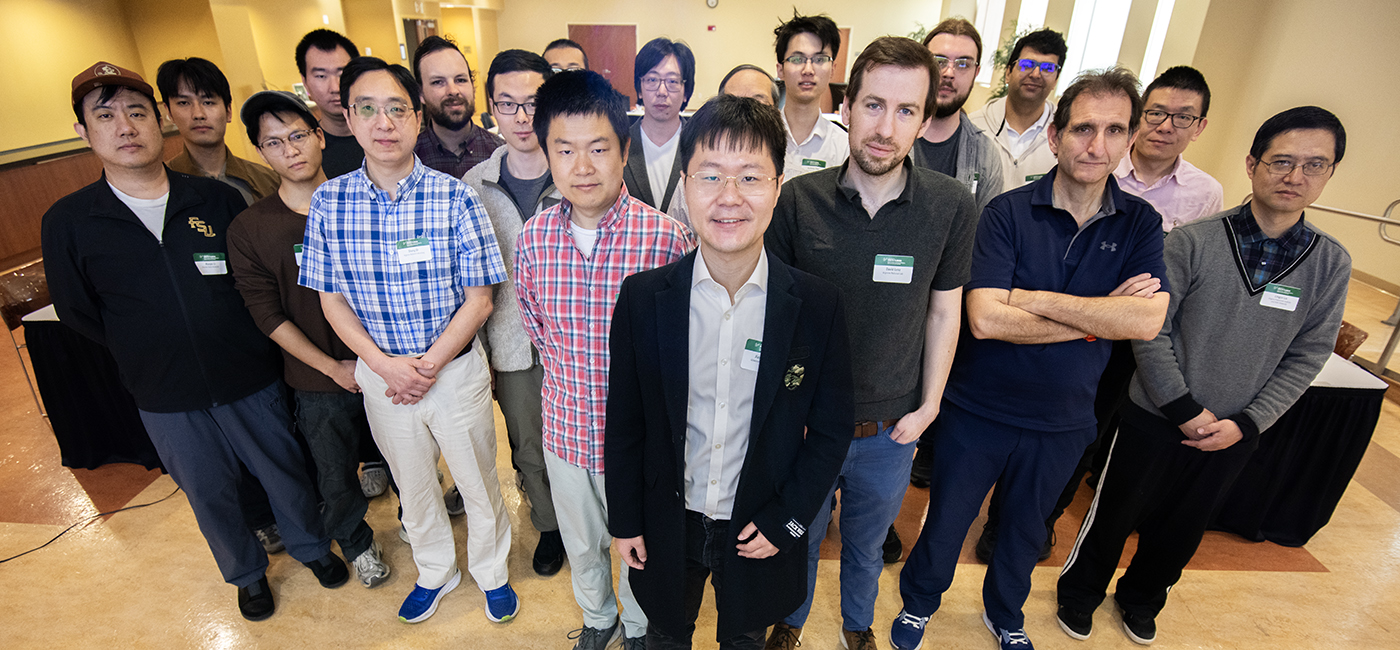
Researchers from leading universities and national laboratories attended this week's two-day FZ–ZF Joint Workshop at the University of South Florida, focused on advances in high-performance computing and scientific data compression.
Hosted by USF's Bellini College of Artificial Intelligence, Cybersecurity and Computing and organized by Assistant Professor Jiajun Huang, the workshop brought together experts from academia and federal research labs to explore emerging technologies for processing, storing and analyzing massive scientific datasets.
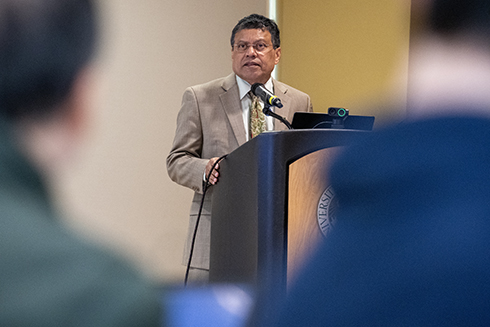
USF Provost Prasant Mohapatra speaks to the aresearchers at the FZ-ZF Joint Workshop.
"At the University of South Florida, we have made significant and strategic investments in high-performance computing, advanced data systems and research computing infrastructure," USF Provost Prasant Mohapatra said. "These investments are designed to support interdisciplinary discovery across our campuses and to enable our researchers to tackle increasingly complex scientific challenges."
The workshop featured presentations from prominent researchers in HPC and data-compression, including Franck Cappello, a senior computer scientist at Argonne National Laboratory and the University of Chicago, an IEEE and ACM Fellow, and recipient of the 2024 IEEE Charles Babbage Award for his work in high-performance computing and data reduction.
Also presenting was Sheng Di of the University of Chicago and Argonne National Laboratory, co-founder of the SZ Lossy Compression framework and an ACM Distinguished Member recognized for his contributions to error-bounded scientific data compression.
Additional insights were shared by Lingjia Liu of Virginia Tech, an IEEE Fellow and co-director of Wireless@Virginia Tech, whose research explores machine learning for next-generation wireless networks.
The workshop also included faculty and researchers from Indiana University, Florida State University, the Ohio State University, Oakland University, Oregon State University, UC Riverside, the University of Helsinki, George Washington University, Texas Tech University and the University of Iowa.
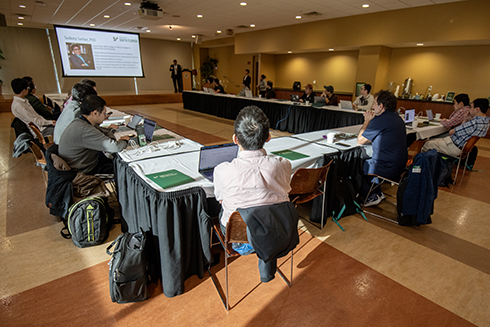
Researchers from leading universities and national laboratories attended the two-day FZ–ZF Joint Workshop.
"Scientific applications and AI are producing data at unprecedented rates," Huang said. "This workshop brought together the core research community tackling that challenge and hosting it at USF reflects our commitment to being at the forefront of high-performance computing and AI research. We had engaging discussions across all sessions, from new compression algorithms and GPU acceleration to AI for science and scientific visualization, and I'm excited to see the research directions that emerge from the collaborations formed here between universities and national laboratories."
The FZ–ZF Joint Workshop underscores the importance of partnerships among universities, federal research laboratories and industry collaborators. As scientific applications grow, advances in high-performance computing and compression technologies will be critical to accelerating discovery across fields such as climate modeling and materials science to biomedical research and artificial intelligence.
"Across engineering, computing, public health, geosciences, cybersecurity and the life sciences, USF faculty are leading cutting-edge work that relies on large-scale data, advanced simulation and AI-driven applications," Mohapatra said. "Our goal is to make sure that our researchers have the tools, platforms and an environment that will foster collaborations as we push the boundaries of discovery."