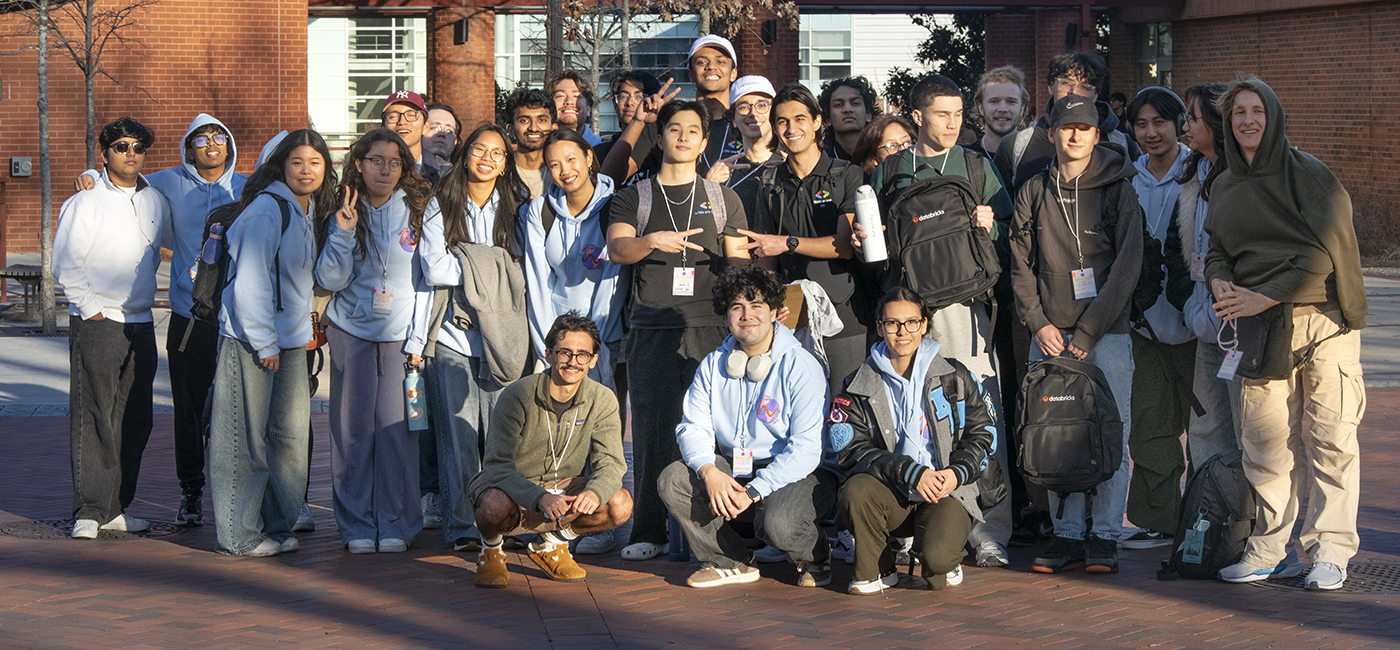
It came down to the final minute for the University of South Florida's Google Developer Group at the Hacklytics 2026 Golden Byte hackathon at Georgia Tech.
After 36 hours of building their anxiety-calming wrist device and companion app, the team had just 60 seconds left to submit their project, the difference between disqualification and acceptance by judges.
They made it in time and won the competition, marking the group's first major victory against top-tier universities.
"That was a little scary," said Jhoon Yi, the group's vice president. "We were able to just get everything working at the very last minute and submit it before time ran out."
The prize: a MacBook Air M4 laptop for each team member, which also included Kalyan Castro de Oliveira, Deep Akbari and Gustavo Galvão e Silva. Several are students in USF's Bellini College of Artificial Intelligence, Cybersecurity and Computing, which emphasizes hands-on innovation and real-world problem solving.
Hacklytics is the Georgia Institute of Technology's annual data science, AI and analytics hackathon. More than 1,200 students from 200+ universities signed up to build data-driven projects over a single weekend.
Brainstorming the solution
Preparation for a hackathon is a cross between creative brainstorming and strategic planning. The object is to identify a problem and find a solution – or hack – for it.
In the case of Hacklytics, teams select one of five tracks to identify and solve. For the USF Google Developer Group, they selected the health care category. The goal: to innovate in "bioinformatics, patient care and personal health technology."
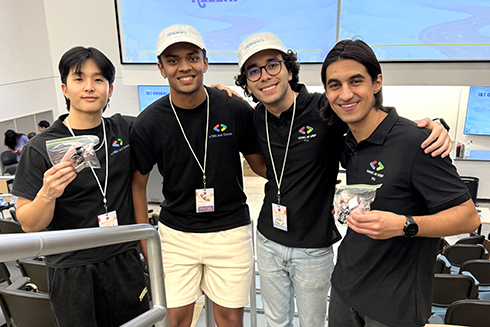
The USF team brainstormed what they wanted to accomplish: a medical hardware device that used two wristbands, equipped with vibration motors, that could reduce a person's anxiety.
They called it - Alleaf. Complete with the tag line: Alleviate. Relief. Turn over a new Leaf.
For Yi, an information technology senior, the project was more than a competition, it was personal.
"I have friends and family who have mental health issues with anxiety," he said. "So, that was my focus, and we were able to come up with the idea – going off a clinical technique called bilateral stimulation. Basically, what this means is just that you're stimulating both sides of your body."
The group's research focused on bilateral stimulation — a clinical technique that rhythmically stimulates both sides of the body to help interrupt the physiological fight-or-flight response. "You could trigger our device, which is kind of a crazy looking thing," he said. "They're supposed to act as wearables, so you put on both wrist straps. If your heart rate spikes, and you're having a panic attack, then the app would automatically trigger our wearable to do the bilateral stimulation to calm you down and put you in a more relaxed state."
That's all the pre-game prep. Then comes the competition.
"You want to come up with the idea beforehand and plan on how you can execute it," Yi said. "So, when it comes to the actual event, you're not eating away at time on, 'What should I make? How should I make it?' That's already kind of figured out."
Hacking against the clock
Teams officially began hacking after an opening ceremony on Feb. 20.
"And that's as soon as 9 p.m. hit, we started with the actual execution of coding and with building the hardware. Then from that point on, we have 36 hours in total – until 9 a.m. on Sunday – to complete our build application and everything. Then we hope that everything is working together."
But not everything goes smoothly.
"Of course, there will be kinks along the road where your plan will not always
go to plan," Yi said. "But you just kind of have to work around that to
get a final product done within those 36 hours."
Time ticked down while they worked.
"The only slip up we had was there's something called, Integration Hell, which is where you have all your components built, but now you've got to actually put them together," he said.
Then it came time for demonstrations in front of the judges.
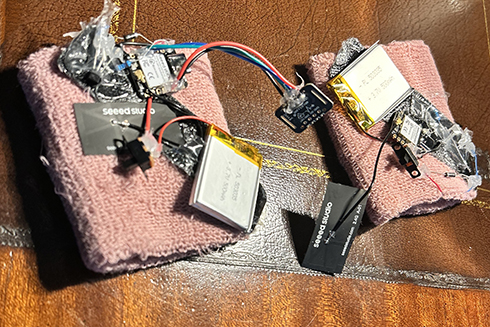
The team developed this medical hardware device that uses two wristbands, equipped with vibration motors, that can reduce a person's anxiety.
"Everything was pretty much working together and successful, so we were able to demo really well for the judges," Yi said. "We put the devices on their wrists, we were tracking their heart rates and also going through our guided meditation app. Instead of just building this prototype for the hardware, we wanted to take a step farther in terms of building a companion application to go directly with the hardware."
Yi said the team's idea for the app was to get away of the same types of meditation apps that relied on methods like counting techniques.
"But we wanted a different approach," Yi said. "We wanted to have a mental health app and an actual hardware wearable to pair with it. Then we can could put them together so it's more immersive for the user and actually more beneficial."
The app includes features such as gratitude journaling, exercises and an AI personalized therapist.
"There's a lot that went into it. Another selling point we had was to use something called AI agents with a vector database to create a personalized AI therapist."
The app-based therapist is not a licensed therapist but could offer a more affordable option for people who cannot access traditional therapy. It's designed to follow therapeutic guidelines and keeps track of conversations to maintain context for users.
The team envisions USF hosting similar competitions in the future, something Bellini College leaders are open to supporting.
But don't expect the competition to solve the same problems. They want new ideas and new problems to hack.
"You want to create new solutions to new problems that want to be addressed and solved from these hackathons. It's a space where creativity meets technology."