People
Faculty
Mark Rains

Professor, USF School of Geosciences; Chief Science Officer of the State of Florida, FDEP
I am an ecohydrologist with a B.A. in Ecology, Behavior, and Evolution, an M.S. in Forestry, and a Ph.D. in Hydrologic Sciences. My research is focused on hydrological connectivity from ridges to reefs, especially between hillslopes, wetlands, and headwater streams; the roles that hydrological processes play in governing ecosystem structure and function; and the roles that science plays in informing water-related law, policy, and decision-making. I have extensive experience in consensus building at the intersection of science and policy in wetland regulatory programs, including past and ongoing work providing the scientific justification underlying the federal definition of “waters of the US” subject to regulation under the Clean Water Act. I routinely contribute to this scientific debate in the legal arena, including two cases heard by the U.S. Supreme Court (i.e., Borden Ranch Partnership and Angelo K. Tsakopoulos, Petitioners v. United States Army Corps of Engineers and Environmental Protection Agency, 537 U.S. 99 [2002]; County of Maui, Petitioner, v. Hawai’i Wildlife Fund; Sierra Club-Maui Group; Surfrider Foundation; West Maui Preservation Association, Respondents [2019]).
Kai Rains

Research Associate Professor
The central theme of my research is ecosystem response to environmental stress such as inundation, disturbance, and soil nutrient limitations. I study response at the organismal level, including root growth and mycorrhizal associations and at the landscape level such as application of geospatial tools to natural resource assessment with a focus on waters and wetlands.
Edgar Guerron-Orejuela
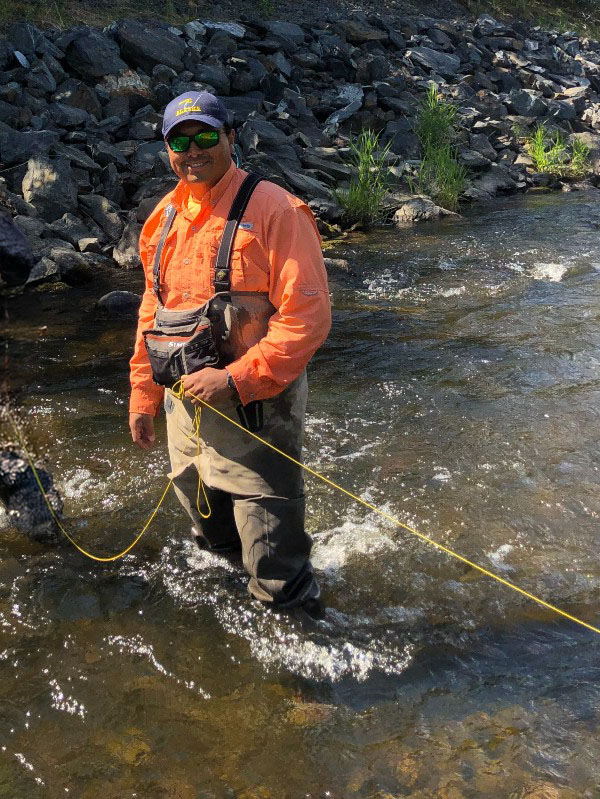
Postdoctoral Fellow, School of Geosciences, University of South Florida
My drive to understand and communicate the interconnections between nature and people has guided my research toward serving diverse communities in Alaska and Florida by building shared knowledge of natural and social resources. My work focuses on the influence of hydrological processes on social–ecological systems. I draw on hydrogeologic and remote sensing data, qualitative methods, and the co-production of knowledge to develop vulnerability models that integrate both physical and social dimensions. In addition, I am developing a growing interest in circularity, with a particular focus on the role of water in circular systems and its societal implications. Much of this work has been centered in Ecuador, where I collaborate with colleagues and communities to better understand how circular approaches can contribute to sustainable resource use, resilience, and environmental management.
Hilary Flower

Associate Professor of Environmental Studies, Eckerd College
Courtesy Associate Professor, University of South Florida
My research pursues the questions: As sea level rise and climate change increasingly threaten low-lying states like Florida, what are the ecological consequences? And how can we build resilience to a ramp disturbance that is unprecedented and uncertain? The Everglades is the testing ground for my work, because the needs for actionable science are pressing, and I feel a strong personal connection to the landscape and its wildlife. My work is funded by the National Science Foundation as part of the Florida Coastal Everglades Longterm Ecological Research Project. I have applied a range of tools to address my overarching questions. I have done field work, benchtop geochemistry experiments and geochemical modeling to investigate how saltwater intrusion into coastal aquifers will affect nutrient availability in overlying estuaries as sea level rises. I am currently working on a series of numerical modeling projects at the landscape-scale using the Everglades Landscape Model. Our recent (2017 and 2019) papers offered glimpses of three possible ecological responses for the Everglades under different sea level rise and climate change scenarios. I am expanding upon this research through investigations into the geochemical reactions that govern nutrient release when seawater intrudes in coastal aquifers. Whether I’m working on the molecular or landscape scale, I thrive on the cycle of curiosity and discovery. I am dedicated to dissolving barriers for people from underrepresented groups to bring their talents and brain-power to further push the boundaries of scientific knowledge.