By Josh Napier, College of Arts and Sciences
A gravedigger is working alone in a churchyard on a cold, clear night.
He looks up and sees a figure sitting on a tombstone: long legs crossed, shoes that curl up at the toes, a tall hat white with frost. Its tongue is out. It's grinning at him.
Then the church windows light up, the organ plays and "whole troops of goblins" pour in and start playing leapfrog over the gravestones. They carry him off underground.
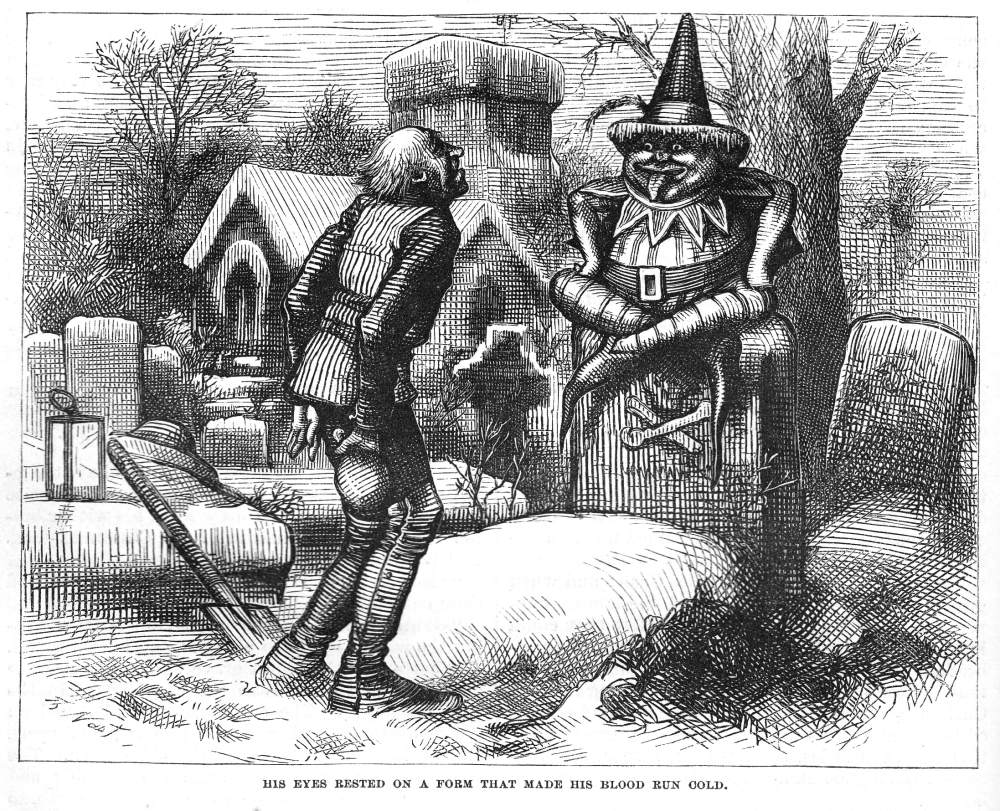
A goblin grins at the gravedigger Gabriel Grub in Thomas Nast's illustration for Charles Dickens' "The Story of the Goblins Who Stole a Sexton," a Christmas tale. (Thomas Nast, from the 1873 Harper & Brothers edition of "The Pickwick Papers." Public domain; scan courtesy of Philip V. Allingham / The Victorian Web)
This excerpt reads like it takes place on Halloween, but it’s actually a Christmas story. The scene comes from Charles Dickens' short story "The Story of the Goblins Who Stole a Sexton" (1837), which takes place on Christmas Eve – a setup he would use again six years later for Ebenezer Scrooge in “A Christmas Carol.” Matt King, an associate professor of history at USF, uses it to make a point.
"For a long time, goblins were associated with Christmas," he said.
The Christmas connection is one of many surprises in King's new book, "A History of Goblins" (Palgrave Macmillan, 2026), which follows the mythical creature over nearly 1,000 years — from its first appearance as a demon tamed by a saint in writings from the Middle Ages to the short, pointy-eared creature we know from books and movies like “The Hobbit” and the “Harry Potter” series. More recently, goblins have become an unlikely symbol of self-expression. What connects these transformations, King argues, is the goblin's enduring place outside society's idea of normal.
But goblins weren't always considered monsters by those who believed in them. For many, they were simply part of a supernatural world that existed alongside Christianity, even as church authorities sought to discourage those beliefs.
King, who teaches the Middle Ages and historical methods at USF, said the book grew out of years of reading sources that he described as "primarily written by crotchety old monks who don't like the way that peasants are thinking about Christianity." The peasants happily believed in Jesus and in the elves, fairies and goblins in the woods, all at the same time. The monks did not.
For centuries, versions of the goblin went by many names, including the Spanish duende and the Scandinavian nisse. The boundaries between these creatures — and between goblins, elves and fairies — were often less distinct than they are today.
One of King’s most surprising discoveries during his goblin research came from rereading "A Midsummer Night's Dream." Puck, he realized, is also called Hobgoblin. For centuries, he said, people drew no real line between a goblin, an elf and a fairy. Children's books and the stage sorted them out in the 1700s and 1800s. Fairies got to be kind, and goblins went underground and turned nasty.
"That's why your kids are visited by the tooth fairy," he said, "and not a tooth goblin who might yank it out of their mouths."
The Halloween question is a piece of that longer story: how did goblins end up on this side of the calendar?
From Christmas to Halloween
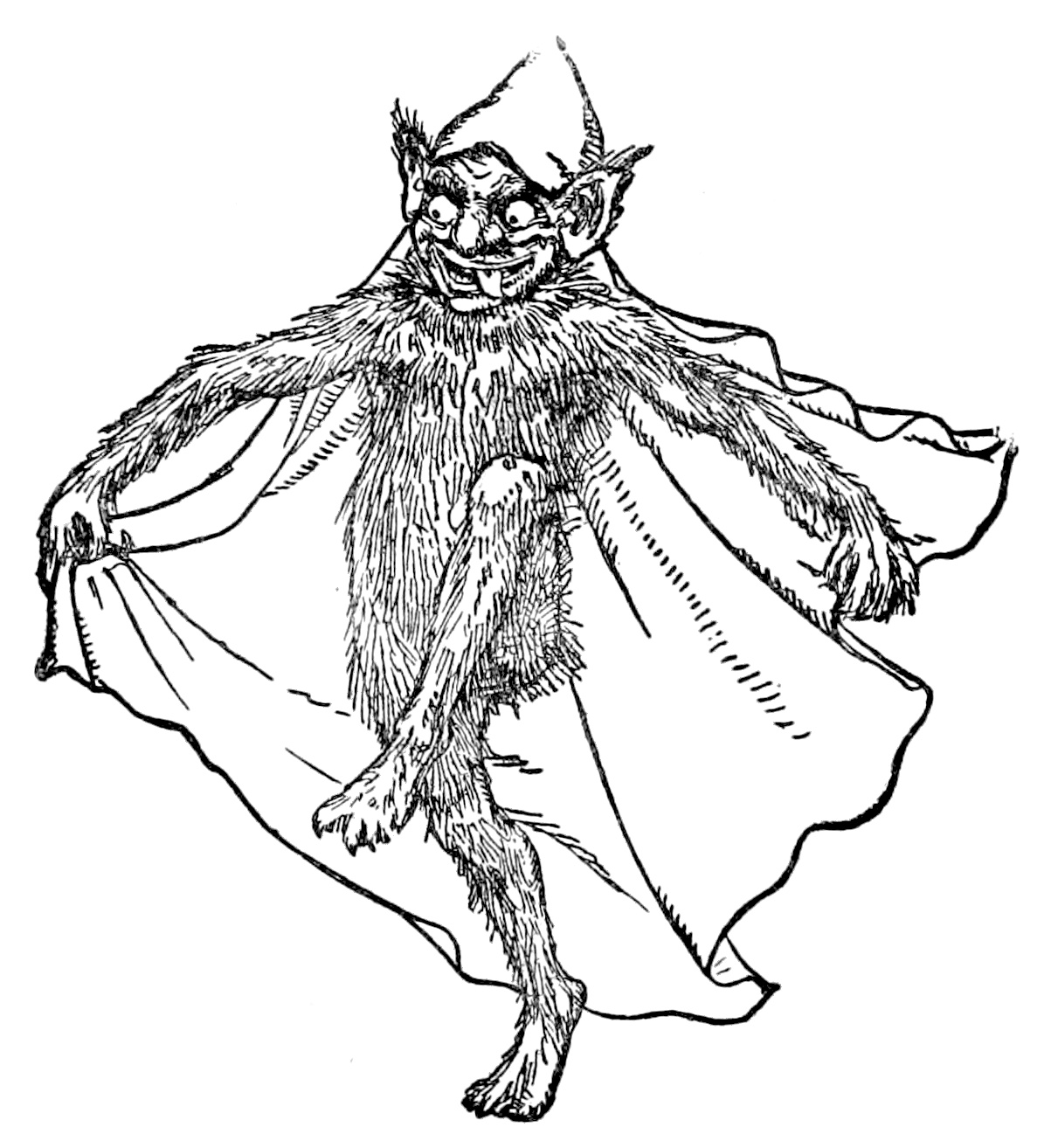
A goblin capers across the page in John D. Batten’s illustration for “English Fairy Tales” (1890), one of the Victorian story collections that made goblins mischief-makers for children, which is what made them a fit for Halloween. (Illustration by John D. Batten for Joseph Jacobs’ “English Fairy Tales,” 1890. Public domain)
The short answer is slowly, and not for any one reason.
"The development of Halloween is a tricky and controversial story," King said. He said the holiday we celebrate today is likely a messy conglomeration of All Saints' Day observances, harvest festivals like Samhain and other folk traditions, and that it took hold in the United States during the 1800s.
Goblins were already familiar characters in Victorian fairy tales, where they had increasingly become mischievous or frightening figures. As Halloween evolved into a holiday increasingly associated with children, goblins were a natural fit.
"There is no singular smoking gun here," King said, "but the alliterative evocation of Halloween as a day of 'ghosts and goblins' caught steam during the 19th century."
"I think the goblin has the right combination of scary, funny and weird that works for Halloween traditions ultimately directed at children," he said. The Christmas goblin hung on into the 20th century, especially in England, and faded gradually.
During his research, King measured how often "goblin" appeared in newspapers around Christmas versus Halloween, and the clippings he found show the shift toward Halloween at the turn of the 20th century. A 1906 Halloween story in The Topeka Daily Herald described the little ones in bed "while the sprites and goblins keep on turning summersaults, standing on their heads and riding round the bedroom on broomsticks until morning puts an end to their revels." Then in 1917, a Canadian farm weekly ran a children's poetry contest built on the line "Once a goblin on Hallowe'en night." The winner has him dancing in the moonlight, "happy and gay," because "he meant to make mischief that night.”
What goblins say about us
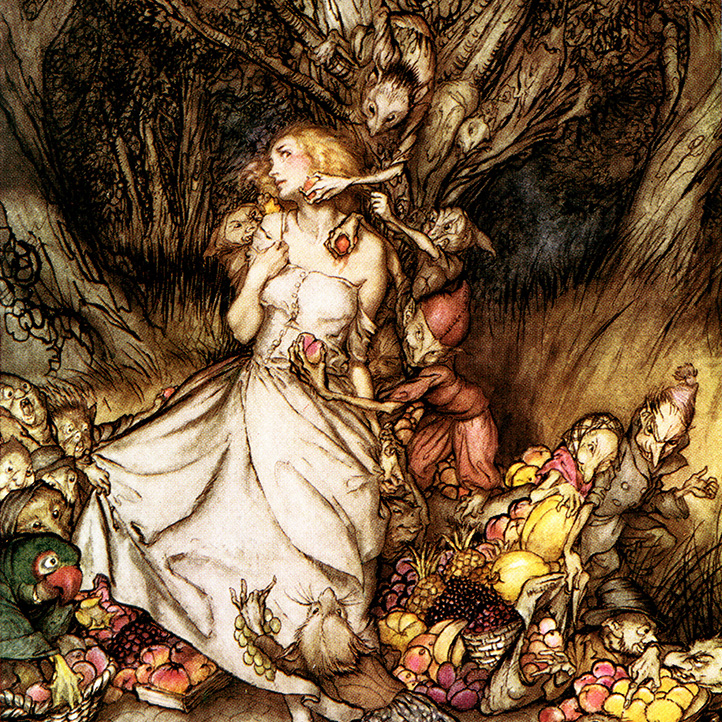
In Christina Rossetti's 1862 poem "Goblin Market," goblin men with animal faces sell enchanted fruit to a girl named Laura, who has no money and pays with a lock of her hair. This illustration by her brother, Dante Gabriel Rossetti, is one of the best-known pictures of the Victorian goblin, the villain of the fairy-tale era. (Wood engraving designed by Dante Gabriel Rossetti and cut by Charles Faulkner of Morris, Marshall, Faulkner & Co. Public domain)
"Humans have always had monsters that reflect our own fears," King said. The goblin's job, in every century, was to stand for whatever a society found ugly or abnormal. "To be a goblin is to be outside the realm of normal," he writes. And for a while that belief fueled cruel associations. In the 1800s, people with dwarfism or crossed eyes were compared to goblins, and the insult ran together with the period's ideas about race and disability.
Today, popular culture embraces goblins and what it means to be one. In 2022, Oxford's word of the year was "goblin mode," a welcome rejection of societal expectations around appearance and behavior. Meanwhile, an aesthetic known as goblincore embraced moss, mud, mushrooms and other conventionally unappealing parts of nature. Both reflect a fascinating reversal, because the qualities that once made goblins frightening or contemptible have become reasons to identify with them.
Traits goblins were mocked for, King writes, "have been reframed as nonconformist assets in an age of absurd societal norms."
Dickens' goblins had to drag a man underground to make him see himself clearly. The people who claim the word today do the looking on their own. They’ve taken everything it used to mean – ugly and strange – and have decided to take the word back for themselves.
"To be a goblin is to be transgressive; to be transgressive is appropriate when societal expectations are so absurd," King writes.
Which may be one reason why Dickens' goblin, sitting on his tombstone all those Christmases ago, was grinning.
A History of Goblins" is out now from Palgrave Macmillan. It will be part of the Department of History’s faculty book celebration at 12:30 p.m. on Nov. 5 in SOC 255 on the Tampa campus.