By Georgia Jackson, College of Arts and Sciences
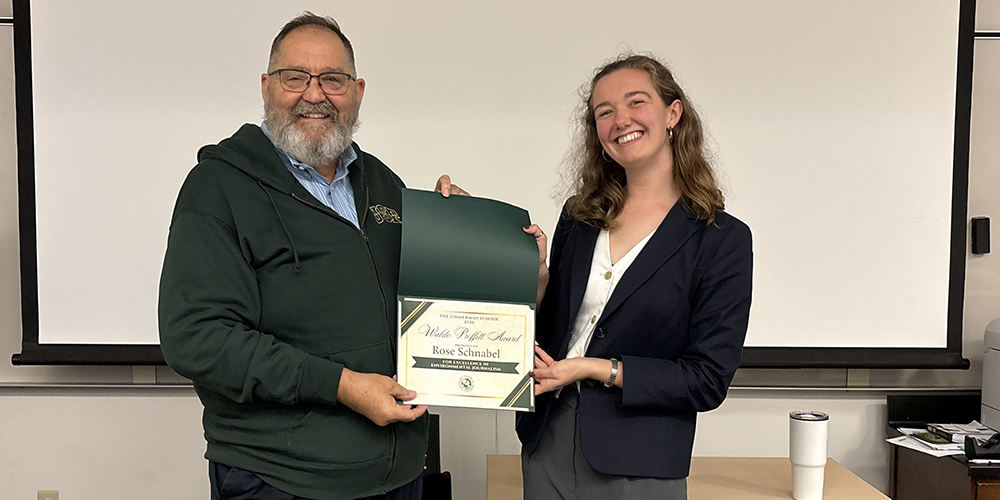
The Zimmerman School of Advertising & Mass Communications presented two works of Florida journalism with the 2026 Waldo Proffitt for Excellence in Environmental Journalism, on Oct. 20, marking the first tie in the history of the award, which recognizes distinguished examples of reporting and commentary about environmental issues in Florida.
Miami Herald reporters Denise Hruby and Susan Merriam received the award for their work, “Built on Sand,” which examines why South Florida high-rise buildings are sinking more than expected and posing a grave danger to residents and the public. WUFT reporter Rose Schnabel received the award for a series of reports about the inequities in rural life and environmental concerns.
A judge for the award said it would be impossible not to recognize both efforts for their “enterprise, depth, clarity and service to the public.”
“Ultimately, it seems to me that choosing one of these projects over the other would diminish what makes each exceptional,” the judge wrote. “These are a very different set of stories, but both entries demonstrate the kind of ambitious, deeply reported environmental journalism that it seems this award should recognize.”
'Built on Sand'
Published in Dec. 2025, this five-part Miami Herald investigation by climate reporter Denise Hruby with data journalist Susan Merriam examines the risks of Florida’s continued development on its barrier islands — home to nearly 765,000 people.
“’Built on Sand’ is an extraordinary example of investigative and explanatory journalism,” the judge wrote. “Denise Hruby and Susan Merriam took a technically complex and consequential question — why some South Florida high-rises are sinking more than expected — and pursued it with great depth.”
Drawing on the first comprehensive mapping of development across those islands and more than 2,000 pages of engineering records, the series reveals that luxury high-rises in Sunny Isles Beach have sunk far more than engineers predicted, with no ongoing monitoring by regulators. It also traces the costs to taxpayers and insurance markets and highlights a Brevard County community that won rare state protections against overdevelopment.
“The reporters gave readers context and answered vital questions they needed to understand the risks,” the judge wrote.
'Rural Environmental Coverage'
WUFT’s “Rural Environmental Coverage” series by Rose Schnabel recognized a body of work on rural environmental issues in North and Central Florida, including Florida's pine straw industry, challenges facing the timber sector, environmental impacts of pine straw harvesting, threats to a rare native plant species from a proposed toll road and odor complaints connected to a landfill serving a rapidly growing region.
“With exquisite writing across a collection of stories about pine-straw harvesting, a threatened native plant population and a landfill affecting a low-income community, Schnabel exposed significant inequities that resulted in public action,” the judge wrote. “Her reporting gives voice to rural residents whose communities are shaped by the demands of bigger cities, focusing on concerns of the marginalized.
“After her story about endangered plants being threatened by a proposed tollway, the state rerouted it. Her stories also sparked action to address a landfill’s odor problems.”
Across the work, Schnabel drew on federal labor data, public records and permit documents to show how environmental costs and economic burdens fall on rural communities and workers with little power to push back.
The judge called it “environmental reporting at its best.”
Established in 1998 by friends of former Sarasota Herald-Tribune editor Waldo Proffitt, the $1,000 award is made possible by the Waldo Proffitt Scholarship Fund and the Community Foundation of Sarasota County. It is administered by the Zimmerman School of Advertising & Mass Communications at the University of South Florida.