By Georgia Jackson and Joshua Napier, College of Arts and Sciences
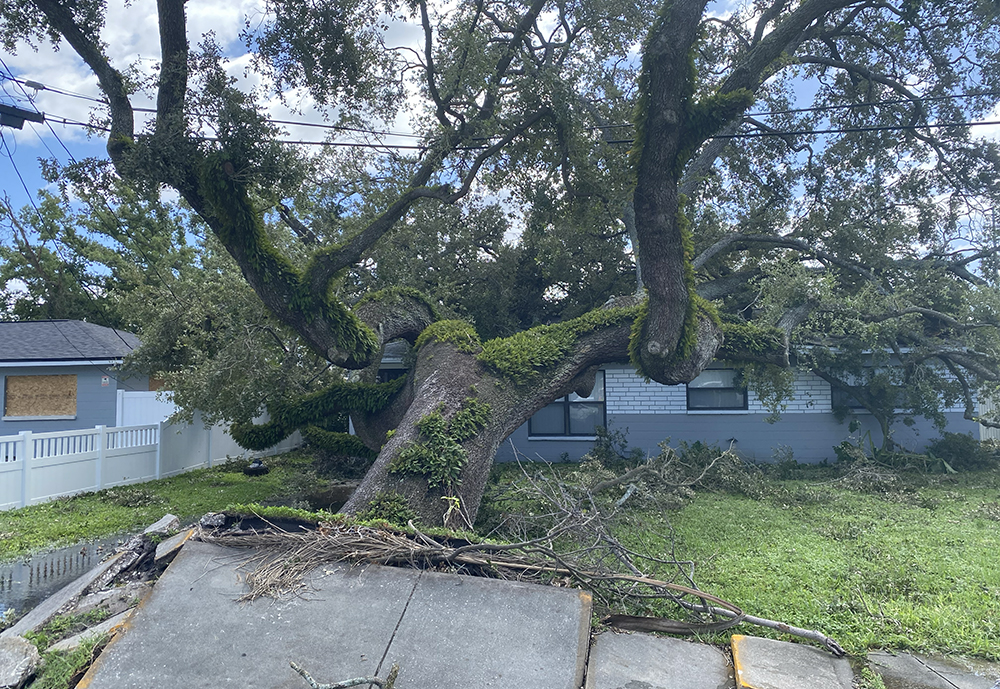
After Hurricanes Helene and Milton tore through Tampa in 2024, bringing trees down on homes, cars, powerlines and roads, USF anthropologist Rebecca Zarger expected residents to be less enthusiastic about replanting.
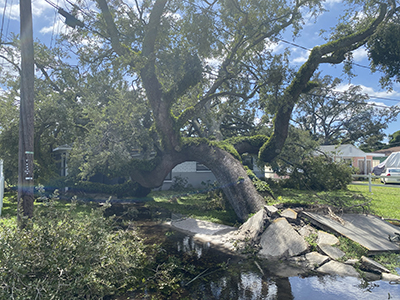
The scale of the cleanup underscored the magnitude of loss. Nearly one million cubic yards of vegetative debris were removed citywide — an amount one news report estimated could have filled Tropicana Field.
Instead, when she surveyed Tampa residents, she found the opposite.
Despite widespread destruction, including more than 970,000 cubic yards of vegetation and mulch for city contractors to haul away, about 85% of survey respondents said their preference for trees had stayed the same or grown stronger. More than 88% agreed that the benefits of trees are worth the risk of hurricane damage to property. And 89.7% said they wanted more trees across Tampa, up from 83% in 2021.
“It sort of reinforced the importance of those things for many people as opposed to making them want to move away from it,” said Zarger, whose research moves beyond data to examine what trees mean to people. “Hurricanes can highlight the risks of living among large trees, but loss of tree coverage can also reinforce how much people value them and the personal connections they provide.”
But the survey also revealed a gap. While nearly 90% of respondents wanted more trees across the city, only half wanted more in their own yards, a share that has barely moved since 2021.
“Most people would much rather have a tree in their neighbor’s yard or on their street or somewhere else in the city than in their backyard because of the expense of maintaining it,” said Zarger, who lost two trees in her own yard during the storms. “The pinch for people is in the cost of maintaining."
The researchers heard this most clearly in neighborhoods that have seen less investment. Concerns about costs of maintaining existing trees on private property were often mentioned, along with fears about aging trees in public rights of way being big risks in future storms.
“The challenge is understanding what it takes to preserve and rebuild a healthy urban canopy when the benefits are shared but the costs and responsibilities often fall on individual homeowners,” said Zarger, who works with Shawn Landry of the School of Geosciences to document changes to Tampa’s tree canopy.
DECADES OF DECISIONS
Landry, a research associate professor and director of the USF Water Institute, said some of the tree-related damage can be explained by species selection, placement, infrastructure and inadequate long-term care.
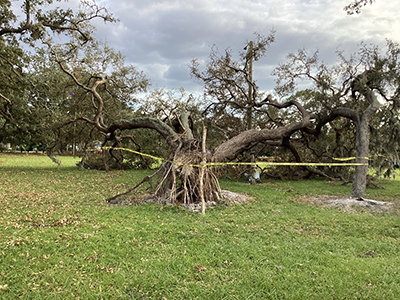
USF researchers evaluated more than 13,000 randomly distributed points across Tampa to assess tree canopy changes resulting from back-to-back hurricanes.
Landry pointed specifically to the planting of laurel oaks, which are prone to trunk decay, and the building of sidewalks and driveways too close to tree roots without leaving room for large trees to grow.
And development has been reshaping Tampa's canopy for decades. The city has had a tree ordinance since the early 1970s, but its protections for large trees carry little weight in practice. The fine for illegally removing a tree is low enough that some people simply cut it down and pay the price, and variance requests to remove protected trees are usually granted.
Recent demand for bigger homes has created additional pressure.
“If you’re going to put in a 5,000-square-foot house on a city of Tampa lot, you’re going to have to mow down everything that’s there,” Landry said.
Developers typically plant a mitigation tree afterward, but some homeowners later remove those, too.
According to Landry, the storms revealed the weakness of these decisions. Newly planted trees without established root systems toppled and decayed laurel oaks snapped. Even live oaks — which are among Florida’s most wind-resistant trees — were pulled from the soil.
“I like to say, it was the result of a legacy of bad decisions,” Landry said. “But if you look at the trees that survived, those are the growing conditions we want all of the trees to have.”
PLANTING IS ONLY THE BEGINNING
If Tampa residents want a more resilient urban canopy, it will require a joint effort — beginning with encouraging homeowners to plant, maintain and live with more trees on their own property.
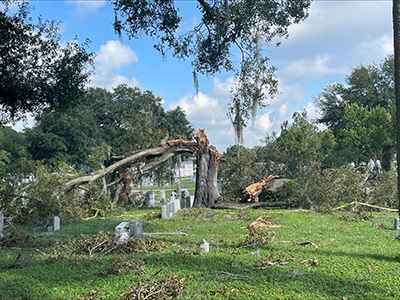
Trees snapped in half at the historic Woodlawn Cemetery, which was established in 1888.
For homeowners ready to plant, Landry’s advice is to plant the “right tree” in the “right place." That means avoiding overcrowding and giving trees room to grow.
Species diversity is also important, Landry warned. Reliance on a single species, like the crepe myrtle, leaves the canopy vulnerable to pests and disease.
“There’s nothing wrong with crepe myrtles,” Landry said. “But it is just overused.”
Landry also noted that homeowners are often limited to options provided by nurseries, which tend to stock familiar species they think will sell, creating a cycle that reinforces existing planting patterns. He said a more diverse palette of trees for city projects could create steadier demands for alternatives and encourage nurseries to grow them.
But planting is only the first step.
“A lot of trees don’t make it because people are just not aware of the fact that you’ve got to keep watering them for a whole year,” Landry said.
To help residents make informed decisions, Landry maintains the Tampa Tree Matrix, a species-selection guide that the research team is updating with additional information on growing conditions, diversity and storm resilience.
He also recommended the City of Tampa’s Tree-Mendous Tampa program, which offers eligible residents free trees and assistance with appropriate planting locations. The program and Tree Matrix can help residents move beyond choosing a tree solely for its appearance.
STEWARDSHIP MEANS SHARED RESPONSIBILITY
But encouraging homeowners to plant more trees won’t be enough on its own.
“A healthier Tampa canopy isn't simply about planting more trees. It's about making better decisions, supporting the people responsible for caring for them and understanding that today's choices will shape the city for generations,” Zarger said.
In recommendations to Tampa City Council, the researchers called for more maintenance funding, assistance for residents caring for trees on private property and a Tree Stewards Program that would train community members to help care for neighborhood trees. Their community-engagement work also underscores the importance of involving residents in planting plans from the beginning.
PLANTING FOR THE NEXT GENERATION
When the storms passed and the skies cleared following the 2024 hurricane season, Zarger was committed to replanting.
“It was important for me to replant a live oak in our backyard after we lost the two,” she said.
Tampa inherited an urban forest shaped by the choices of earlier generations, good and bad. What residents and the city decide to preserve, plant and care for now will shape the canopy the next generation lives under.
Zarger’s live oak is her own small part of that. Live oaks tend to take somewhere between 50 and 100 years to reach their full height. It’s likely she won’t see the tree reach maturity.
“It’s going to be for the next family that lives here after we’re gone,” said Zarger. “You’re leaving a legacy, right? That feels better to me than not planting a tree.”