Scientists historically understood the greatest skin cancer risk to be due to the UVB region of the solar spectrum, but new research suggests DNA damage can form in the dark after sun exposure has ended.
By Georgia Jackson, College of Arts and Sciences
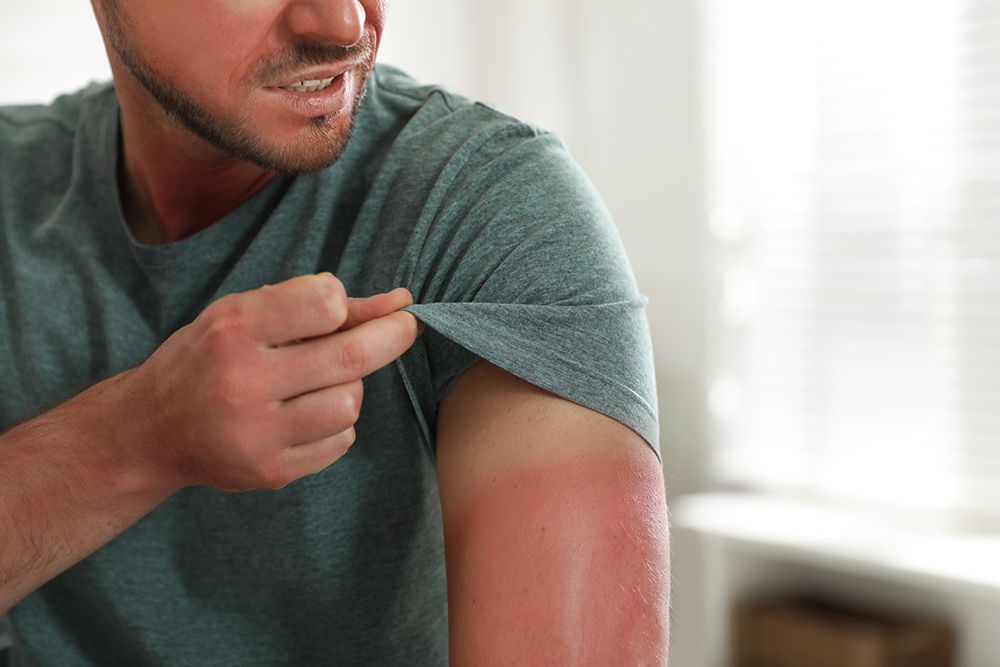
USF researchers are no strangers to sunburn.
They know that exposure to ultraviolet (UV) light from the sun or artificial sources can penetrate and damage the skin.
They also know the sun’s rays can do damage on cool and even cloudy days.
But it was only recently that they learned some of that damage takes place after people have returned indoors.
“Historically, we've thought that the DNA damage induced by sunlight correlates with the solar spectrum — that sunlight itself defines the ‘action spectrum,’ or which wavelengths are most effective at causing the damage,” said USF researcher Marcus Cooke. “Recently, however, it was discovered that some of this damage can form in the dark after the sunlight is gone.”
In something of a “eureka moment,” Cooke, a professor and chair of the Department of Molecular Biosciences, realized the so-called “action spectrum” for this kind of damage must be broader than scientists had traditionally assumed.
He took his theory to Sanjay Premi, an assistant professor in the Moffitt Cancer Center and one of the first to show that some UV-related DNA damage continues to form hours after sun exposure ends.
Premi agreed. If ultraviolet radiation was indeed damaging skin cells hours after sun exposure ended, then perhaps the effective action spectrum was broader than previously thought.
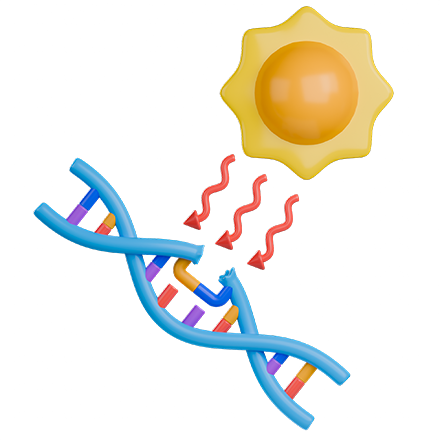
In a new article published in “Photochemistry and Photobiology,” Cooke and Premi argue the biological action spectrum for sun damage is determined not only by direct DNA absorption, but also by the cells’ capacity to generate DNA-damaging excited states through redox chemistry. In other words, while sunlight causes direct damage when absorbed by DNA, it also causes indirect damage when absorbed by molecules other than DNA present in skin cells. When these molecules absorb light, they rise to a higher energy state, often generating reactive oxygen species that go on to damage DNA indirectly — even though the original light wasn't absorbed by the DNA itself.
The paper was co-authored by Jyoti Srivastava, a senior research scientist at Moffitt Cancer Center.
The three call for new photoprotection methods — like sunscreens, protective gear and behavioral habits — that would prevent the damage that occurs in the dark.
“The action spectrum of cyclobutane pyrimidine dimer (CPD) formation has long been viewed as reflecting the DNA absorption spectrum and closely aligned with the erythema (sunburn) spectrum,” they write in the paper. “This alignment established the prevailing paradigm in which erythema serves as a surrogate for mutagenic risk and ultraviolet B radiation is responsible for biologically meaningful DNA damage in skin.”
Cooke's insight has huge implications for the biology of skin cancer, and the way we prevent DNA damage in the skin.
CPDs are a type of DNA damage that can lead to mutations. Scientists long believed they formed mainly when UV light directly hit DNA, and that the wavelengths producing the most CPDs were also those most likely to cause sunburn. But the discovery of delayed — or “dark” — CPDs changes things.
“It is increasingly well established that CPD formation is not limited to direct photon absorption but can additionally arise through longer-wavelength, redox-driven chemiexcitation pathways, particularly within the UVA range,” they write in the paper. “Emerging evidence further suggests that non-melanin oxidative pathways can generate chemiexcited states potentially relevant to DNA damage.”
One reviewer called the insight, which has huge implications for the biology of skin cancer, “an important clarion call to the skin photobiology community to reassess and broaden the approach to photoprotection.”
The novel framework underscores the need for photoprotective strategies, including a new generation of sunscreens, that target both direct and indirect DNA damage pathways.