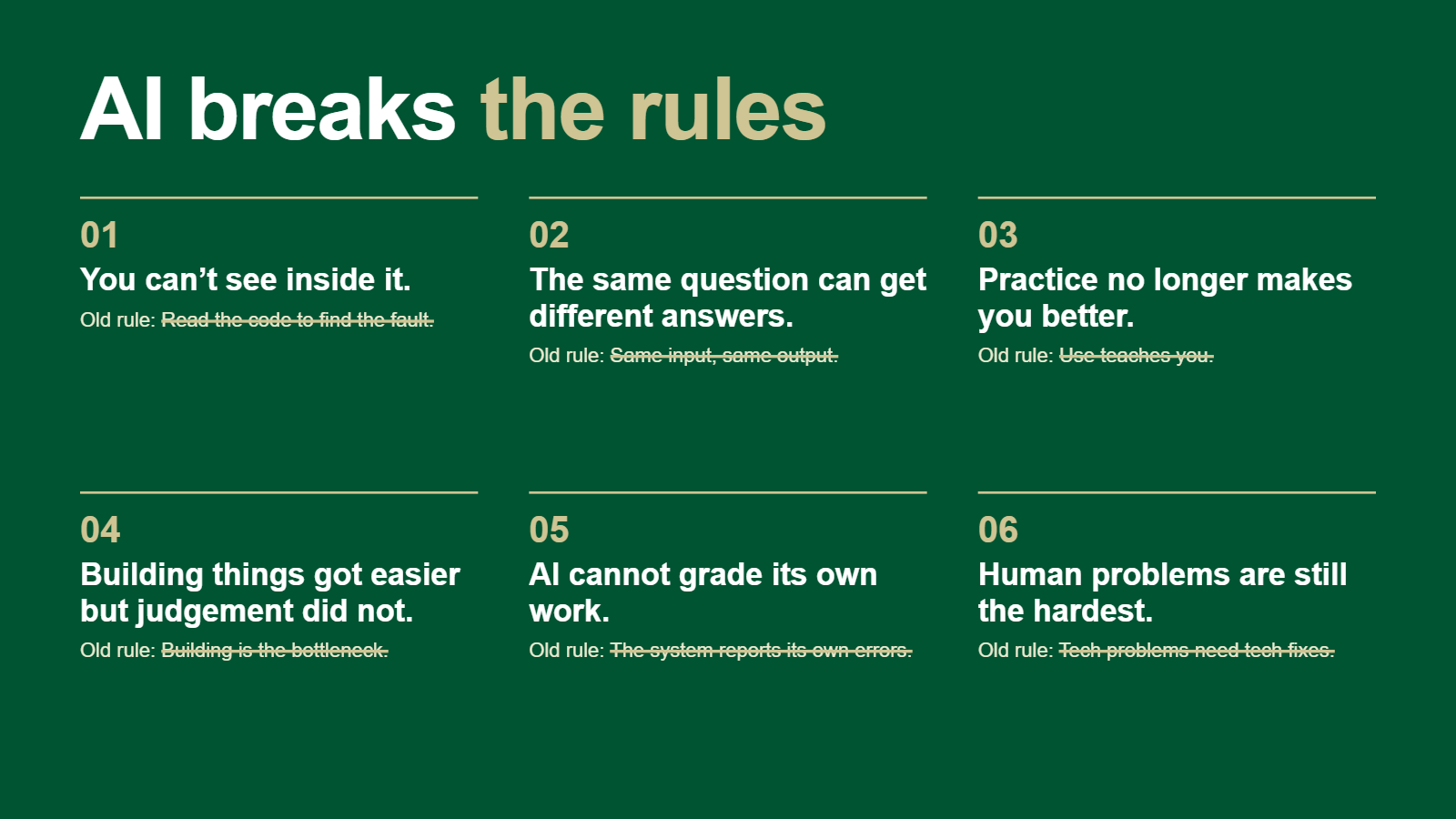
Every major technology shift arrived with a promise: enterprise systems such as SAP and Salesforce promised integration, cloud computing promised scale, and mobile promised reach. Each one came with difficult implementations, but none of them changed what it means to know something.
AI is the first technology to change that, yet many organizations are still adopting it the way they adopted ERP or cloud, with a vendor, a project plan, and a go-live date. That playbook keeps coming up short, and below are six reasons why, along with what each one means for the people who lead AI work in business.
Six Reasons why AI Breaks The Rules You Know
-
You can’t see inside it.
A large language model gives you an answer, but you can’t trace how it got there. When older systems broke, they usually failed loudly: an error message, a crash, a report that wouldn’t run. A model rarely fails that way, because it always replies, and a wrong answer often reads just as confidently as a right one. Since reading the code won’t tell you much, the real work now is building guardrails around the output: checks on what goes in, rules on what comes out, and people who know when to override it.
- The same question can get different answers.
Business software was built on predictability, and testing, code review, and audits all assume the same input produces the same output. Generative AI breaks that assumption, and the effect is easy to see in practice. Ask a model to summarize the same contract twice and you may get two different summaries, both plausible. Model evaluation has become a discipline of its own, and someone on the team has to own it, with test sets, scoring criteria, and a record of how the system performs over time. - Practice no longer makes you better.
Most tools teach you as you use them because they tell you when you got something wrong, but AI rarely gives you that feedback. The output looks polished whether it is accurate or not, so there is no clear signal to learn from. People can use these tools every day for months without getting any better at it. Skill comes from structured evaluation: comparing outputs against a known standard, tracking errors, and adjusting the approach, which is something repetition alone won’t teach you. - Building things got easier, but judgment didn’t.
A small team can now produce fifty options in the time it used to take to build three, and prototypes that once took months can be stood up in days. The bottleneck has moved to judgment: which option is worth funding, which one is good enough, and when to stop. That is why orchestration and agent design, deciding how models, tools, and people fit together, now matter more than coding proficiency alone. - The tool can’t grade its own work.
Early microscope users often couldn’t tell whether they were looking at the specimen or a flaw in the lens, and AI users face the same problem today. Asking a model whether its own answer is right just gets you another answer through the same lens. Proof has to come from outside the system: governance, independent verification, and clean, well-managed data. - The hardest problems are often human.
Most corporate policies were written for traditional software. Middle managers sit between executives who want results now and teams who are uneasy about what AI means for their jobs. Junior staff often pick up the tools faster than senior staff, which upends the usual flow of expertise. And people rarely agree on what “good enough” means for an AI output. These are change management problems more than engineering problems, and they call for leaders who can handle both.
A prompt guide or a weekend course won’t fix any of this. Organizations need people who understand what AI can do and where its limits lie inside a real business. That combination is rare, and employers are paying for it: PwC’s 2026 Global AI Jobs Barometer found that workers with AI skills earn an average wage premium of 62 percent, up from 57 percent the year before.
Where the MS in AI in Business fits
That thinking shaped the MS in AI in Business at the University of South Florida’s Muma College of Business, one of the first programs of its kind in the nation and part of the college’s broader push to build AI into its business curriculum. USF offers it in two formats:
- Digital Transformation is an online program with live weekend classes for working professionals, who finish the program with a board-ready AI transformation blueprint.
- Enterprise Integration is an in-person, full-time program for recent graduates and early-career professionals who want to go deep on RAG pipelines, agent frameworks, and LLMOps and to finish the program with a working prototype.
Everyone will eventually have access to the same AI models, but very few people will know how to work with them well, and that gap is the opportunity.