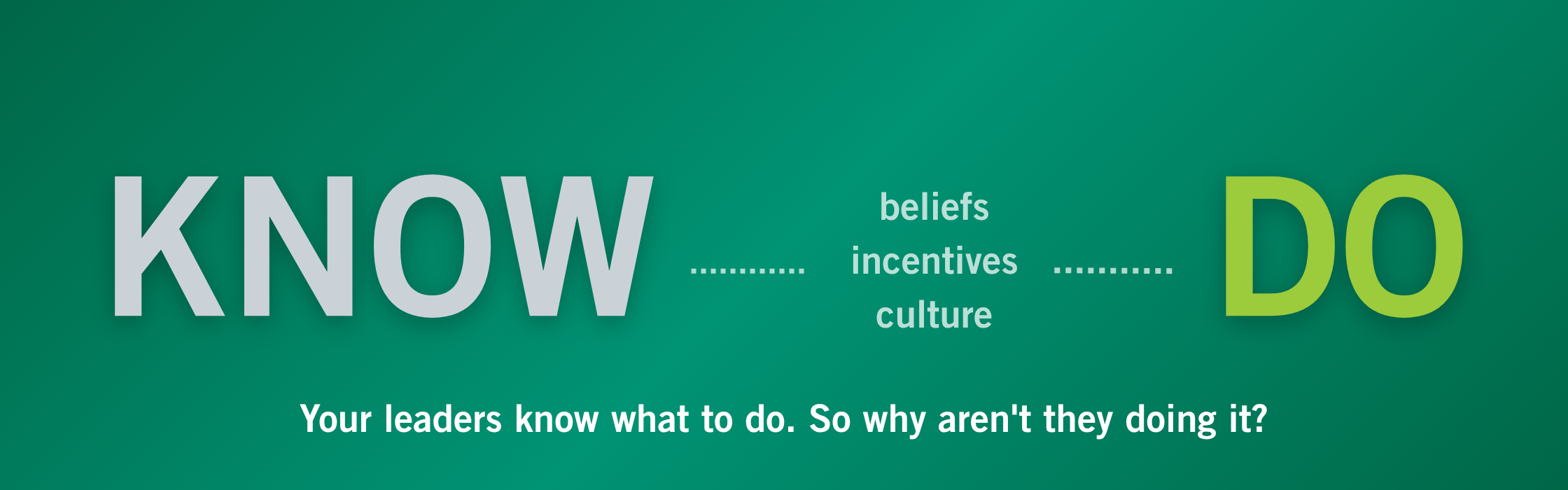
Leadership development often focuses on what leaders need to learn. But what if the bigger issue is what gets in the way of doing what they already know?
When Alan Mulally arrived at Ford in 2006, the company was in serious trouble. He introduced a weekly Business Plan Review where senior executives used a simple color system to show how things were going. Green meant on plan, yellow meant there were concerns and red meant there was a problem. At one of the first meetings, Ford was preparing to lose billions of dollars, yet almost everything on the screen was green. Mulally asked the obvious question: How could everything possibly be green when the company was losing billions?
Ford's executives had learned that bringing bad news to the boss could be dangerous. Mulally had told them he wanted transparency, but they weren't sure they believed him. Then Mark Fields, who was leading Ford's Americas business at the time, put up a red status report. A problem with the new Ford Edge was going to delay production, and people in the room reportedly wondered what would happen to him. Mulally applauded and asked, “Who can help?” Soon, more red started showing up in the meetings.
Ford's leaders didn't need to be taught that transparency was important. They knew that. What changed was their understanding of what would happen when they actually brought a problem into the room. I think there's something important in that for how we develop leaders.
Leaders usually know what good leadership looks like.
Ask a group of experienced leaders what great leadership requires and you'll hear many of the same things: empathy, courage, clarity, collaboration, accountability, developing others, listening and being willing to admit when you don't have all the answers. None of this is particularly new. Yet organizations still struggle with leaders who avoid difficult conversations, hold onto decisions they should delegate, protect their own part of the business, resist feedback or have trouble leading when the answer isn't clear. So maybe the issue isn't always knowing what to do.
A recent Boston Consulting Group article, “Mind the Belief Gap,” got me thinking about this. BCG surveyed 563 senior leaders across 11 markets and found that 63% believe theirsenior leaders aren't well prepared for what long-term success will require. The authors describe a “belief gap” between what leaders know good leadership requires and what leadership teams can actually get themselves to do. Their research points to three things that matter: reframing underlying beliefs, practicing new behaviors and reinforcing those behaviors through the organization. Only 15% of the leaders surveyed said their organizations consistently do all three.
How often, then, are we trying to teach something when the real barrier isn't knowledge at all? Think about a company that tells its leaders to collaborate across the enterprise, but bonuses are based largely on individual business-unit performance. Leaders protect their best people, and those who hit their own numbers continue to get promoted even if they aren't particularly good enterprise partners. People figure out pretty quickly what really matters. Or consider innovation. An organization talks about experimentation and intelligent risk-taking, then grills someone in a business review when a new idea doesn't work. Everyone else is watching and learns something from that experience too. Developing people isn't much different. We tell managers that coaching and developing their teams is one of their most important responsibilities, but often the person who gets noticed is the manager who umps in, fixes the problem and saves the day. The manager who gives people room to struggle a little, coaches them and lets them find the answer may not look nearly as impressive in the moment. In each case, the organization may be reinforcing the very behavior it says it wants to change.
What happens around the leader matters
Microsoft is an interesting example. When Satya Nadella became CEO in 2014, the company had a reputation for an intensely competitive culture where individual achievement mattered a great deal. Nadella began talking about moving from a culture of “know-it-alls” to “learn-it-alls.” But it wasn't just language. Over time, Microsoft also changed how it reinforced the idea. Contributing to the success of others became part of performance discussions, while learning, experimentation and collaboration became more explicit parts of the culture.
Pixar approached candor in a similarly practical way. Most organizations would say they want people to give honest feedback. That's harder when the work is unfinished, when someone has invested months in an idea or when the person receiving the feedback has considerably more organizational power. Pixar created a process for it. Through its well-known Braintrust, people regularly share unfinished work, challenge assumptions and help one another figure out what's not working. Ed Catmull, Pixar's cofounder and longtimeleader, has also been unusually open about mistakes the company made along the way. Pixar didn't put “candor” on a poster. It made candor part of how the work got done.
Are we starting in the right place?
We usually begin leadership development with some version of, “What should we teach our leaders?” I'm increasingly interested in a different starting point: What does the business actually need leaders to do differently? Then I'd want to understand what's getting in the way. What do leaders believe about how you succeed in that organization? Where did those beliefs come from? What gets rewarded? What gets someone in trouble? What happens when someone behaves differently?
The answers might lead to a leadership program, but they might not. If the business needs more collaboration across boundaries, put leaders to work on a real enterprise problem where they can't succeed without one another. If leaders need to get better at operating through uncertainty, give them a messy problem without a neatly packaged answer. If feedback is an issue, create an experience where they receive candid feedback and have to do something with it.
What happens when they go back to work is just as important. A leader can have a great development experience and return Monday morning to exactly the same environment they left on Friday. Their boss behaves the same way, the incentives haven't changed and the organization's processes still reward the old behavior. We probably shouldn't be surprised when the development doesn't stick.
That's one of the ideas from the BCG research that has stayed with me. Beliefs aren't just individual. Leadership teams develop shared beliefs about how things really work: what gets rewarded, what gets someone in trouble, whose voice matters and what it takes to succeed. Those beliefs can be far more powerful than anything taught in a classroom.
Maybe that's the question we should be asking before we design the next leadership program. Not just, “What do our leaders need to learn?” but, “What do we need them to do differently—and what's keeping them from doing it now?”
Ready to close the gap?
The Center for Executive and Leadership Education at the University of South Florida partners with organizations to design leadership development around what your business actually needs leaders to do differently, and what’s getting in the way. Our custom programs use real business challenges, candid feedback and practical tools that help new behaviors stick long after the program ends.
Reference: Boston Consulting Group, “Mind the Belief Gap: How the Best Leadership
Teams Reframe, Practice, and Reinforce New Ways of Leading,” 2026.