USF Innovative Education | Alumni Spotlight
Megan Tran combines her background in psychology, biomedical sciences and music with her computer science education to make an impact on a range of human experiences from concussion recovery to learning the violin.
She is a graduate student within the Bellini College for Artificial Intelligence, Cybersecurity and Computing. Moreover, she is a published machine-learning research assistant at the SHIELD Lab, a software engineering intern at USF’s Institute of Applied Engineering, and an M.S. in Computer Science candidate set to graduate in December 2026.
But this wasn’t her original career path.
A Pivot That Started with DNA Research
Tran earned her bachelor’s degrees in biomedical sciences and psychology as a student in USF’s Judy Genshaft Honors College, dabbling with game development and coding through Khan Academy in her free time. As she finished her undergraduate degrees, a research assistant position introduced her to combining computing with her health-focused majors. There, she automated programs that assist scientists in reliably analyzing DNA data.
“I found that pretty cool,” she said. “I wanted to apply that and transition into something where I can combine technology and the sciences.”
That curiosity led her to USF’s online Pathway to Computing (PTC) Graduate Certificate program, which was designed for exactly this kind of student: driven, credentialed in another field, and ready to build something new. She picked PTC because it gave her the foundation required to complete the M.S. in Computer Science.
Fiddling Around: Turning Violin Practice into a Video Game
During her master’s degree, she built her violin video game, “Strings Attached: A
Rhythm-Based Game for Learning the Violin Bow” to make learning the instrument less
intimidating. After being introduced to computer vision and gamification in her internship
with USF Assistant Professor John Templeton’s physical therapy system Galactic Glide, she wanted to apply those concepts to music education.
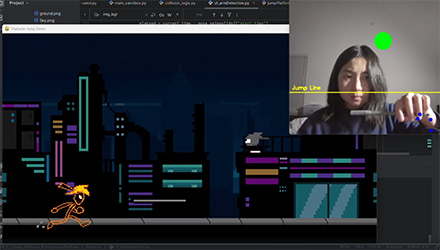
Megan Tran's game, Strings Attached, uses computer vision and rhythm-based gameplay to transform beginner violin practice into an engaging, interactive learning experience.
“If I could gamify the basics of learning the violin, like Wii Sports where you move around and have fun, then that’s what gets people engaged,” she said, noting inspiration on gamification elements from platforms like Duolingo.
Strings Attached combines computer vision with rhythm-based gameplay, using a player’s bowing motions to control a cartoon character in time with the music. Tran hand-crafted the original character art and composed the music to deliver a charming, retro feel.
To determine if her project was worth continuing, she asked fellow USF students, professors, coworkers, and even gym-goers to demo her game. She shared progress updates on LinkedIn, which reached over 25,000 viewers worldwide, including a technology leader at Microsoft, a Meta software engineer, academics in Ireland, and developers in India seeking her career advice.
After seeing how much testers enjoyed the gameplay, her next step is partnering with local music schools and programs to evaluate whether the product could enhance violin instruction for beginners.
Blending Machine Learning with Clinical Practice
Aside from her video game project, Tran is a machine-learning research assistant in
Templeton’s SHIELD Lab.
“Doing research allows me to learn from different peers and [especially] my professor, because the way that he thinks allows me to view things in various perspectives that I never thought of before,” she said. “It’s like you’ve been enlightened.”
What makes her research fulfilling is collaborating with medical professionals outside of computer science. One of Tran’s biggest accomplishments is her first-author publication on using machine learning to predict when patients recover from sport-related concussions. She not only sees the clinical impact of her data analysis, but also finds that her scientific background is put to meaningful use.
The Program That Built the Foundation
All of her achievements could not have happened without the Pathway to Computing program. It is fully online, requires no GRE and is built for those with non-computing backgrounds
looking to pivot toward AI, cybersecurity, data science or software engineering without
earning an additional bachelor’s degree.
Two courses stand out in Tran’s memory: an object-oriented programming class with Marbin Pazos-Revilla and a networking essentials course with Ken Christensen, which she calls the building blocks of everything that followed.
“Those projects gave me fundamentals that allowed me to do well in my internship,” she said. “The project scopes made sense because I had those fundamentals.”
Shaun Canavan’s algorithms course left a mark, too. While she enjoyed learning about code on her own before PTC, the guidance from her professors and structure of the program helped her efficiently solidify her skills.
“PTC is a great program and all the professors are great,” she said. “Definitely use their office hours. It also makes learning much better experience-wise. Don’t feel intimidated by the classes. You just have to start somewhere. Start simple so that it’s easier to build up.”
That type of open communication is also something she recommends using outside the classroom. “Shoot your shot when it comes to applying to internships, because it will help you prepare for when you apply for jobs.”
What Comes Next
Tran plans to enter the industry full-time after graduating, though she hasn’t ruled out a Ph.D. She might one day follow in Templeton’s footsteps to become a mentor who applies interdisciplinary knowledge and a talent for communication to inspire the next generation of students.
For her, Pathway to Computing was truly a bridge between a pre-existing interest and a formal computer science education that adds credibility to her resume, opening doors for future projects.
If you’re inspired by Tran’s story and are curious if Pathway to Computing is right for you, RSVP for the virtual info session on Wednesday, Sept. 16 at 6 p.m. ET. The program director and online success coach will walk through program details and answer questions live via Microsoft Teams.
The PTC program is supported by USF Innovative Education, which partners with USF faculty and colleges to expand access to high-quality online learning. Through an interdisciplinary approach and proven course design practices, InEd helps ensure students gain the skills needed for today’s rapidly evolving workforce.