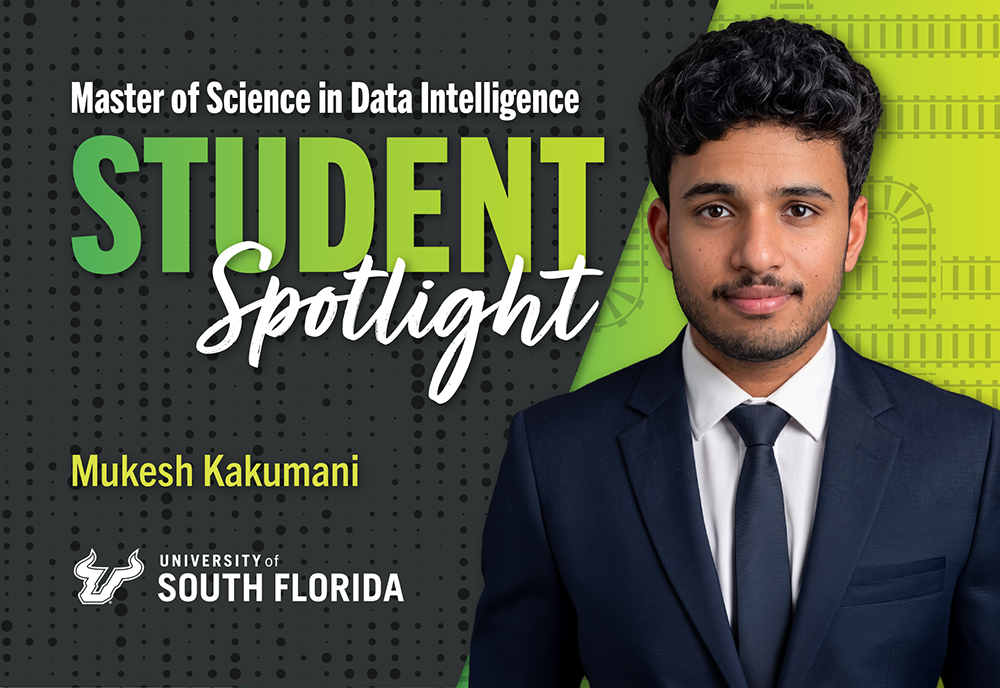
Loud sirens, flashing ambulance lights and the rumble of train engines are all signs that complex systems are in motion. Those systems, Mukesh Kakumani has learned, are enabled by data.
As a Master of Science in Data Intelligence (MSDI) student at the University of South Florida, Kakumani analyzed a 27-million-record emergency medical services dataset used to forecast workforce needs and completed a rail-focused internship centered on transportation safety. Both experiences showed how data can guide decisions that affect millions.
"I came into the program without prior corporate or industrial experience," Kakumani said. "I had ambition, but I was still searching for the exact direction and confidence needed to turn that ambition into a career."
A Broader Approach with Deeper Confidence
Kakumani discovered MSDI while researching graduate programs in data science, machine learning and decision-making. USF stood out because it went beyond model building to combine data, computing, statistics, optimization and applied decision-making, with a flexible curriculum and close faculty interaction.
Although he had technical experience before enrolling, Kakumani wanted the confidence to apply those skills to larger problems. “An equally important change was learning to communicate my work, explaining why I chose a particular approach, defending my decisions, presenting results and discussing technical ideas with faculty, researchers, classmates and professionals,” he said.
Discovering Data Across Industries
Before joining the program, Kakumani viewed data largely through a technical lens.
"The program showed me that data is a universal language," he said. "It opened my eyes to industries and opportunities I never would have considered before."
Before MSDI, Kakumani associated data science with technology, finance, healthcare and business analytics. The program showed him how the same skills support cybersecurity, transportation, infrastructure, supply chains, forecasting and public-sector planning.
“The business problem may completely change, but skills such as modeling, classification, forecasting, optimization and extracting useful information from large datasets remain extremely valuable,” he said.
Steering Toward a Sense of Purpose
Kakumani sought meaningful ways to apply his skills. He became a teaching assistant, helping students with technical concepts and data-driven problem-solving. He later joined a research initiative forecasting healthcare workforce capacity with statewide data designed to inform planning through 2050.
"Knowing that the research could help guide decisions about healthcare resources and workforce planning gave the work a sense of purpose," he said. "It reinforced that data isn't just numbers on a screen. It can help shape better outcomes for people and communities."
Learning Through Mentorship and Practice
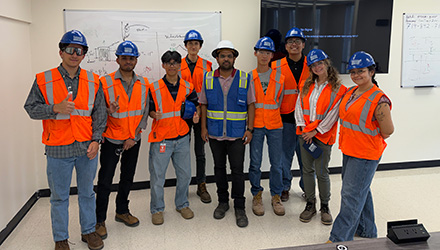
Kakumani, second on the left, gained hands-on experience analyzing field-test data during a rail-focused internship at the U.S. Department of Transportation’s Transportation Technology Center in Colorado.
Along the way, faculty encouraged him to take on new challenges. USF College of Engineering Industrial and Management Systems Engineering Department Chair Tapas Das helped connect classroom learning with research, teaching and professional growth.
"My academic journey has truly been guided by Dr. Das' mentorship," Kakumani said.
In an independent study with Das, Kakumani completed research, presentations and writing assignments before selecting fake video detection for a comprehensive paper. It was his first USF presentation experience and pushed him to explain a complex, emerging issue to an academic audience.
Kakumani said MSDI courses pair theory with datasets, programming, modeling and projects. Some emphasize machine learning and AI, while others focus on statistics, optimization, algorithms or decision-making.
In his final semester, he is taking Statistical Design Models with Das to learn how to design experiments, identify factors that influence outcomes and draw reliable conclusions. The course adds a new perspective: not only how to analyze existing data, but how strong data should be generated.
Putting Data Intelligence in Motion
That confidence was tested when Kakumani was selected for a rail-focused internship through the Consolidated Rail Infrastructure and Safety Improvements (CRISI) program. At the U.S. Department of Transportation's Transportation Technology Center in Colorado, he analyzed field-test data used to evaluate rail-tie performance and observed how testing supports railroad safety.
"Seeing how data moves behind the scenes to power operational logic bridged the gap between classroom theory and real-world impact," he said. "I was no longer just a student studying datasets. I was actively working with systems that kept critical infrastructure moving."
Growth That Lead to Confidence and Unlimited Potential
Now preparing to graduate in December 2026, Kakumani sees his journey differently. What once felt like uncertainty became an opportunity for growth.
After graduating, Kakumani plans to pursue a full-time role in data science, machine learning, data engineering or analytics. His healthcare research and railway infrastructure experiences made him less focused on one industry and more interested in challenging problems, purposeful data and measurable impact.
"The biggest change wasn't just developing technical skills," he said. "It was gaining the confidence to step into new opportunities and trust that I could figure things out."
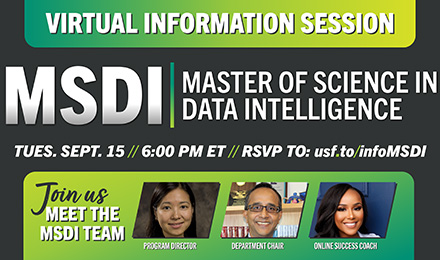
If you’re inspired by Kakumani’s story and are curious if MSDI is right for you, RSVP for the virtual info session on Tuesday, Sept. 15 at 6 p.m. ET. The program director and online success coach will walk through program details and answer questions live via Microsoft Teams.
USF's MSDI program is offered jointly by the USF College of Engineering Industrial and Management Systems Engineering and the Bellini College for Artificial Intelligence, Cybersecurity and Computing Computer Science departments.
The MSDI program is supported by USF Innovative Education, which partners with USF faculty and colleges to expand access to high-quality online learning. MSDI is offered fully online or in-person, and both delivery methods provide the same expert USF faculty, industry connections, and hands-on experience. Through an interdisciplinary approach and proven course design practices, InEd helps ensure students gain the skills needed for today’s rapidly evolving workforce.