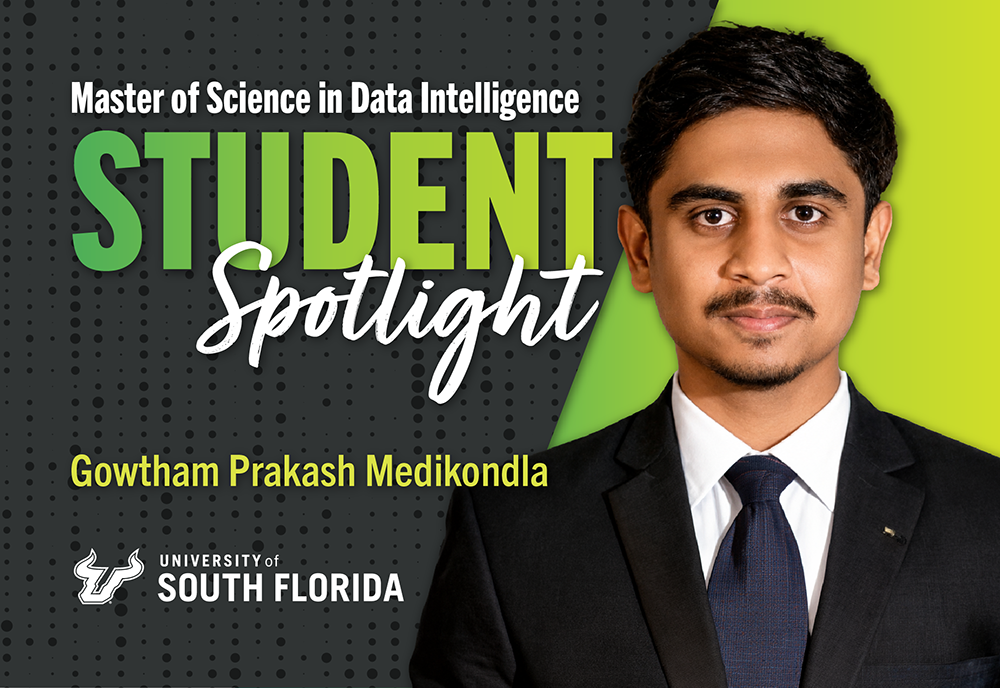
Gowtham Prakash Medikondla already knew how to build software. What he wanted was a master’s program that would help him move beyond maintaining existing systems and begin exploring the unanswered questions shaping artificial intelligence.
That goal led him to USF’s Master of Science in Data Intelligence (MSDI) program. The 30-credit-hour degree combines data engineering, analytics, cloud technologies, AI and machine learning. Students can complete it fully online or in-person, with the same USF faculty and hands-on learning opportunities in either format.
Using AI to Solve Human Problems
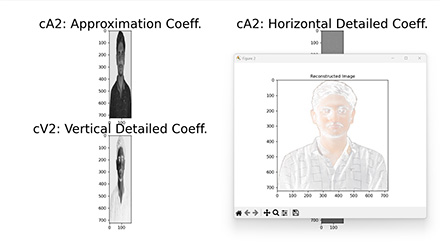
Gowtham Prakash Medikondla's facial-expression analysis using AI to explore patterns in human emotion.
Before enrolling in MSDI, Medikondla had already built a strong foundation in software development and artificial intelligence. As an AI and machine learning intern and later a Python developer, he built data pipelines, machine learning models and cloud-based applications. Yet what interested him most wasn't maintaining existing systems, but applying AI to meaningful human challenges.
That interest led him to projects focused on autism spectrum disorder screening and facial-expression analysis for depression detection. Together, they sparked his interest in healthcare applications and reinforced his desire to use AI to improve people's lives.
Why MSDI Felt Different
USF’s blend of engineering and computer science distinguished MSDI from the other programs he considered. It is offered jointly by the College of Engineering’s Department of Industrial and Management Systems Engineering and the Bellini College for Artificial Intelligence, Cybersecurity and Computing Department of Computer Science. He was drawn to the curriculum's interdisciplinary approach, which combines technical computing skills with real-world problem solving. MSDI’s specialized study options allow students to focus on decision intelligence, artificial intelligence or a general data intelligence track.
Medikondla said the interdisciplinary approach has taught him to view AI as part of a larger system rather than only as a technical model. He is learning to consider the full process, including how data is collected, processed and analyzed, how AI fits into an operating system, and how its output can support meaningful decisions. The combination has also helped him connect technical development with efficiency, reliability and applications that directly affect people.
“I had never seen a program that combined engineering and computer science,” Medikondla said. “The approach was very different.”
Just as important was the encouragement he received from USF Industrial and Management Systems Engineering Department Chair Tapas Das before enrolling. Before choosing USF, Medikondla spent time researching different graduate programs and speaking with faculty members about what set their curricula apart.
Das told him that the faculty were eager to have him as a student in the MSDI program. Das also explained that he could explore research opportunities with other professors after enrolling. For Medikondla, the message showed that USF encouraged students to explore different areas and build connections with faculty.
He said the encouragement he received from Das helped reinforce that USF is a place where students are welcomed and supported.
Permission to Fail, Freedom to Learn
Once enrolled, he found that the difference extended beyond the course list. Projects, presentations and papers carried substantial weight in several of his classes, giving students room to develop and test ideas instead of focusing solely on a correct final result. Professor Kaixun Hua encouraged students to try different approaches and learn from what happened.
“Even if the result is bad, the approach and the thinking should be new,” Medikondla said. “The way we try and the way we think is given more importance.”
That philosophy supports the kind of work that drew him to AI. In the Deep Learning Analytics course, he tested curriculum learning in neural machine translation and found that the approach did not improve the results in that application. For Medikondla, an unexpected outcome was still useful because it revealed the limits of a method and opened the door to better questions.
What’s Next
Healthcare remains an area he hopes to explore. He was drawn partly to USF because of the possibility of health-related opportunities and internships, and he sees AI as a way to investigate problems with direct human relevance.
For prospective students, Medikondla identifies three defining MSDI benefits: approachable professors, an interdisciplinary curriculum built around real-world problems and project-focused learning that rewards implementation. The online option extends the curriculum to students who need greater flexibility, with full- and part-time options. All delivery methods incorporate the same faculty and hands-on focus.
“To know the concept - the theory - is good,” he said. “But if we want to go deep, we need to try it out.”
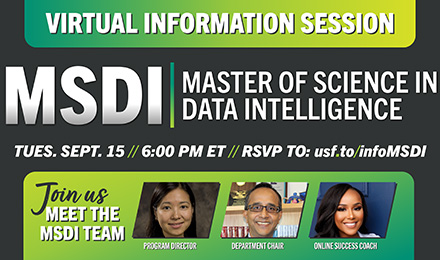
If you’re inspired by Medikondla’s story and are curious if MSDI is right for you, RSVP for the virtual info session on Tuesday, Sept. 15 at 6 p.m. ET. The program director and online success coach will walk through program details and answer questions live via Microsoft Teams.
The MSDI program is supported by USF Innovative Education, which partners with USF faculty and colleges to expand access to high-quality online learning. MSDI is offered fully online or in-person, and both delivery methods provide the same expert USF faculty, industry connections, and hands-on experience. Through an interdisciplinary approach and proven course design practices, InEd helps ensure students gain the skills needed for today’s rapidly evolving workforce.