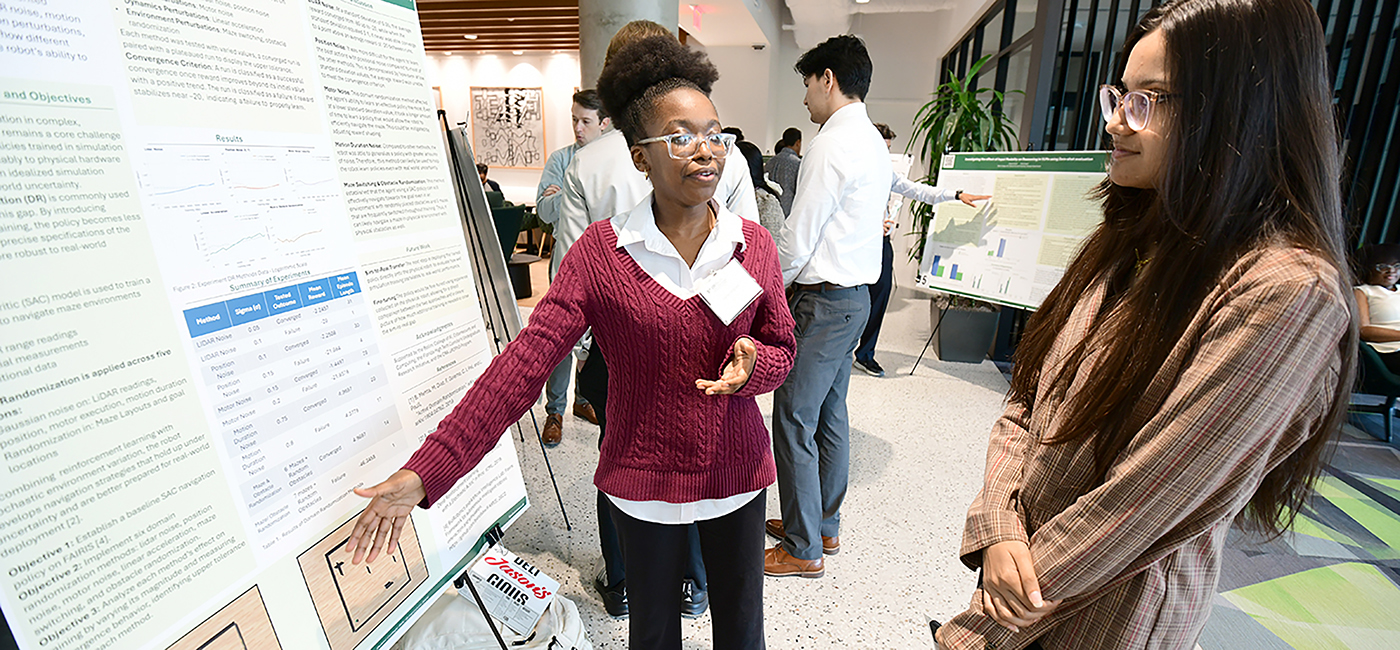
USF's Bellini College of Artificial Intelligence, Cybersecurity and Computing is launching a first-of-its-kind Tech Career Advancement Program that integrates career readiness, experiential learning and industry engagement into every stage of a student's education.
The program, known as tCAP, embeds career preparation into every stage of a student’s education. Beginning in their first semester, students begin building the technical, professional and workplace skills employers say they need through career coaching, industry mentoring, experiential learning and workforce-focused coursework.
“The pace of change in the fields of artificial intelligence, cybersecurity and computing demands a different approach to higher education,” said Sudeep Sarkar, launch dean of the Bellini College. “Employers want to hire students who have more than a strong technical foundation. They want them to have the experience, professional skills and confidence to contribute from their first day on the job. That’s exactly what tCAP was built to do.”
The framework of tCAP builds on the Bellini Talent Center with the National Association of Colleges and Employers' career readiness competencies. It further integrates the technical fluency and professional capabilities required for success in AI, cybersecurity and computing careers.
How does tCAP work?
Unlike many traditional career-readiness initiatives that rely on optional participation, tCAP is embedded into the student experience and begins when students enroll in Bellini College.
Bellini College students are automatically part of tCAP upon enrollment into the college, and their participation in the program begins on the first day of class. The program is built around three interconnected pillars: readiness, experience and connection, which guide students from orientation through graduation. By the end of their sophomore year, students will have completed the foundational tCAP curriculum and developed the professional competencies needed to pursue internships and other experiential learning opportunities, such as undergraduate research, entrepreneurship, study abroad, industry projects and other approved experiences.
“This is an all-encompassing program that we’ve worked with our industry partners to develop,” said Katelyn Rumenik, assistant director of tCAP. “Throughout this program, students build professional portfolios, participate in networking and mentoring opportunities, complete hands-on projects, and gain experience through internships, undergraduate research, entrepreneurship, study abroad and other approved experiential learning pathways.”
Students begin by completing four one-credit tCAP classes across their first five semesters, that help them build career readiness alongside their academic coursework without extending time to graduation. Those courses focus on experiential learning labs that introduce them to industry-standard software, tools and workflows.
The experiential learning experience
One example of the program's approach is a series of workforce-focused courses developed by Associate Professor Kurt Friday. Courses such as Computing Tools for Workforce Readiness and Cybersecurity Tools for Workforce Readiness immerse students in the same cloud platforms, cybersecurity tools and development environments used by today's employers, giving them practical experience that extends beyond traditional classroom instruction.
“Our students already develop a strong technical foundation in their degree programs,” Friday said. “What we want to do here is give them experience applying that knowledge in the kinds of environments they’ll encounter in the workplace, so the first time they see these tools and workflows isn’t on the first day of an internship or job.”
For Jose Contreras-Perez, one of the first students to complete Computing Tools for Workforce Readiness, the experience has already paid dividends.
“Dr. Friday made the class interactive and accessible to everybody's skill level,” Contreras-Perez said. "He not only explained AWS and Git, but also Terraform, Jenkins, Docker and how they all work together in an environment. Being exposed to these tools has been very beneficial to my performance in job interviews as I can now explain the workflows that are usually used in the workplace.”
Wyatt Jones, who also took the course, said the class stood out because it reflected the skills employers are looking for in new graduates.
“This course seems extremely student focused, toward a goal of prepping students with essentials to be in the modern-day tech workforce," Jones said. "This course was designed by Dr. Friday having conversations with real industry professionals about what the graduating student should know as they enter this field. This resonated a lot with me as it showed how much effort went into the student's success.”
Becoming career ready
Those courses represent just one component of a broader strategy that distinguishes the Bellini College's approach to workforce preparation.
“Our goal isn't simply to graduate outstanding technologists," Sarkar said. "It's to graduate professionals who have already worked with industry tools, faced real world problems, built meaningful professional networks and understand how to thrive in a rapidly changing workforce. That's what will set our graduates apart.”
By the end of their fifth semester, students are prepared to pursue internships or cooperative education experiences with the technical knowledge, workplace skills and professional confidence needed to succeed in industry settings. Through this structured progression, students graduate not only degree-ready but industry-ready.
“Heading into their junior and senior years, we want our students to be ready to meaningfully contribute to the problems facing our industry partners,” said Jessica Martin, tCAP’s coordinator. “We are building the career pipeline for the future here and we want them to be ready for what awaits them in the real world.”