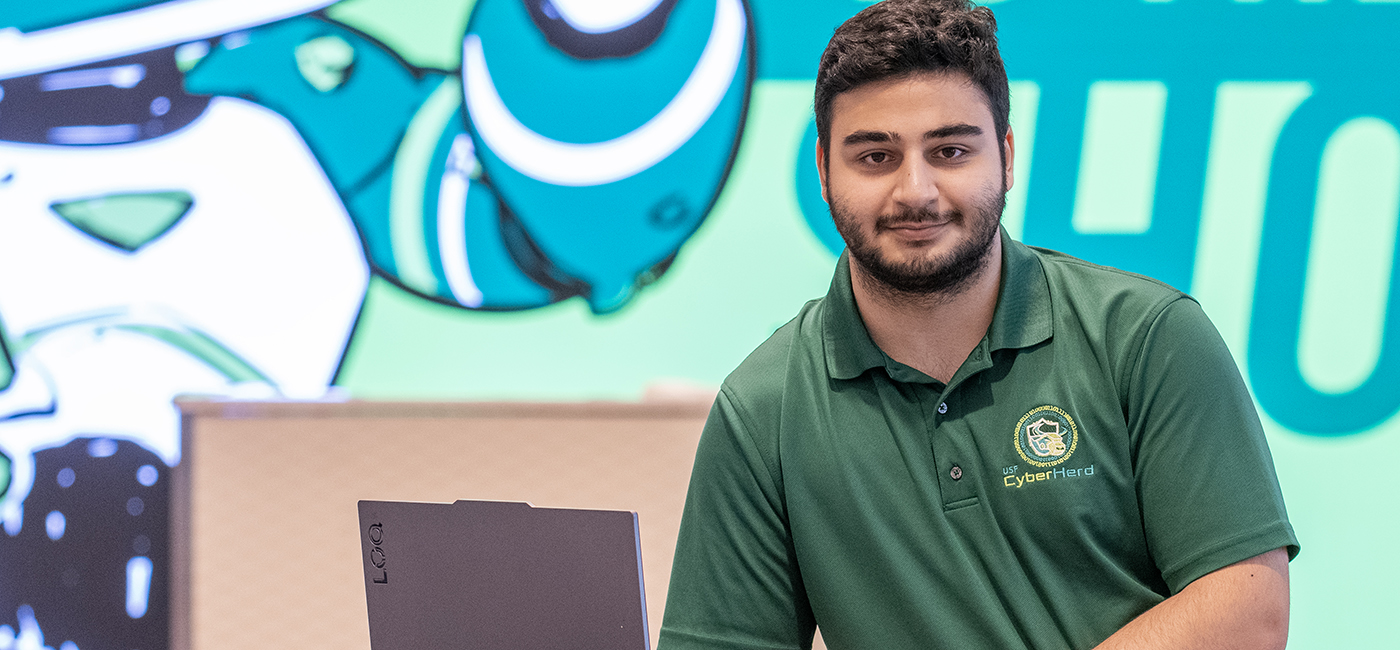
Fagan Afandiyev has a knack for analyzing situations, finding vulnerabilities and creating strategic solutions. That talent led to a highly anticipated internship this summer as a penetration tester at Microsoft's Redmond, Washington headquarters.
But his analytical ability to think strategically wasn't something that began in a college classroom. It emerged years earlier in high school, and his instructors took notice.
During Afandiyev's high school years, he excelled in developing clever strategies to compete in national and international robotics competitions.
His talents then became been a driving force in his college career, studying cybersecurity at USF's Bellini College of Artificial Intelligence, Cybersecurity and Computing. Whitehatters and CyberHerd competitions soon followed.
And in his internship role as a penetration tester, he will work at identifying weaknesses in computer systems before attackers can exploit them. He's made it his specialty.
"You're trying to find vulnerabilities that someone, an attacker, will have found, and you're reporting that so it can be patched," he said. "What's great is that I've been specializing in Microsoft systems the last three years. So, getting the internship is just great!"
Discovering a passion for technology
Afandiyev's interest in computing began in middle school when teachers recognized his aptitude for working with computers.
"So, it started in middle school, and I was in sixth grade at the time," he said. "My school was making a quiz for the whole school."
At the time, his school in Azerbaijan was identifying students with strong critical thinking skills and introducing them to specialized areas of study.
"The professor realized that I'm real good computers, IT and stuff," he said. "The robotics teacher at the school, he just told me, 'Just go sit by my side and watch for a while, then you're going do robotics things yourself.'"
It was a pivotal moment for Afandiyev, he said. "That was the turning point where I started competing."
Afandiyev quickly found success in robotics competitions. Soon, he was competing internationally and the team traveled to Romania for a world championship competition in 2018.
The competition involved sumo-style robot matches where teams attempted to push opponents' robots out of an arena.
"We had them straight up," he said. "What most teams do, they just use the same basic logic, go straight and analyze what's near you."
But he wanted to take a different approach. Instead of relying on brute force, Afandiyev proposed a little programming strategy to outmaneuver the team's competitors.
"I knew they were going to do that," he said of their opponents' strategy. "So, I made my remote turn right, instead of coming forward, I'd go around the circle to push them from the back, because back is always the weakest point."
That strategic approach helped the team reach the finals and a second-place finish. At another world competition in Texas, they placed fourth.
Finding his herd at USF
Now a junior at USF, Afandiyev laughs when he talk about what drew him to USF.
"I mean, for international students, USF is really appealing because of the scholarships they offer," he said.
While he knew of Florida's weather, especially the sweltering summers, his arrival in Tampa was an adjustment. It was nothing like Azerbaijan, which has hot, dry summers and mild winters.
"In Florida, it was really humid," he said. "When I got here, it was raining. There was a huge difference to move from there to here."
After moving in with the help of family friends, he began to explore what USF had to offer. But it was a challenge for Afandiyev.
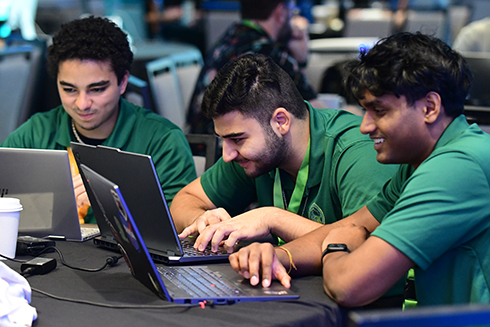
"I was more introverted when I came here," he remembers. But it didn't last and it all changed when he began meeting the members of the different clubs at a meeting in USF's engineering building. He met with the different clubs and spoke with the Whitehatters Computer Security Club, a club that focused on cybersecurity competitions. It was at that point he knew he met the right folks.
"I didn't know they were going to be my friends that day, but I knew they were going to be my friends," he said.
As a member of the club, he learned social skills that he didn't have before.
His success in the Whitehatters also led to USF's competitive CyberHerd team where he has quickly become an asset in national competitions.
His curiosity in different clubs also had an impact on his studies. While he began as a computer science student, he learned it didn't align with his true passion.
I want to become a software developer. I want to make software. I want to make a big program. I'm more into scripting, so small programs that do automations is more helpful for cyber than it is for computer science."
That realization led him to change his major to cybersecurity.
Where he once struggled academically, he now excels.
"It's so much easier when it's more of a fit," he said. "And I have five classes this semester!"
Real world experience
Afandiyev's success is tied to USF's experiential learning, both in the classroom work and in the clubs. Being able to apply his work to real world situations has also led to professional success.
In addition to his upcoming internship with Microsoft, Afandiyev has also gained significant industry experience. He has worked as a cybersecurity consultant with White Knight Labs for almost two years. As a consultant, companies hire the firm to test their systems and identify security risks.
Afandiyev works on projects where clients ask the firm to probe their systems for vulnerabilities before malicious attackers can find them.
"If someone wants their systems tested, they come and the companies get someone for the project."
Now, Afandiyev is preparing for his next step with Microsoft and hopes the experience will open the door to a full-time role after graduation.
"Hopefully it's going to be all right, and I'll have a return offer," he said. "It's really exciting to have this heading into my senior year."