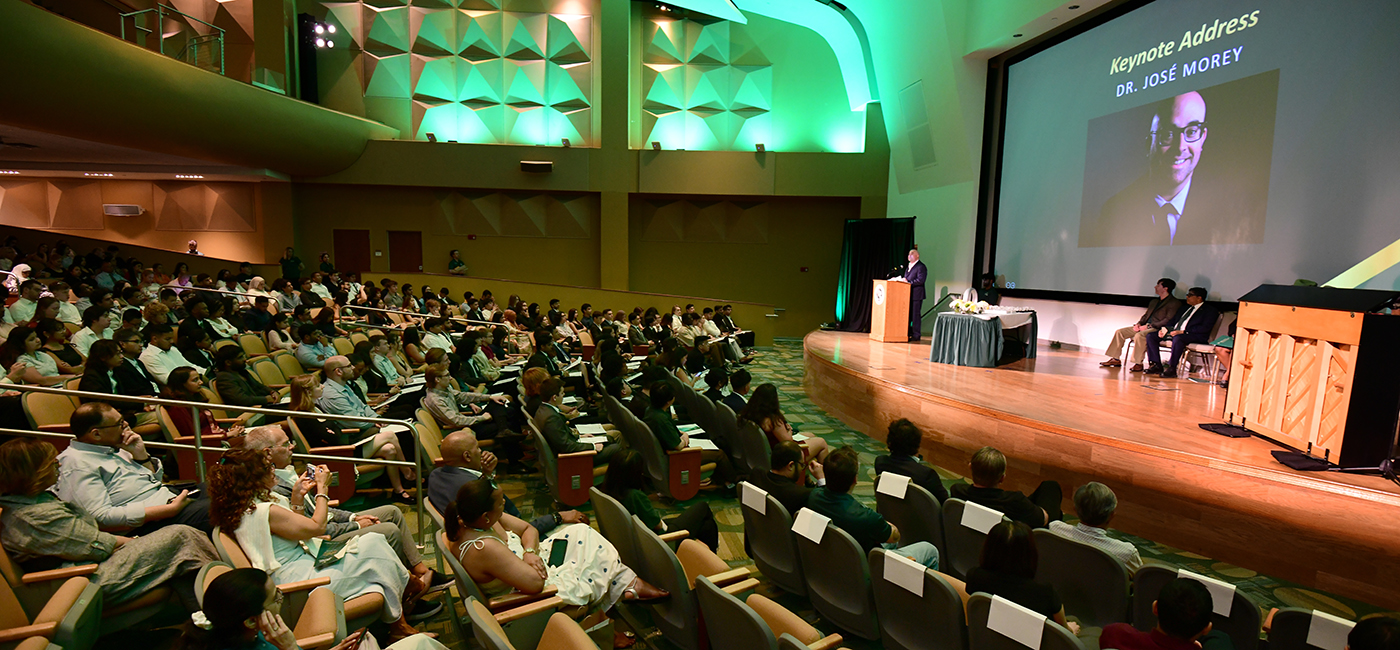
Students from the Bellini College of Artificial Intelligence, Cybersecurity and Computing gathered in the Marshall Student Center’s Oval Theater Friday for the college’s induction ceremonies that recognized their transition into the engineering and computer science professions.
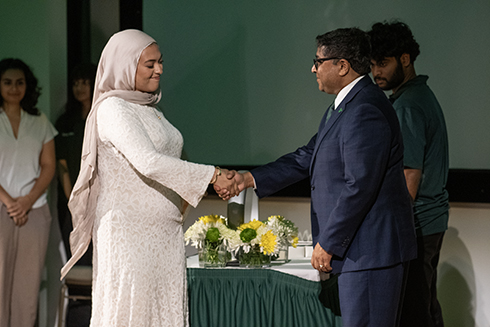
Launch Dean Sudeep Sarkar, who oversaw the ceremonies, noted their significance and the time the students spent helping establish the new college.
“You are graduating at a defining moment in the life of the Bellini College, and your achievements are now part of the foundation on which your college will continue to grow,” he said. “Through your programs, you have learned the foundations of your disciplines, applied them in practical ways, and prepared yourselves for professions that are evolving every day.”
The college's computer science, cybersecurity and information technology students took part in an induction to the profession ceremony, where they accepted a pin that symbolizes their commitment to integrity and professional conduct. Graduates in the engineering field also participated in the Order of the Engineer ceremony, which emphasizes the ethical responsibilities of the profession and included receiving a stainless-steel ring.
Dr. José Morey, who is a member of the Bellini College Academic Advisory Board, served
as the keynote speaker for Friday’s event.
Morey, who is a physician, founder and CEO of Ad Astra Media, has served in leadership
and advisory roles with NASA, MIT, the White House Office of Science and Technology
Policy, and the National Institute of Standards and Technology, where he contributed
to national efforts related to artificial intelligence and innovation.
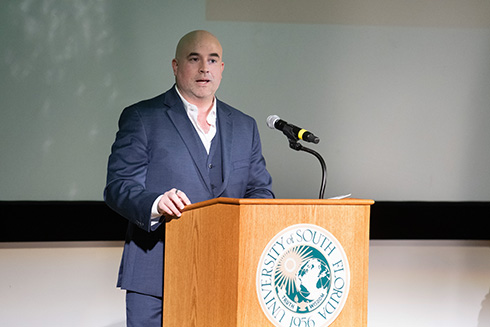
Morey reflected on how curiosity, creativity, adaptability and a willingness to cross
disciplines shaped his own unconventional career path, encouraging graduates to embrace
change rather than fear it.
“You are entering a world changing faster than any generation before has ever seen,”
he said. “AI is rewriting industries in real time. Medicine is becoming personalized
through genetics and technology. Robotics are changing labor, and even the definition
of what a career is, is evolving."
That change has caused uncertainty, which can worry some whose identity is built around
stability, he said. "But history has never belonged to the people who resisted change."
Using Leonardo da Vinci as an example of someone who was able to evolve, adapt and
persevere, Morey emphasized that the future will be defined by those who continue
learning, think beyond traditional boundaries and connect fields like technology,
science and the humanities.
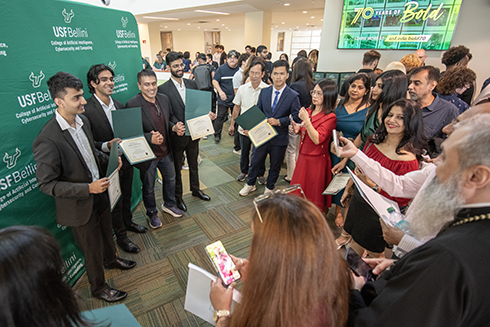
“We are now in a new Renaissance, another explosion of knowledge, another rewriting of the future, which means that you as students, and we in society, have two choices,” he said. “We can fear change or we become adaptable enough to thrive within it. The people who succeed in the next 20 years will not necessarily be the people with the highest grades. It will be the people who can reinvent themselves again and again.”
Following Morey’s remarks, the ceremony returned to its focus on the graduates and the responsibilities they will carry into their respective fields.
“As our world becomes more and more dependent on digital infrastructure, including
artificial intelligence, the tools you will use will change, the roles you will play
will evolve, and the challenges you will encounter will grow more complex,” Sarkar
said. “But the knowledge, habits and ethical foundation you have developed will help
you meet those changes with confidence and purpose."
Photo Gallery