By Georgia Jackson, College of Arts and Sciences
For many high school students, the idea of testing plasmid DNA sounds like an activity reserved for a research lab, not a classroom. But thanks to a partnership between the University of South Florida and the Amgen Foundation, students in Hillsborough, Pinellas, Polk and Sumter counties will have the opportunity to do exactly that when the school year begins — extracting plasmid DNA, running gel electrophoresis and reading real genetic data, all with equipment they'd otherwise never touch until college.
The program, known as the Amgen Biotech Experience (ABE), is made available to high school teachers and students in the Tampa Bay area through USF's Department of Integrative Biology, where Associate Professor Luanna Prevost oversees a growing network of local teachers bringing cutting-edge biotechnology into their classrooms — at no cost to them or their schools.
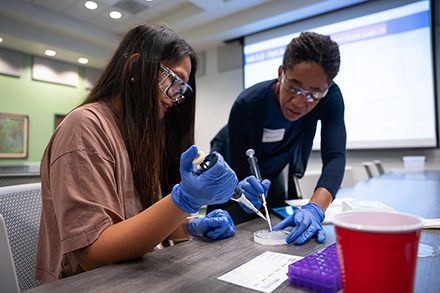
Prevost (right) hosted a professional earning experience at USF on July 17 to train teachers on the program's lab sequence. [Photo by Corey Lepak]
“We are thrilled to work with teachers throughout the Tampa Bay area to help them bring authentic labs to their classrooms and get students excited about doing science and exploring science careers,” said Prevost, who hosted a professional learning experience for local teachers on July 17.
Globally, ABE has reached more than 1.2 million students since it launched in 1990; in a typical year, it reaches roughly 99,000 students and 1,650 teachers across 27 locations.
Prevost has been building that reach locally since a 2018-19 pilot. Forty-five teachers have since participated in training through USF. This school year alone, 25 active teachers implemented ABE labs in their classrooms, reaching 2,368 students.
Everyone on Prevost’s team — including the teachers she partners with in the community — is passionate about providing high school students with engaging science experiences and lowering barriers to science participation.
CLASSROOMS ACROSS TAMPA BAY EMBRACE BIOTECHNOLOGY
For Mishell Thomas-King, who teaches biology at Alonso High School and integrated the ABE curriculum into her classroom for the first time last year, the timing coincided with the pilot of ABE's newest module, Exploring Precision Medicine. She said it gave her students something textbooks alone couldn't: a hands-on way to connect abstract genetics concepts to real biological data.
"Giving my students the opportunity to be able to practice the stuff that they're learning about on paper was absolutely amazing," Thomas-King said.
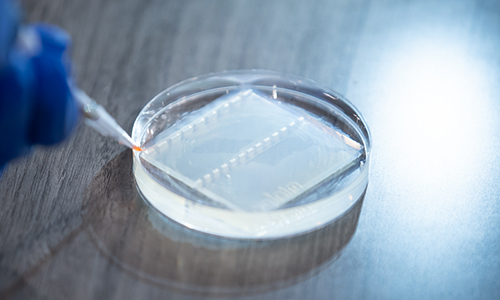
Students who had previously only discussed genotypes and phenotypes in the abstract were able to test their own traits directly — using restriction enzymes to cut DNA, amplifying genes and reading their own results on a gel.
"Being able to actually hold an actual gel with their actual DNA in it and being able to figure out their actual genotype — that was such an amazing experience," Thomas-King said.
The experience was so meaningful to Thomas-King's students, many are now considering careers in medicine, research and engineering, and several have gone on to summer research programs at institutions like Moffitt Cancer Center.
"So many of them are motivated and driven," said Thomas-King, who was selected as a fellow in the ABE Tampa Rise Fellowship, a new opportunity Prevost's team launched this year to develop teacher leadership within the program.
Like Thomas-King, Ana Rosario said bringing ABE into her biology course at Jefferson High School was one of the best decisions she's made for her students.
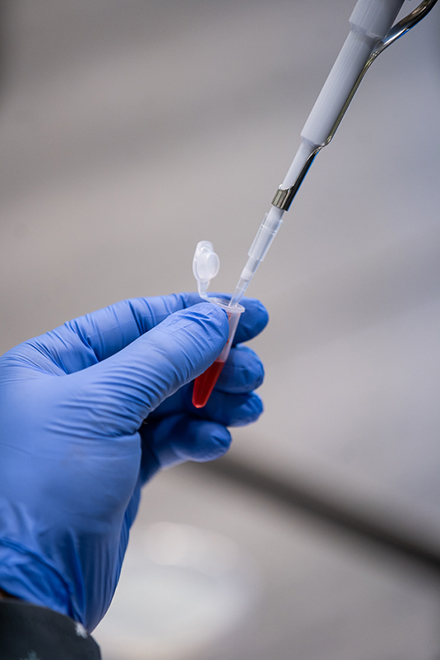
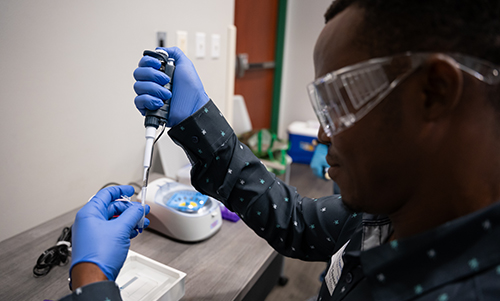
Teachers learn micropipetting, gel electrophoresis, restriction enzyme digestion and bacterial transformation. [Photo by Corey Lepak]
"The ABE curriculum has enriched the classroom by providing laboratory experience that the students wouldn't have ever had unless they went into a science related major in college," Rosario said.
She described the labs as the most memorable part of the school year for her students — a chance to use real scientific equipment rather than, as students have told her in the past, just "play with water."
Like Thomas-King's students, Rosario’s are also planning careers in laboratory technology, pathology and medical technology design. The experience also gave her the confidence to bring Genetics Honors to Jefferson High School as a new course offering, with plans to incorporate more ABE labs into the curriculum going forward.
"I would absolutely recommend the program to other educators," Rosario said. "This is an experience like no other and our students need the exposure that the ABE curriculum provides. It is engaging, complex and fun."
Brynna McFarland has also seen several of her students at Plant City High School commit to pursuing biotechnology at the university level as a result of the ABE program. But McFarland said the curriculum is important to each of her students, regardless of their career path.
“Since many of my students will not go into a STEM major or career, ABE is one of their few opportunities to complete serious bench work in high school,” McFarland said. “Many students who are not planning to attend post-secondary education have reported that ABE made them feel like a real scientist and that they have accomplished something meaningful by following through the lab sequences.”
This is why McFarland continues to utilize the program each year.
“It is crucial to me that students have every reasonable opportunity to participate in laboratory work in high school regardless of their future STEM potential,” she said.
BRING ABE TO YOUR CLASSROOM
Prevost and the ABE Tampa team will host additional professional earning experiences
at USF on Sept. 12 and 14 to train teachers on the program's lab sequence — from micropipetting
and gel electrophoresis to restriction enzyme digestion and bacterial transformation
— before loaning them the equipment to run the labs in their own classrooms during
the school year.
Teachers interested in learning more about ABE Tampa can contact Prevost at CAS-ABETampa@usf.edu.