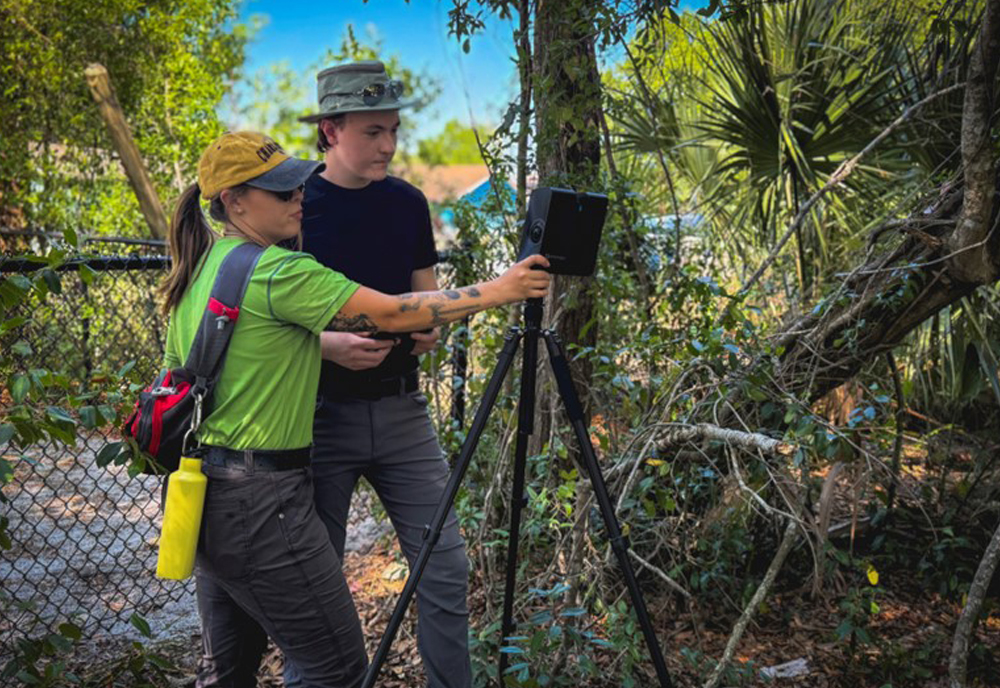
By Dakota Galvin, College of Arts and Sciences
In Black cemeteries across Florida, unmarked graves and fading headstones have a second chance at being remembered thanks to a collaboration between USF’s Institute for Digital Exploration (IDEx) and the Living Heritage Institute’s Black Cemetery Network. Individually, these organizations share a common mission: to use the past to educate the present and shape a more informed future. Together, they’re merging community driven research with cutting-edge 3D technology to document burial grounds that have long been overlooked, neglected or erased.
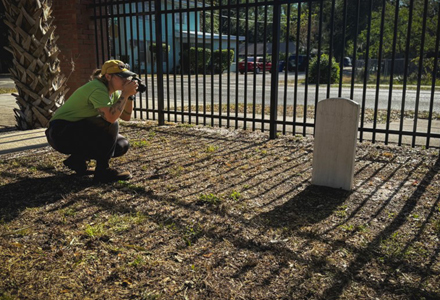
IDex staff member Amanda Aklan performing mapping a headstone via a digital photogrammetry. [Photo courtesy of Lisa Shorts]
One of those sites sits tucked behind a quiet neighborhood in Winter Haven. Lake Maude Cemetery has more than a century of history, with generations of Black residents laid to rest beneath its oaks. But time, weather and development have left their mark.
The Florence Villa Community Association (FVCA), which has long championed efforts to revitalize and protect the cemetery, reached out about joining the Black Cemetery Network. Since then, Antoinette Jackson, the director and founder of BCN and chair of USF’s Department of Anthropology, has begun developing preservation plans to document, map and protect the physical site, as well as collect historical records and oral histories that will help tell the story of Lake Maude Cemetery for future generations.
A year later, IDEx’s director Davide Tanasi and one of his students contacted Jackson to ask whether there were any cemetery sites that could benefit from 3D digitization and preservation modeling. Familiar with the Lake Maude project and the community’s needs, Jackson connected them and the partnership took shape.
“The Black Cemetery Network operates on a powerful principle: that each cemetery tells a story, and connecting those stories creates a larger national narrative about African American history,” said Tanasi, who is also a professor in USF's Department of History.
“What we at IDEx contributes is the toolkit to tell those stories in new ways,” he added.
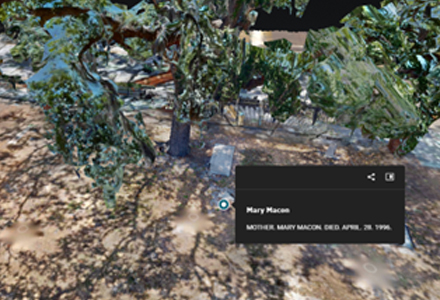
3D scans of Lake Maude Cemetery in Winter Haven, Fla. [Image courtesy of Davide Tanasi]
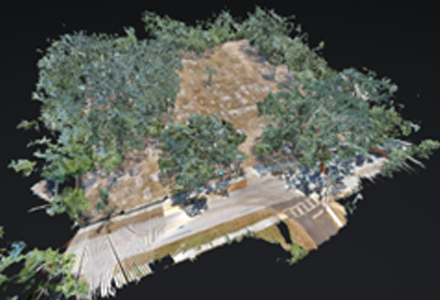
IDEx’s overall 3D model and virtual tour of the site let descendants, researchers, and communities explore virtually through a cemetery from anywhere in the world. For families who have moved away from Winter Haven or who are unable to travel, this provides a new outlet for accessibility. It also establishes a visual record to monitor environmental and structural changes over time.
“Digital archaeology is democratizing access to heritage in ways that were not possible even a decade ago,” Tanasi said. “A web-based virtual tour can be explored by a middle school class in Chicago, a genealogist in London, or an elderly descendant who cannot physically visit. That reach transforms who gets to engage with these histories.”
While the technology expands on what is possible, Jackson emphasizes that the work begins — and ends — with the community.
“We make partnerships with intention,” Jackson said. “Our strategic partnerships support cemetery teams around the country who are advocating for historic Black cemetery preservation and for remembering those buried in these sites,” she added.
“There is so much history contained in Black cemeteries that can benefit us all as we learn from the past and plan the future we want to build.”
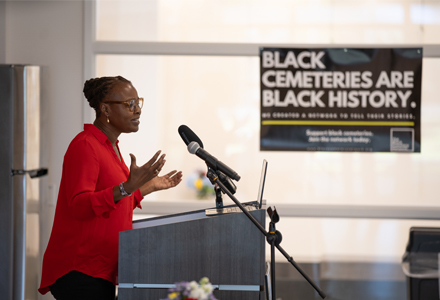
Antoinette Jackson at a Black Cemetery Network event in 2023. [Photo by Corey Lepak]
The Lake Maude Cemetery project will continue contributing to the broader mission of the Black Cemetery Network, providing digital access for descendant families, researchers and educators. The digital models will also support FVCA’s long-term preservation goals, helping guide restoration efforts and protect the site from future erasure. According to Tanasi, the IDEx team hopes these efforts will serve as a model for future collaborations across Florida, where technology, heritage and community come together to preserve the legacies of those who built and sustained their neighborhoods.
Jackson and her team will host the first national Black Cemetery Network Conference on May 21-22 on USF’s St. Petersburg campus.
Learn more about the conference and how you can support the Black Cemetery Network.