By Anna Mayor, College of Arts and Sciences
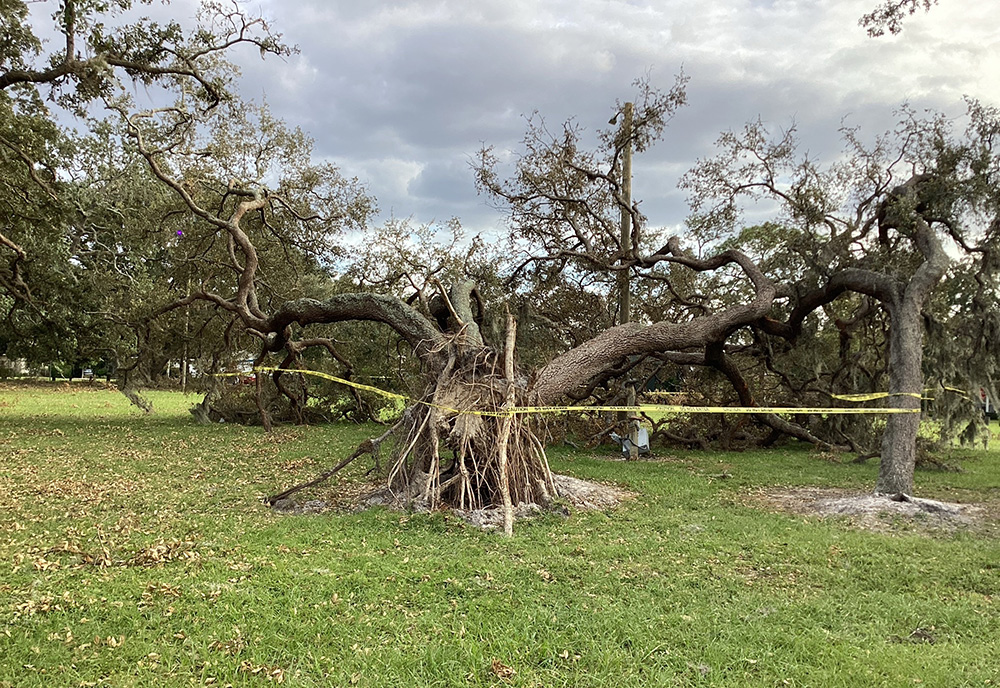
Hurricanes Helene and Milton didn’t just batter Tampa’s coastlines and neighborhoods in 2024 — they also dismantled years of growth in the city’s urban tree canopy, leaving residents across the city with less shade.
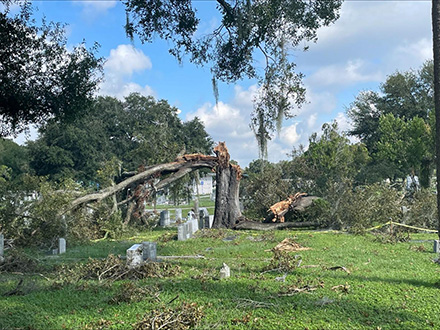
Trees snapped in half at the historic Woodlawn Cemetery, which was established in 1888. [Photo courtesy of the City of Tampa]
A new post-storm canopy assessment, led by College of Arts and Sciences researchers Shawn Landry and Rebecca Zarger, reveals that Tampa’s citywide tree canopy fell to 29.9% in 2025, down from 31.4% in 2024. The loss represents a 4.8% decline driven largely by storm damage, wiping out canopy gains achieved since 2021.
“Between 2021 and 2024, the city showed it was capable of increasing canopy through planting, protection and management,” said Landry, a research associate professor in the School of Geosciences. “But the 2024 hurricane season eliminated all of those gains in just a few days.”
Measuring the damage
Their assessment, requested by Tampa City Council outside the city’s typical five-year
review cycle, was made possible by the availability of pre- and post-storm aerial
imagery. Using a dot-based analysis method, they evaluated more than 13,000 randomly
distributed points across the city to determine whether each point fell on tree canopy.
Landry explained that unlike automated remote-sensing tools, the dot-based approach
relies on trained human interpretation, with each point reviewed by at least three
people and discrepancies resolved through additional review. The method provides consistent,
highly accurate measurements of canopy change over time.
By the numbers: neighborhood losses
The results showed canopy loss was uneven across Tampa and closely mirrored the storms’ paths. Central Tampa, including downtown, Davis Islands, Ybor City and East Tampa, experienced the largest decline at 8.2%. South Tampa and the USF area followed with losses of 6.2% and 6.9%, respectively. Westshore saw a 3.3% decrease, while New Tampa lost just 1.2% of its tree coverage.
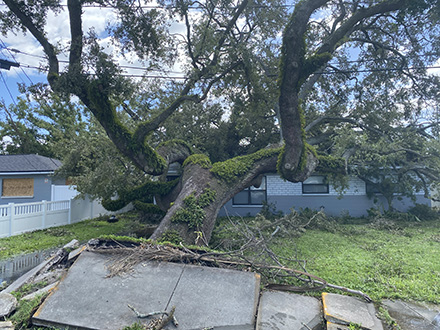
Many of the trees that fell during the storms were likely damaged by the combination of saturated soils and high winds. [Photo courtesy of the City of Tampa]
“The strongest winds occurred in the southern areas, while the heaviest rainfall was concentrated in central and eastern parts of the city,” Landry said. “That combination played a major role in where trees failed.”
Back-to-back storms compounded the damage, Landry explained.
Helene dropped two to five inches of rain across Tampa, saturating soils before Milton arrived with 11.43 inches of rain in a single day — the second-highest one-day total on record.
Waterlogged soils weakened root systems, leaving even wind-resistant species vulnerable when powerful winds arrived, according to Landry.
Understanding tree species vulnerability
While detailed species-level loss data is still unavailable, researchers observed widespread damage to laurel oaks, which tend to have shorter lifespans and structural weaknesses, as well as significant losses of mature live oaks.
“Recently planted trees also proved vulnerable due to their shallow, developing root systems,” Landry added.
The scale of the cleanup underscored the magnitude of loss. Nearly one million cubic yards of vegetative debris were removed citywide — an amount one news report estimated could have filled Tropicana Field. Cleanup efforts stretched nearly three months and involved city contractors, private landscapers and homeowners.
“In some neighborhoods, debris piles reached more than 15 feet high and covered areas equivalent to two football fields,” Zarger, an associate professor in the Department of Anthropology, said.
Residents feel the loss
Although parks and streets have since returned to normal use, the loss of mature trees — many more than a century old — left a lasting impression on residents.
To better understand that human impact, Landry and Zarger conducted a post-hurricane survey that drew more than 300 responses from residents across Tampa.
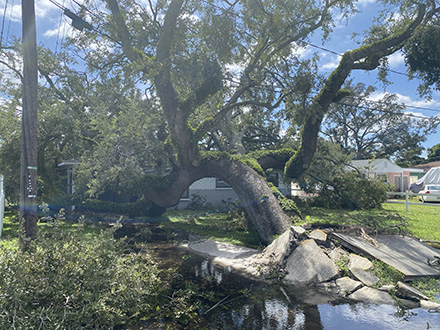
The scale of the cleanup underscored the magnitude of loss. Nearly one million cubic yards of vegetative debris were removed citywide — an amount one news report estimated could have filled Tropicana Field. [Photo courtesy of the City of Tampa]
“Nearly one in five respondents reported losing a tree, yet 79% said those losses did not result in structural damage to homes or vehicles. Only 2.5% experienced major structural damage due to falling trees,” Zarger said.
Despite the destruction, support for trees remained strong.
“Residents were deeply affected by the loss of large, historic trees,” Zarger said. “But what stood out is that people still overwhelmingly value trees for their beauty, shade and environmental benefits — even after experiencing storm damage.”
On average, residents reported spending $3,200 and about 14 hours on cleanup efforts. Survey responses also highlighted concerns about uneven canopy coverage, the costs of tree maintenance, and the removal of large trees due to development. Many respondents noted that replacement trees often do not provide the same level of shade or cooling benefits as the mature trees they replace.
A recent report by the Tampa Bay Times suggests some residents are experiencing higher electric bills as a result.
Designing a storm-ready canopy
According to Zarger and Landry, the findings point to the need for a dual strategy moving forward: planting new trees while also investing in the maintenance and protection of existing canopy.
“Maintaining mature trees is just as important as replanting,” Landry said. “Regular pruning and care — especially on private property — may help reduce future storm damage, even though it can be costly.”
They hope the study will inform city planning decisions, including guidance on wind-resistant species, infrastructure changes such as burying power lines and financial programs to help residents manage tree care costs.
“People want trees,” Zarger said. “Our challenge now is figuring out how to grow and manage a more resilient urban forest that can withstand future storms while continuing to provide the benefits Tampa residents value so deeply.”