By Georgia Jackson, College of Arts and Sciences
Daniel Hargrave knows what food distributions and routine check-ins mean to the veterans he visits each week. A doctoral candidate in anthropology at USF, Hargrave lost his sight in an explosion during the Bosnian War and later experienced intermittent homelessness for more than 15 years.
“I’m always checking in, having conversations, hanging out, just spending time,” said Hargrave, who serves as an AmeriCorps member with Operation: Veteran Connect — a Seniors in Service program.
At USF, Hargrave is turning his experience into research on disabled veterans who receive food assistance and other services through the program.
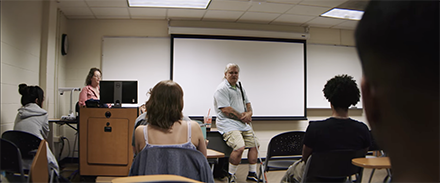
Hargrave is a doctoral candidate in the Department of Anthropology. [Photo courtesy of the Humana Foundation]
“Unfortunately, disabled veterans are a hard-to-reach group that is vulnerable to food insecurity and its health consequences,” said Professor of Anthropology David Himmelgreen. “They tend to have higher rates of chronic diseases and poorer mental health.”
Hargrave's research aims to target that problem by asking a difficult question: What keeps veterans from choosing happy, healthy lives over unhealthy ways of coping with trauma, guilt, regret or anger?
The choice, Hargrave said, is often shaped by larger economic and political forces.
“Are you going to choose to eat or pay your bill?” he said.
Hargrave’s research on disabled veterans is supported by the USF Center for the Advancement of Food Security & Healthy Communities, where he works under Himmelgreen’s mentorship.
“The results from this study will provide information that can guide interventions that improve their access to nutritious food and other social services,” Himmelgreen said. “This study is only partially about numbers and statistics. More importantly, we will learn about the challenges of everyday life that disabled veterans face and their solutions to overcoming them.”
Himmelgreen said Hargrave is “perfectly suited for this research.” As a disabled veteran who has experienced homelessness, Hargrave is uniquely positioned to build trust and uncover sensitive information that other researchers might not be able to access, while bringing an anthropologist’s training to the work.
“I hope that Dan’s findings will go beyond academic circles and reach service providers, policy makers, and funding agencies so that sustainable programs can be developed which truly address the needs of veterans who have sacrificed so much in the service of this country,” Himmelgreen said.
Hargrave is hopeful, too.
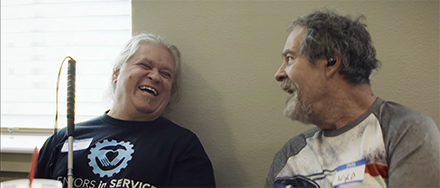
Hargrave said spending time with a struggling veteran — even for a couple of hours — can help save a life. [Photo courtesy of the Humana Foundation]
“I want to illuminate those intangible ... underlying issues of guilt, shame, trauma, regret, loss, sadness, anger,” he said. “There is a multidirectional, interconnected relationship with all of those things.”
Food assistance, according to Hargrave, is only a starting point.
“It takes more than just the food,” he said. “It takes human connection and bonds.”
In Hargrave's experience, much of what veterans struggle with can be traced to a loss of identity. He said many enter the military expecting to serve for decades, only to be discharged because of an unexpected injury or illness.
“When I got into the Army, that was my identity. I was proud of it,” Hargrave said.
When that identity is lost, he said, many struggle to cope.
Hargrave experienced that loss firsthand.
“I had lost my identity as a husband, as a father. I lost my identity as a soldier and a sergeant,” he said. “And I had to assume the identity of being disabled and blind.”
There were 6,488 veteran suicides in 2024, according to the U.S. Department of Veterans Affairs’ 2026 National Veteran Suicide Prevention Annual Report — an average of more than 17 per day.
Hargrave said spending time with a struggling veteran — even for a couple of hours — can help save a life.
While Hargrave may be perfectly suited to his current role as researcher and volunteer, he made it clear anyone can get involved.
“It doesn’t take a veteran to help a veteran,” he said. “It just takes a kind, caring, warm, loving human being to understand someone is suffering, and they’re doing it in silence.
“A lot of times the key to helping people is not to tell them what to do. Sometimes it’s just to listen.”
Learn more about the USF Center for the Advancement of Food Security & Healthy Communities.