By Dakota Galvin, College of Arts & Sciences
“The first time I saw Tim Curry as Frank, I thought, ‘Okay, that’s it — how do I become that?’” said Charles Suor, Women’s, Gender and Sexuality Studies (WGSS) alum and performer with Tampa’s Hell on Heels shadow cast of “The Rocky Horror Picture Show.”
“Rocky was foundational to finding who I am,” he said.
When Tim Curry died at age 80 this August, communities around the world felt the loss of an artist whose work reshaped the possibilities of gender, performance and self-expression. Midnight screenings of “The Rocky Horror Picture Show” surged in attendance across the country, theatre marquees updated their tributes and fans returned to the film in celebration and grief.
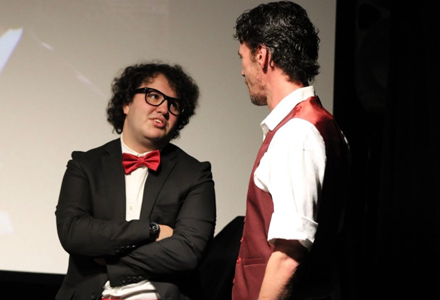
Charles Suor (left) as Brad in Tampa Bay's "Hell on Heels" RHPS shadow cast. (Photo courtesy of Charles Suor)
Tim Curry’s performance as Dr. Frank N.Furter is central to that legacy. When “The Rocky Horror Picture Show” premiered in 1975, Curry’s portrayal of the “sweet transvestite from Transsexual, Transylvania” was unlike anything mainstream audiences had seen — campy, chaotic and gender bending. His charisma transformed the role into an icon of queer performance, anchoring the film’s cult status and shaping generations of fans who found freedom, humor and identity in his unapologetic presence.
As audiences revisit the film, the resurgence carries particular meaning for scholars like Suor, who have long examined Rocky Horror as a landmark of queer performance, gender expression and cult-film culture. But that isn’t the only way Suor honors Curry’s legacy. He also brings that scholarship to life on stage through Hell on Heels, Tampa’s long running Rocky Horror shadow cast. The troupe performs year-round and has become a cornerstone of the region’s cult-film community, drawing crowds who come for the callbacks, the costumes and the communal joy that defines the Rocky Horror experience. As one of its regular performers, Suor sees firsthand how Curry’s influence continues to shape the show — and how audiences are returning in greater numbers to celebrate it.
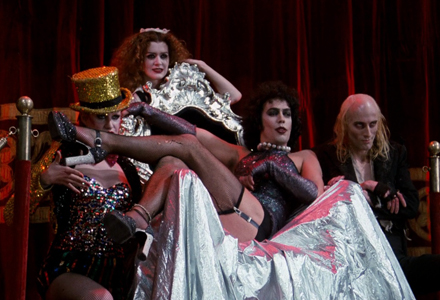
Tim Curry (center) as Frank-N-Furter in the 1975 film 'Rocky Horror Picture Show.’ Credit: Photo: 20th Century Studios / The Rocky Horror Picture Show.
First released in 1975, “The Rocky Horror Picture Show” began as a stage musical before becoming a cult film phenomenon. What started as a box office flop transformed into a midnight movie ritual, complete with audience call backs, props, costumes and shadow cast performances that reenact the film live. Over decades, it has become a cornerstone of queer cinema — a space where camp, gender play and community participation define the experience as much as the film itself.
For Suor, that longevity comes from the film’s ability to offer a space where queerness, camp and transgression aren’t just accepted but celebrated. He sees Rocky Horror as a rare example of a story where a queer-coded character isn’t punished for breaking norms but embraced for it.
“Frank is messy, chaotic and unapologetically himself,” Suor said. “People come back because the film gives them permission to be the same.” That sense of liberation, he added, feels even more poignant now as audiences gather to honor Curry’s legacy.
Another Hell on Heels performer, Derek Rosenberg, a Zimmerman School for Advertising and Mass Communications alum, said Rocky Horror’s staying power comes from the community it creates.
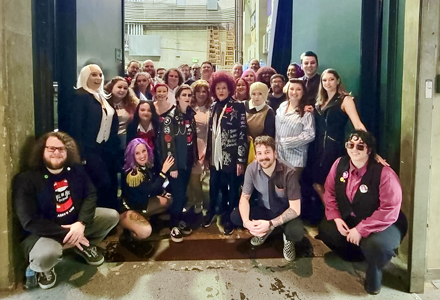
The Hell on Heels cast with Rocky Horror Picture Show actress Patricia Quinn (Magenta). (Photo courtesy of Hell on Heels)
“Rocky Horror gives people a place to be themselves,” he said. “That sense of acceptance is why the show still resonates — and why we keep performing it all year long.”
As audiences gather in theaters across Tampa Bay and beyond, Curry’s influence remains unmistakable — in the call‑backs, the costumes, the laughter and the sense of freedom that fills the room. For performers like Suor and Rosenberg, honoring that legacy means keeping the show alive with the same chaotic joy Curry brought to the screen.
When asked what he would say to Curry if he had the chance, Suor’s answer was simple.
“I’d tell him thank you,” he said. “Thank you for giving so many of us a place to belong.”