By: Dave Scheiber
It began with an ambitious after-school pilot program seven years ago, a partnership with a center serving youth from historically marginalized communities in St Petersburg. Today it has blossomed into a national online resource to spur children’s academic, social and emotional growth through reading – unlocking the door to boundless possibilities.
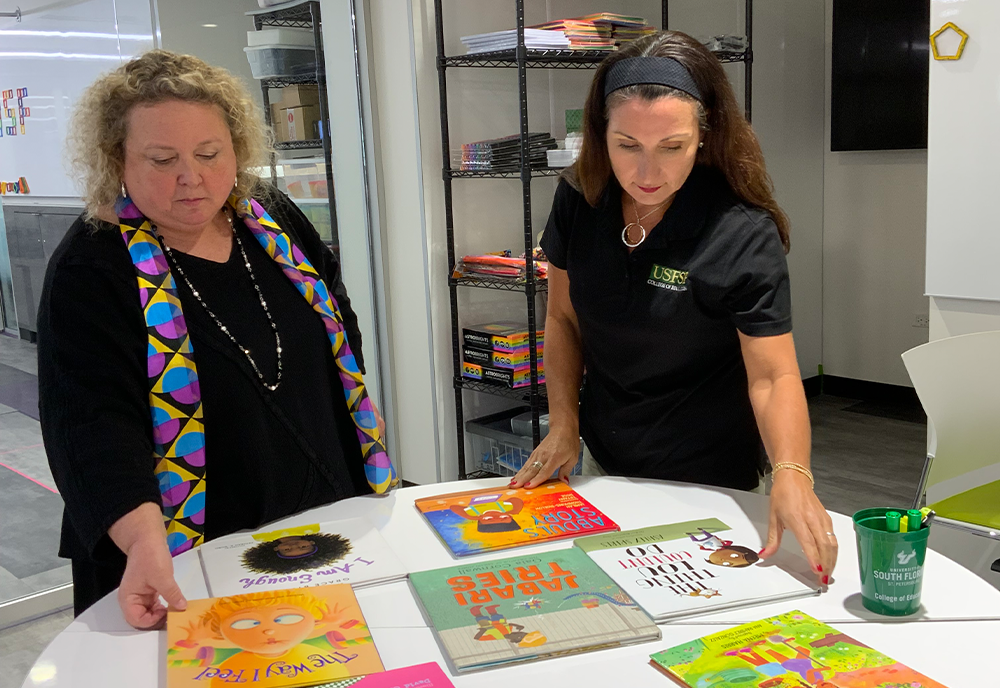
The site – conceived of and run by a pair of longtime USF College of Education professors and researchers, AnnMarie Gunn and Susan Bennett – has a name that sums up its mission succinctly: GrowThroughReading.com.
The website’s home page makes its goal immediately clear, proclaiming Building Resiliency Through Stories: A Research-Based Social Emotional Literacy Program for Parents and Caregivers, Classroom Teachers, and Childcare Professionals.
And in a few clicks, the site spells out a broad curriculum geared for children in preschool through second grade, with each lesson adhering to Florida’s educational standards and paired with an acclaimed illustrated book for kids, designed to encourage meaningful conversations and individual development.
“We believe everything happens through children’s books – that we can fix all the world’s problems through children’s literature,” says Gunn. “I say that tongue in cheek but we truly believe it can make a difference, and our work has underscored that.”
Gunn and Bennett, who have collaborated on literacy initiatives at USF since 2011, set the wheels in motion for their online project in 2018 by creating a much-needed library for the Police Athletic League (PAL) of St. Petersburg after-school center. The site benefited an area where 100 percent of the children are on free or reduced lunch programs, and many of them represent the racially diverse population and come from the surrounding neighborhood.
“They had minimal academic program and there were only about 40 books on a shelf somewhere, and lots of TVs,” Gunn recalls. “Slowly but surely, we started writing grants and redesigning the space to be more conducive to play but also be an overlying academic area – designing a whole reading area in the room.”
In no time, they filled it with evocative children’s books that became a gateway for enriching vocabulary, enhancing learning and expanding personal growth.
But then came the pandemic in 2020. It shut down schools in Pinellas and around the country, and interrupting the learning process at every level of education. When the COVID shutdowns finally subsided, students across the board had to reacclimate to the classroom and their study routines. And in PAL’s after-school program, there was another issue.
“After COVID was over, the head of the program, Heather Robb, was very distressed and worried about some of the behaviors she was seeing in her young children,” Gunn says. “So, Susan and I started talking about what we could do as an intervention as literacy professors, not as psychologists, because we’re not psychologists.”
That intervention ultimately took the form of a pilot study – an eight-week program where kindergarten to second-grade children worked with USF preservice teachers. They were hired to work in small groups with the children, and a doctoral student wrote lesson plans for each of the books that were chosen as teaching tools.
The goal: try to give the young students access to language so they would be able to talk about their feelings – and the space to do that.
“We viewed hundreds of books and from those we picked eight books for the eight weeks,” Bennett says. “And we just really believed in discourse and dialogue – talking about things, trying to increase the children’s vocabulary. And we used a quantitative scale to measure the children’s social/emotional growth and an instrument to assess their vocabulary development. What we found was that the children with lowest scores improved the most – and all of the children’s vocabulary improved.”
In addition, Bennett drew from her arts-based background to integrate art and music into the lesson plans and program structure. After the eight weeks, the feedback from families, staff and children was tremendously positive – and the program continues to thrive today.
“Once it was up and running, we thought, ‘We did this little program and it was great, but now what do we do?’ ” Gunn says.
What they did was obtain new funding and adapt their entire curriculum into their new, online children’s literacy site, GrowThroughReading.com.
It includes five cell competencies based on CASEL’s framework (devised by the nonprofit Collaborative for Academic, Social and Emotional Learning): Self-Awareness, Self-Management, Social Awareness, Relationship Skills and Responsible Decision Making – all revolving around the program’s core: Social & Emotional Learning. The plans are free for teachers, and Gunn and Bennett are in the process of seeking funding to create a “parent/caregiver” component with modified lesson plans. And, of course, they are seeking funding to grow their website, strengthen their outreach and expand their impact.
They’ve each followed distinctly different paths to this point. Gunn, a graduate of Florida State University, is a former elementary school teacher in South Florida. Her first class was filled with youngsters from Cuba, Puerto Rico and Haiti, and she wanted to improve her ability to teach children whose native language was not English. At the same time, she received a full scholarship to Florida Atlantic University, which had just started a master’s program in ESOL (English for Students of Other Languages).
“That was really a turning point in my personal life, because I would not otherwise have been able to afford to get a master’s degree,” she says. “But I got my degree in ESOL while teaching elementary school – and I’ve always had a soft spot for second-language learners.”
Gunn eventually moved after 10 years of teaching school there to the Tampa Bay area, earned her PhD at USF and never left. She has an extensive record of publications in peer-reviewed journals and books, has made numerous international, national and local conference presentations, and received funding from the National Science Foundation and many other entities.
Bennett had planned to be a veterinarian but changed course to women’s studies at Ohio State University. “I realized I wanted to make a difference in the world – you know, social justice and educational equality,” she says. “So, in trying to figure out what I wanted to do, I became a teacher. And I had a strong calling to work with indigenous populations.”
She wound up working with kindergarteners on a Navajo reservation and later taught at an urban school in Florida and Cincinnati, where she earned her master’s degree. “I wanted to change lives through education, and then I realized that if I got my doctorate, I could reach teachers who could then reach 25 students every year,” she recollects.
Bennett earned her doctorate at the University of South Florida and then went to teach at the University of Mississippi. At a conference, she crossed paths with Gunn, and they decided to write a paper together, never imagining they would one day be working side by side on life-changing learning programs.
After teaching both in the Hillsborough School System and then at Ole Miss, Bennett jumped at the opportunity to take a teaching position at USF St. Petersburg and officially joined forces with Gunn. Whether working with university students, incarcerated youth or marginalized children, she still integrates creative arts into her lessons, drawing on music, visual art and drama to communicate with her pupils.
Another major Gunn-Bennett collaboration came in 2019, when they provided literacy instruction to some 50 inmates at the Polk Correctional Institutions, and their relationship with the Florida Department of Corrections led to professional development for teachers across the state of Florida who teach adult correctional institutions and may lead to similar initiatives in the future.
For now, though, their focus is on their new website, spreading the word about it throughout the region, state and country, and hoping – as they like to say – to make the world a better place with the help of children’s books.