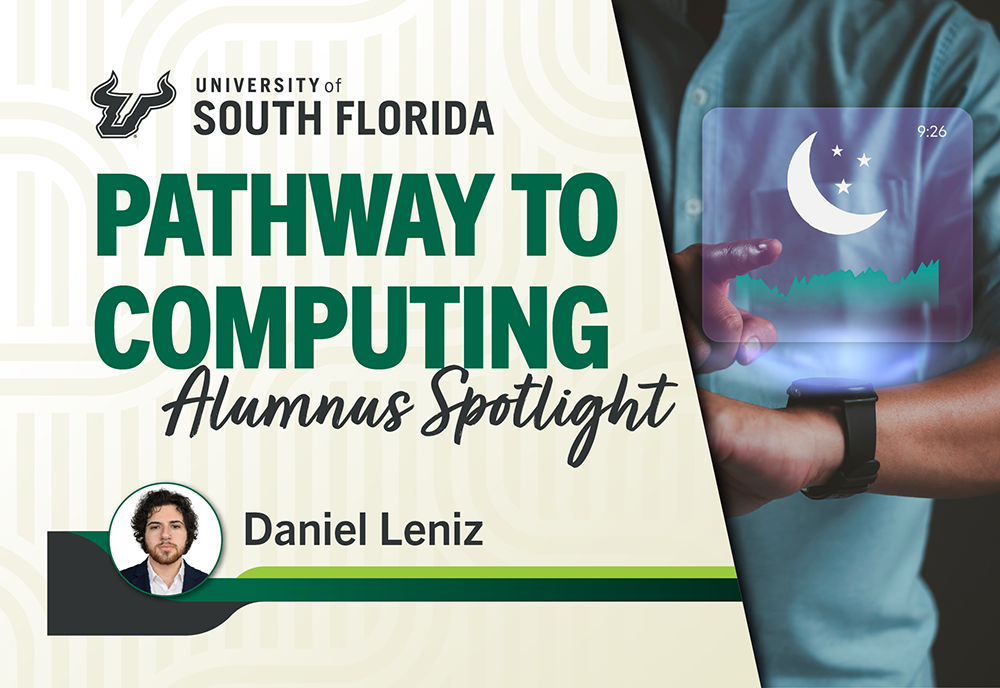
When Daniel Leniz first started learning to code, he wasn't sitting in a university classroom.
Instead, he pieced together online courses, YouTube videos and coding tutorials while building projects and securing development internships through networking. Still, he felt something was missing.
"I learned a lot on my own, but there were gaps," Leniz said. "You don't always know what you don't know when you're teaching yourself."
Now, Leniz has completed the Master of Science in Computer Science from USF’s Bellini College for Artificial Intelligence, Cybersecurity and Computing while working full-time. He credits USF's fully online Pathway to Computing Graduate Certificate program (PTC) with helping make that achievement possible.
Finding a Different Route
With a background in psychology and political science, Leniz did not originally plan to work in technology. In fact, he once envisioned himself attending law school.
After preparing for the LSAT and speaking with attorneys, he realized law was not the right fit for the work-life balance he wanted. Around the same time, encouragement from a friend in software development led him to programming.
Curiosity quickly became a passion. Leniz enrolled in online courses, watched tutorials and built personal projects, including a weather application. He taught himself Python and JavaScript and experimented with technologies like React.
Building a Strong Foundation
For Leniz, PTC provided more than technical preparation.
The program helped him transition back into academic life after several years away while introducing concepts he had not encountered through independent learning, including networking fundamentals and computer architecture.
PTC is a fully online graduate certificate that requires no GRE and is built for those with non-computing backgrounds looking to pivot toward AI, cybersecurity, data science or software engineering without earning another bachelor’s degree.
Just as valuable was the opportunity to learn alongside professors and classmates. One of those friendships was with Megan Tran, a fellow student who shared classes with him throughout both the PTC and MSCS programs. They both earned bachelor’s degrees in psychology, started learning to code on their own, and decided to use PTC to pivot career trajectories.
"Whatever I was struggling with, I wasn't the only one struggling with it," Leniz said. "It was nice to be surrounded by that instead of learning alone in my apartment."
From PTC to Master’s Degree
While earning his master’s degree in computer science, Leniz applied his technical skills to real-world challenges.
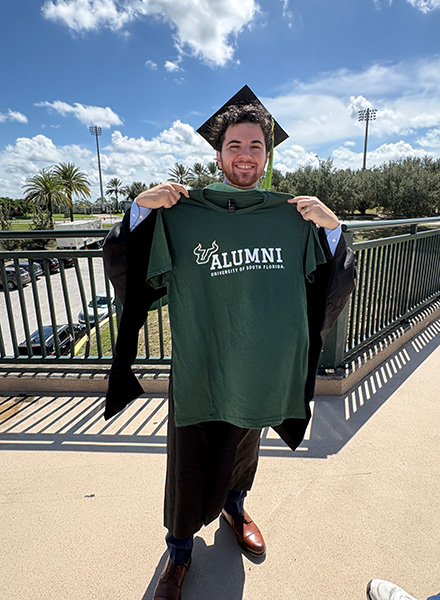
Daniel Leniz celebrates earning his Master of Science in Computer Science from USF after beginning his academic journey in computing through the fully online Pathway to Computing Graduate Certificate.
One meaningful experience involved developing a sleep-tracking application with Dr. Priscilla Amofa-Ho in USF's College of Nursing. The app was designed to help individuals with mild cognitive impairment track sleep patterns, answer health questionnaires and access educational resources.
The project allowed Leniz to see how technology can support healthcare research while giving him hands-on software development experience outside the classroom.
He also credits the faculty from both PTC and the MSCS with helping him gain confidence as a student.
One professor in particular stood out: Assistant Professor John Templeton.
Leniz described Templeton as one of the best educators he has had, praising his ability to break complex concepts into understandable pieces and support students who needed extra help.
More than Technical Skills
While Leniz strengthened his programming abilities throughout his academic journey, he believes his nontechnical background continues to provide value.
His psychology degree helped him develop communication, empathy and interpersonal skills that benefit him in both technology roles and professional networking opportunities.
"Even if you don't have a computer science background, you can pull transferable skills from somewhere," Leniz said. "You can pull from pretty much anything if you sit down and think about it."
A Message to Future Students
For prospective students considering computing, Leniz hopes his experience shows there is no single path into the field.
Whether someone is coming from psychology, business, healthcare or another discipline, he believes bridge programs like PTC can help students explore computing, build confidence and prepare for what comes next.
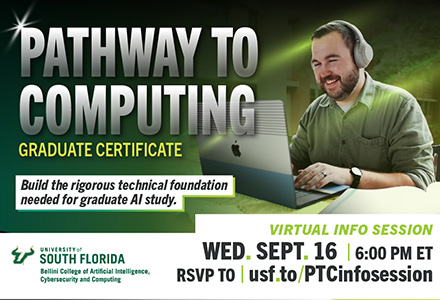
If you’re inspired by Leniz’s story and are curious if Pathway to Computing is right for you, RSVP for the virtual info session on Wednesday, Sept. 16 at 6 p.m. ET. The program director and online success coach will walk through program details and answer questions live via Microsoft Teams.
The PTC program is supported by USF Innovative Education, which partners with USF faculty and colleges to expand access to high-quality online learning. Through an interdisciplinary approach and proven course design practices, InEd helps ensure students gain the skills needed for today’s rapidly evolving workforce.